 OKX
OKX Review: Is the Derivatives Experience Worth It?
 HuaYu ExchangePublished Updated
OKX stands out for its professional derivatives trading tools, unified trading account, and Web3 wallet ecosystem. Combining spot trading, perpetual futures, automated trading strategies, and on-chain asset management, OKX provides a comprehensive platform for active traders and Web3 users.
OKX is a global cryptocurrency trading platform built around a distinctive combination of spot markets, derivatives, advanced account management, automated trading tools and Web3 services founded in 2017. Its strongest proposition is not simply the number of cryptocurrencies available. It is the ability to manage different trading strategies through an interconnected trading environment.
The platform's Unified Trading Account is central to that proposition. Eligible traders can manage spot and derivatives positions through several account modes, including more sophisticated cross-currency and portfolio margin arrangements. OKX also offers trading bots, professional market-data APIs and a separate self-custody wallet ecosystem. These features make it particularly relevant to active traders who want more control over execution and capital allocation.
That breadth comes with complexity. Advanced margin configurations require a clear understanding of collateral and liquidation rules, while the availability of derivatives, fiat services and other products varies by jurisdiction. This review examines where OKX delivers meaningful advantages, how its costs and safeguards work, and which traders can make the most of its capabilities.
- Unified Trading Account with multiple account and margin modes.
- Broad trading ecosystem covering spot, derivatives and options where available.
- Built-in grid, DCA, TWAP and iceberg trading tools.
- Professional REST and WebSocket APIs for market data and order execution.
- Regular, cryptographically verifiable Proof of Reserves disclosures.
- Separate Web3 wallet ecosystem for self-custody and on-chain activity.
- Advanced margin arrangements introduce a steeper learning curve.
- Product availability, fee schedules and legal protections differ by region.
- Shared collateral can transmit losses between positions.
- OKX has a significant historical US anti-money-laundering compliance case.
Detailed Review
1. OKX Platform Overview
| Field | Details |
|---|---|
| Exchange Name | OKX |
| Founded | 2017 |
| KYC Requirements | Mandatory identity verification (KYC required) |
| Main Trading Products | Spot trading, perpetual futures, delivery futures, options, and the OKX Wallet Web3 ecosystem |
| Regulation & Compliance | Malta MFSA (MiCA), Singapore MAS, Dubai VARA |
| Standard Futures Maker Fee | 0.02% |
| Standard Futures Taker Fee | 0.05% |
| Maximum Trading Leverage | Up to 125× on selected cryptocurrency perpetual futures contracts, subject to contract-specific and position-tier limits |
| Trading & Strategy Tools | Spot Grid, Futures Grid, Dollar-Cost Averaging (DCA), arbitrage strategies, TWAP, iceberg orders, and API-based trading |
| Deposit & Withdrawal Methods | On-chain cryptocurrency deposits and withdrawals, internal transfers, and fiat purchase or payment options in supported regions |
| Quick Verdict / Best For | OKX stands out for its Unified Trading Account, derivatives trading capabilities, automated strategy tools, and integrated Web3 wallet ecosystem. It is particularly suited to active traders, derivatives traders, and users managing multiple trading strategies. Beginners should carefully assess leverage and margin risks. |
| Official Website | OKX |
Data notes: Standard futures fees are based on Huayu Exchange's CEX Ranking records. Actual fees may vary by account tier and trading conditions. Regulatory entries reflect the owner-approved information recorded in the Ranking and do not imply that every affiliated entity holds identical authorizations across jurisdictions. Product availability depends on regional restrictions and account eligibility.
2. OKX Trading Fees & Costs
2.1 OKX's Fee Structure Rewards Different Trading Behaviours Differently
The question is not simply whether OKX has low trading fees. It is whether its pricing and account structure make economic sense for the way a trader actually uses the platform.
An occasional spot investor, an active perpetual-futures trader and a systematic trader running multiple strategies can face substantially different cost profiles on the same exchange.
OKX uses maker/taker pricing across its order-book markets. Orders that add liquidity generally qualify for maker pricing, while orders that immediately execute against available liquidity incur taker fees. A limit order is not automatically a maker order: if it crosses the book and executes immediately, taker pricing can apply.
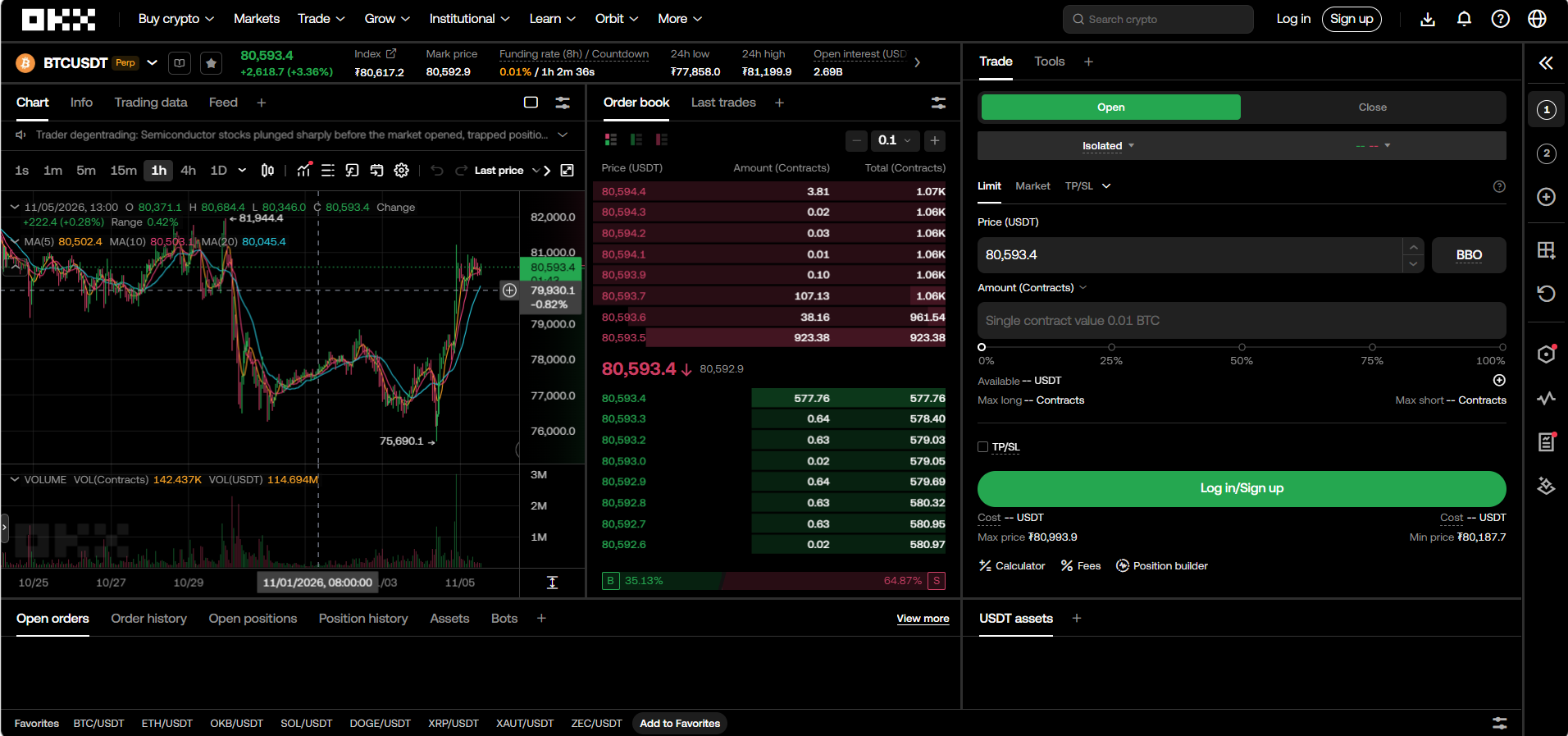
The applicable rate also depends on the account's fee tier, instrument, trading-pair group and regional service arrangements.
That makes the lowest advertised VIP rate a poor benchmark for an ordinary retail account.
2.2 Spot and Futures Fees: What Do the Published Rates Actually Show?
OKX's August 2026 announcement, implemented in September, provides a useful reference for its Standard Group fee structure.
The following rates are examples from the published Regular-tier schedules:
| Product and Published Fee Scope | Maker | Taker |
|---|---|---|
| Spot Standard Group, Regular tier | 0.0800% | 0.1000% |
| Futures Standard Group, Regular tier | 0.0200% | 0.0500% |
Source: OKX, Advance Notice: Spot and Futures Trading Fee Adjustment, August 2026.
These are documented schedule examples, not universal rates for every OKX customer. Local arrangements and product-specific schedules can differ, including those applying to Australian retail derivatives and certain Singapore customer categories.
For spot traders, transaction costs usually involve the entry and exit fees alongside the price at which each order is filled.
Futures traders must also consider position adjustments, funding and potential liquidation-related charges.
OKX's higher VIP tiers can offer materially lower fees, including negative maker rates under qualifying schedules. Those benefits require meeting substantial eligibility thresholds and should not be presented as standard retail pricing.
For the rate that actually applies, traders should consult their current OKX fee tier and the schedule displayed for the relevant instrument.
2.3 Perpetual Futures: Funding Can Matter More Than the Entry Fee
For a trader holding OKX perpetual futures, the opening commission is only one component of the position's economics.
Trading fees apply to executed orders, including position entries, exits and adjustments. They are generally calculated against executed contract value, not merely the margin deposited to support a leveraged position.
Funding adds another variable.
OKX uses periodic funding payments between long and short positions to help keep perpetual prices aligned with their reference markets.
When the funding rate is positive, long positions generally pay short positions. When it is negative, the direction reverses.
OKX's official documentation describes an eight-hour default funding cycle, with some contracts using one-, two- or four-hour intervals. The applicable schedule depends on the instrument.
Funding is not simply another commission collected by the exchange. OKX facilitates the transfer between opposing traders.
For short-duration strategies, the timing of a position relative to a funding settlement can affect the result. A position closed before the relevant settlement does not participate in that funding event.
For longer-held positions, repeated funding payments may become a significant component of total cost, although funding can also be received rather than paid.
This is particularly relevant to traders using OKX's Unified Trading Account to manage spot positions alongside perpetual-futures hedges. Reducing directional exposure does not eliminate execution fees or the economics of funding.
The meaningful comparison is therefore the full cost of opening, maintaining and closing the strategy—not merely the quoted futures maker fee.
2.4 Trading Bots: Automation Does Not Remove Transaction Costs
OKX's automated trading tools can execute strategies according to predefined rules, but the resulting orders remain subject to applicable trading fees.
Consider spot grid trading. A strategy may repeatedly buy and sell within a specified range, increasing the number of transactions as prices move.
That activity can generate frequent small gains on completed grid trades, but it also accumulates transaction fees. If the grid spacing is too narrow, fees and slippage may absorb much of the intended price difference.
Grid profits should also be distinguished from the strategy's total profit or loss, which reflects the changing value of assets held.
Futures-based automation introduces further considerations, including funding payments and leveraged-position risk.
The economic value of an OKX trading bot is therefore determined by its realised net performance, trade frequency, execution behaviour and applicable charges—not simply by whether the platform offers a bot without a separate setup fee.
2.5 Does the Unified Trading Account Make OKX Cheaper?
Not necessarily in terms of transaction fees.
The more distinctive economic advantage of OKX's Unified Trading Account is capital efficiency.
Eligible account modes allow traders to manage collateral and margin across multiple supported products. Depending on the configuration, more advanced risk models may recognise certain offsetting exposures.
This can reduce operational friction and improve the utilisation of assets that would otherwise sit in separate trading accounts.
However, better collateral utilisation is not the same as lower maker or taker fees.
For someone making occasional spot purchases, the additional account complexity may offer little economic benefit.
For a professional trader managing multiple positions, the ability to coordinate collateral and portfolio exposure can be a meaningful part of the platform's overall value.
That efficiency comes with its own trade-offs. Shared collateral can transmit losses between positions, while eligible assets may be subject to different valuation and discount rules.
OKX's cost proposition is therefore broader than its published fee schedule, but it should not be confused with a universal discount on trading commissions.
2.6 Huayu Exchange Verdict: Where Does OKX Offer Real Cost Value?
OKX's tiered pricing is relevant to high-volume traders, but the most attractive VIP rates are not representative of what every customer pays.
For spot investors, the useful benchmark is the actual fee and execution price for the chosen pair.
For active derivatives traders, cumulative taker fees, funding and repeated position adjustments can matter more than a low advertised maker rate.
For bot users, transaction frequency and net strategy performance determine whether automation is economically worthwhile.
For multi-strategy professionals, OKX's integrated margin architecture introduces a separate form of value through more flexible capital management.
Overall, OKX is best evaluated as a combination of tiered execution pricing and account-level capital efficiency. Whether it is cheaper than a competing exchange depends on the customer's actual fee schedule, trading instruments and strategy—not on a single headline percentage.
3. Liquidity & Market Depth
3.1 The Important Question Is Not Just How Much Liquidity OKX Displays
For traders assessing OKX, a more useful question than headline trading volume is how much of the displayed order-book liquidity is actually accessible to their orders.
That distinction has become particularly relevant following OKX's 2026 changes to its Retail Price Improvement (RPI) infrastructure.
Alongside conventional spot and derivatives order books, OKX provides consolidated market-data feeds that distinguish ordinary liquidity from qualifying RPI liquidity. This introduces a practical complication: the depth visible through a particular feed may not represent the amount every account can execute against.
A meaningful assessment of OKX therefore needs to distinguish three things: reported trading activity, displayed order-book depth, and liquidity available to a particular order.
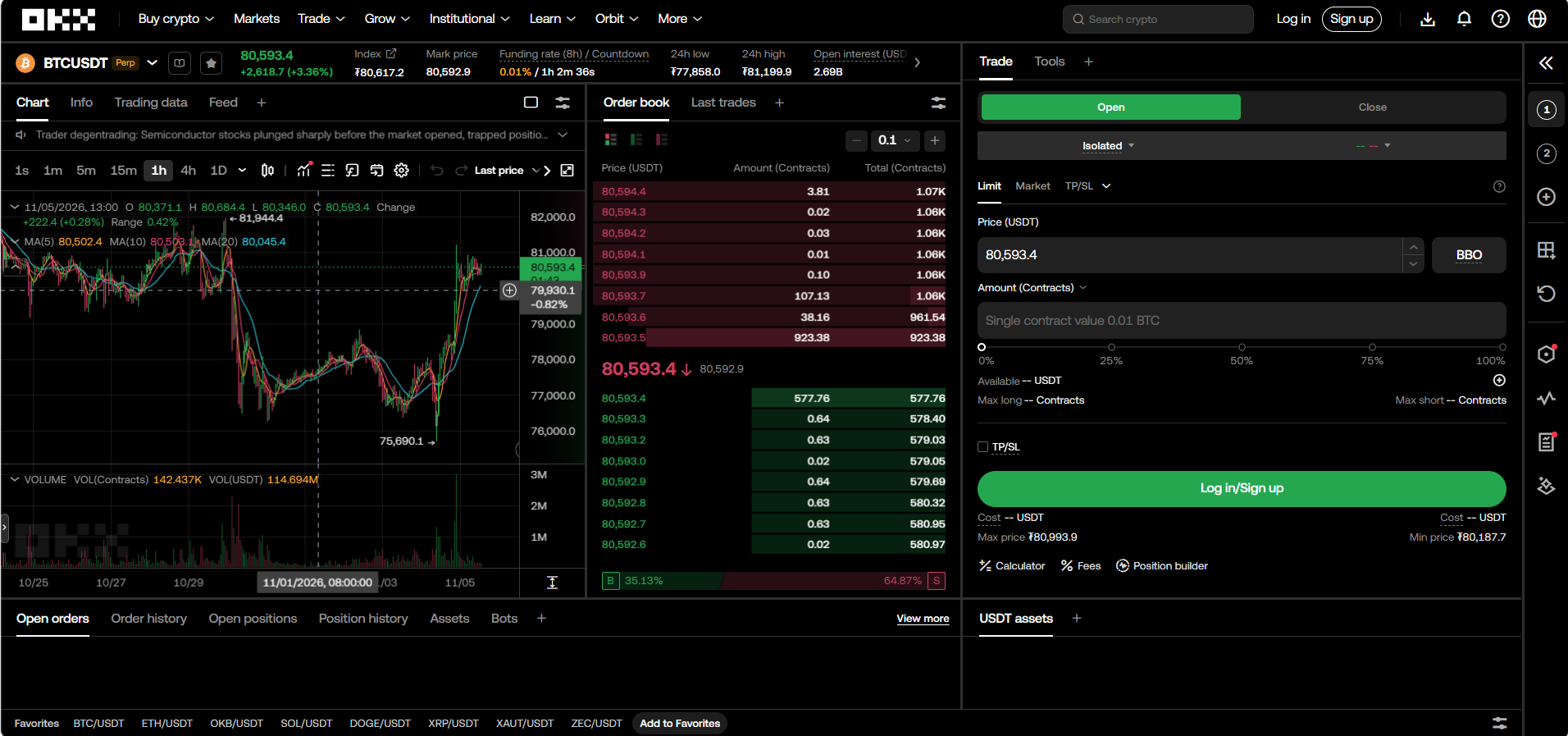
3.2 Spot and Perpetual Futures: Related Assets, Separate Execution Markets
BTC/USDT spot and BTC-USDT perpetual futures trade in separate order books on OKX. Although both reference Bitcoin, they have different participants, liquidity conditions, and execution characteristics.
For spot trading, execution quality depends on the available bids and asks, trade direction, and order size.
Perpetual futures introduce additional considerations, including leveraged positioning, funding conditions, and the possibility of liquidation-driven market pressure.
This distinction becomes particularly important for traders using OKX's Unified Trading Account.
Consider a trader holding BTC spot while maintaining a short BTC perpetual position. The account may calculate margin and portfolio exposure according to the applicable rules, but the two positions still execute in separate markets.
Unified margin management does not merge the underlying order books.
A hedged strategy can therefore encounter different execution costs on each side. If liquidity deteriorates in one market, entering, adjusting, or closing the combined position may become more expensive than the trader expected.
OKX provides an integrated environment for managing these positions. That integration is valuable, but it does not remove the need to evaluate each execution market independently.
3.3 Retail Price Improvement: An Important Detail in OKX's Liquidity Structure
In July 2026, OKX announced the transition from its Enhanced Liquidity Program (ELP) terminology to Retail Price Improvement (RPI), alongside a consolidated books-rpi market-data feed.
The significance is not simply a renamed API channel. The feed allows traders and developers to distinguish ordinary liquidity from currently tradeable RPI liquidity.
According to OKX's official API documentation, each price level includes the following fields:
| Field | Meaning | Why It Matters |
|---|---|---|
| totalQty | Combined ordinary and currently tradeable RPI quantity | Shows consolidated depth at a price level |
| nonRpiQty | Ordinary liquidity excluding RPI | Identifies the conventional order-book component |
| totalQty - nonRpiQty | Currently tradeable RPI quantity | Shows the additional RPI component |
| rpiTakerAccess | Order parameter requesting access to RPI liquidity | Helps determine whether an order can interact with that liquidity |
One detail has direct implications for execution analysis.
OKX's documentation explains that a taker with the appropriate RPI access may execute against the eligible totalQty, while a taker without that access can execute only against nonRpiQty.
The same displayed order-book level can therefore represent different executable quantities for different orders.
If a price level contains additional RPI quantity, a trader cannot assume that every ordinary order will automatically interact with it.
OKX also revised RPI visibility rules in August 2026. Certain RPI orders that cross the ordinary best bid or offer, or cross opposing RPI orders, may be hidden from the currently tradeable consolidated RPI book.
An October 2026 update introduced the bbo-rpi-tbt channel for RPI best bid and ask information, including some hidden RPI quotes excluded from books-rpi.
These distinctions matter when developers compare feeds, reconstruct order books, or estimate execution costs.
However, RPI availability does not demonstrate that every customer receives a better fill. Actual price improvement depends on eligibility, order configuration, available liquidity, and execution results.
3.4 Professional Market Data: Feed Speed Is Not Execution Speed
OKX offers several order-book channels with different depth limits, update frequencies, and access conditions.
| Market-Data Channel | Documented Characteristics | Practical Application |
|---|---|---|
| books5 | Five-level snapshots, generally updated every 100 milliseconds | Basic order-book monitoring |
| books | Up to 400 depth levels with 100-millisecond incremental updates | Broader depth analysis |
| books50-l2-tbt | 50-level incremental depth, 10-millisecond updates, subject to access requirements | Higher-frequency trading systems |
| books-l2-tbt | 400-level incremental depth, 10-millisecond updates, subject to access requirements | Detailed high-frequency order-book analysis |
| books-rpi | Consolidated ordinary and currently tradeable RPI depth, with 100-millisecond WebSocket incremental updates | Examining liquidity composition and accessibility |
OKX documents login and VIP eligibility requirements for certain higher-frequency channels. These feeds should not be presented as universally accessible.
There is also a critical difference between market-data generation, feed publication, and actual order execution.
A 10-millisecond feed update interval does not mean an order will be submitted, matched, and confirmed within 10 milliseconds.
End-to-end execution depends on network conditions, queue position, matching behaviour, available liquidity, and the trading system's state.
For ordinary investors, a conventional order-book display may be sufficient. For systematic traders, feed selection, incremental book reconstruction, and access permissions can materially affect the reliability of their infrastructure.
OKX's strength here is the breadth of its market-data infrastructure—not a guarantee that every customer receives identical execution performance.
3.5 How Should Larger Traders Evaluate OKX's Actual Depth?
A single order-book screenshot provides only a limited view of execution conditions.
For larger orders, a more useful assessment fixes the instrument, market type, direction, notional size, and observation time. It then examines the depth actually accessible to the order.
On OKX, that also requires specifying whether the analysis uses the ordinary order book or a consolidated feed containing eligible RPI liquidity.
For example, comparing OKX's RPI-inclusive depth directly against another exchange's conventional order book may produce a misleading result if the liquidity categories and access conditions differ.
Displayed orders are also not guaranteed fills. Quotes can be cancelled, new orders can arrive, and execution depends on order instructions and matching priority.
OKX's TWAP and Iceberg Order tools can help traders manage order timing and visible order size. They do not create missing market liquidity or guarantee lower slippage.
This review does not include a reproducible, synchronized order-book dataset collected across OKX and competing exchanges. Accordingly, it does not assign OKX an unsupported numerical ranking for market depth or execution quality.
3.6 Huayu Exchange Assessment: Where Does OKX Stand Out?
What makes OKX worth examining is not simply the presence of liquid spot and derivatives markets. It is the combination of those markets with professional order-book feeds, differentiated liquidity data, and execution tools.
For ordinary spot traders, the most relevant considerations remain the spread, available quantity, and total trading cost of the specific pair. Sophisticated market-data infrastructure may offer little direct benefit.
For active derivatives traders, the important task is to evaluate contract-specific depth and execution conditions, particularly when managing multiple positions through a unified account.
For systematic traders, OKX's layered data feeds and RPI infrastructure provide opportunities for more detailed liquidity analysis. They also introduce additional responsibilities around access rights, feed interpretation, and execution verification.
Overall, OKX's most defensible liquidity-related strength is its market-data and execution infrastructure for professional trading. Whether it delivers a better fill for an individual trader must still be established using the relevant instrument, order size, account permissions, and actual market conditions.
4. Security & Regulatory Compliance
4.1 Is OKX Safe and Reliable?
Overall, OKX is a well-established cryptocurrency exchange worth considering. For users concerned about fund security and platform reliability, OKX offers more than a mature range of trading products. The exchange regularly publishes Proof of Reserves (PoR) reports and has obtained regulatory authorization in certain jurisdictions, providing users with verifiable information to assess its transparency and credibility.
One notable advantage is OKX's Proof of Reserves system, which allows users to independently verify relevant asset information. Its regulatory progress in Europe also reflects the exchange's efforts to operate within established compliance frameworks. Together, these factors strengthen OKX's position in terms of transparency and platform trustworthiness.
However, assessing an exchange's reliability involves more than its brand recognition or regulatory licenses. It is equally important to understand what Proof of Reserves actually covers, how regulatory protections differ across jurisdictions, and how security responsibilities vary between exchange accounts and Web3 wallets. The following sections examine these factors in greater detail.
4.2 OKX's Security Profile Has Three Distinct Layers
OKX's security cannot be assessed through a single reserve ratio or regulatory licence. The platform combines a centralised exchange, an integrated trading-account structure and a self-custody Web3 wallet, each with a different security perimeter.
Three questions matter: what evidence supports the exchange's reported asset reserves, which legal entity provides the service, and who controls the assets at any given point.
OKX's recurring Proof of Reserves programme addresses part of the first question. Its European MiCA authorisation addresses the regulatory status of a particular legal entity. OKX Wallet introduces a separate model in which users assume responsibility for wallet credentials and on-chain transaction authorisations.
None of these protections automatically extends to every product carrying the OKX name.
4.3 OKX Shield: Conditional Compensation for Unauthorized Account Losses
In September 2026, OKX introduced OKX Shield, an additional account protection programme designed for eligible users. If an account is unlawfully taken over by a third party and assets are transferred without authorisation, affected users may apply for compensation, subject to the programme's eligibility requirements and review process.
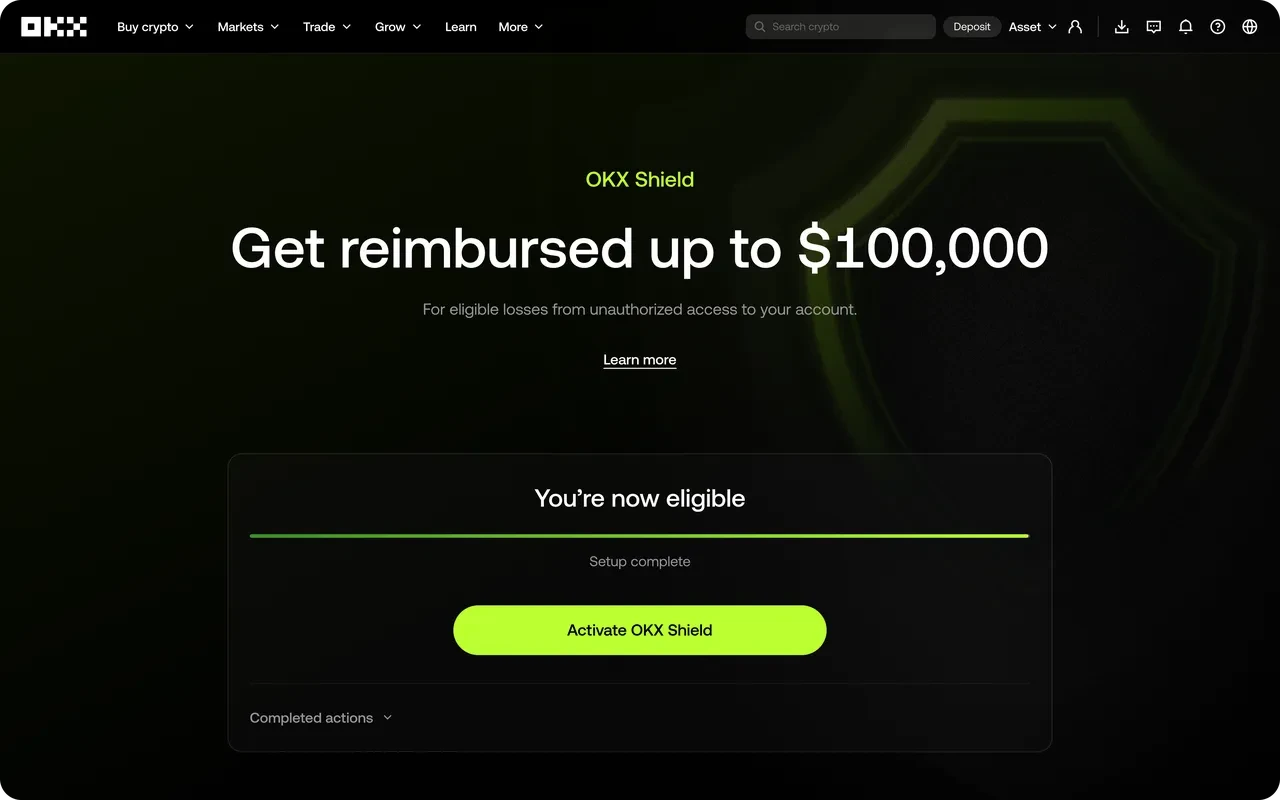
Unlike conventional security measures such as two-factor authentication, withdrawal restrictions and device verification, OKX Shield extends beyond preventing account compromises. It also establishes a framework for addressing certain losses after a qualifying security incident.
For traders who maintain substantial balances on an exchange, this represents a potentially valuable additional layer of protection.
How Much Compensation Does OKX Shield Provide?
According to the programme terms published by OKX, maximum compensation limits vary by account tier:
| Account Tier | Maximum Compensation |
|---|---|
| Regular users | Up to USD 100,000 |
| VIP 1–3 | Up to USD 250,000 |
| VIP 4–6 | Up to USD 500,000 |
These USD-denominated limits apply to certain participating OKX entities. The initial European Economic Area programme uses EUR-denominated limits of €100,000, €250,000 and €500,000 for the corresponding tiers.
Actual coverage depends on the user's OKX entity, account tier, jurisdiction and applicable programme terms.
What Security Requirements Must Users Complete?
OKX Shield is not automatically activated when a user opens an account.
Eligible users generally need to complete account and device security checks, enable a passkey, configure large-withdrawal protection, apply the required web-withdrawal safeguards and enable multi-factor authentication (MFA) for supported activities.
Users must then accept the programme terms and activate OKX Shield.
Maintaining these security settings is also important. If an account or associated device no longer satisfies the required security conditions, Shield protection may become inactive until the issues are resolved and eligibility is reverified.
Which Losses May Qualify for Compensation?
OKX Shield primarily addresses qualifying third-party account takeover incidents involving unauthorised asset transfers.
Potentially eligible incidents may include certain phishing attacks, malware infections or SIM-swapping attacks that result in unauthorised access and asset withdrawals.
However, the programme does not cover ordinary trading losses, leveraged liquidations or transactions that users personally authorise, confirm or sign, even when those actions are influenced by fraud. Certain API-key compromise scenarios may also be excluded.
Users must report qualifying incidents within the required timeframe. OKX specifies that a formal compensation claim must be submitted within 72 hours of the final unauthorised transaction, together with any required supporting evidence.
The main advantage of OKX Shield is that it extends account security beyond preventive controls to include a conditional post-incident compensation mechanism.
Its integration with passkeys, device verification and withdrawal safeguards is particularly noteworthy. By linking compensation eligibility to stronger security practices, the programme encourages users to maintain more robust account protection.
Nevertheless, OKX Shield is a voluntary, discretionary compensation programme. It is not an insurance policy, deposit guarantee or unconditional reimbursement commitment.
Under the published programme terms, each KYC-verified user may receive only one approved compensation payment during their lifetime across participating OKX entities. This limitation applies even when the approved payment is below the maximum compensation amount.
Geographical availability is another significant limitation. The programme was initially introduced for eligible users served by certain European OKX entities. Availability elsewhere depends on the relevant operating entity, local restrictions and account eligibility.
The advertised maximum compensation amount should therefore not be interpreted as automatic protection for every OKX customer.
Overall, OKX Shield is a meaningful addition to the exchange's account security framework, particularly for eligible users who maintain strong security controls. However, it does not eliminate exchange custody risk, replace independent security assessments or guarantee recovery from every form of asset loss.
4.3 Proof of Reserves: Meaningful Transparency, but Not a Complete Financial Audit
OKX has operated a recurring Proof of Reserves (PoR) programme since November 2022.
Its 49th report, published on November 2, 2026, disclosed reserve information for major assets including BTC, ETH, USDT and USDC. The report described approximately $27.88 billion held across those four asset categories.
That figure represents a defined reserve snapshot, not the company's total assets, net worth or consolidated financial position.
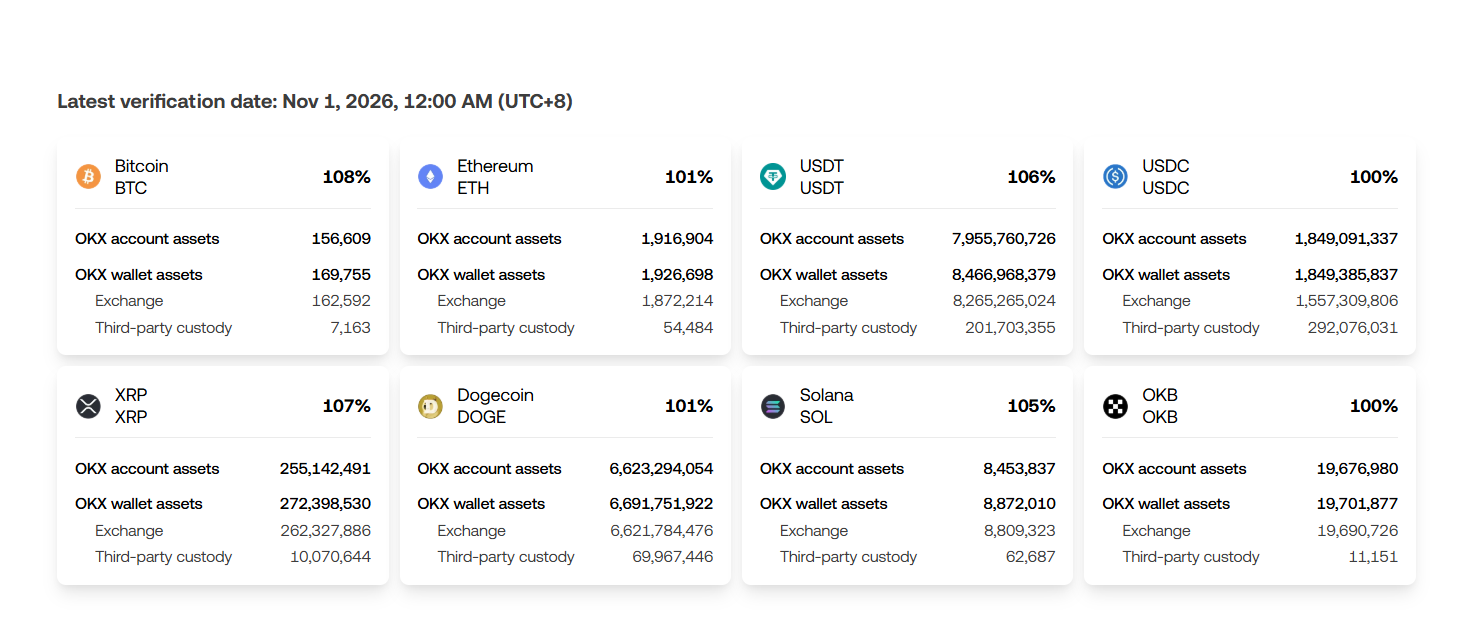
An important feature of OKX's approach is that its disclosure extends beyond a headline coverage percentage.
The exchange publishes supporting reserve and liability materials and provides cryptographic verification resources, including zk-STARK-related proof files. Its official archive lists supporting materials dated November 1, 2026.
For customers, this offers a way to investigate whether their balances are included in the relevant proof and to examine supporting reserve information.
However, the distinction between reserve verification and a full financial audit remains fundamental.
A reserve ratio measures the relationship between specified assets and corresponding reported liabilities at a particular point in time. It does not independently establish that every corporate liability, legal exposure or operational obligation has been accounted for.
Nor does a reserve ratio above 100% amount to deposit insurance or guarantee uninterrupted withdrawals during a market crisis.
Huayu Exchange assessment: OKX's recurring PoR disclosures are a substantive transparency measure. They provide useful evidence for evaluating defined customer-asset reserves, but they should be considered alongside custody arrangements, governance, operational controls and regulatory obligations.
4.4 European MiCA Authorisation: Which OKX Entity Is Regulated?
The legal entity behind an OKX account matters more than a generic statement that the exchange is regulated.
According to OKX Europe's published information, OKX Europe Limited received authorisation as a Crypto-Asset Service Provider from the Malta Financial Services Authority (MFSA) on January 27, 2025, under the European Union's Markets in Crypto-Assets (MiCA) framework.
Relevant regulatory records and European service documentation identify the authorised entity and the crypto-asset services covered by its permissions.
This is a meaningful regulatory development. It places the relevant European operation within a defined framework governing authorised services, organisational standards, compliance and customer protections.
But MiCA authorisation is entity-specific and service-specific.
It should not be interpreted as proof that every OKX operation worldwide is licensed under MiCA, or that all derivatives and Web3 wallet activities fall within the same regulatory perimeter.
A customer in the European Economic Area may be served by a different legal entity, under different product terms, from a customer accessing OKX elsewhere.
The practical question is therefore not simply whether OKX holds a licence. It is whether the entity providing the customer's actual service is authorised to offer that particular product in the relevant jurisdiction.
4.5 The 2025 US Case Remains a Material Part of OKX's Compliance History
OKX's regulatory record includes a serious enforcement action.
On February 24, 2025, the United States Department of Justice announced that Aux Cayes Fintech Co. Ltd, an OKX operating entity, had pleaded guilty to operating an unlicensed money-transmitting business.
The case concerned historical failures involving access by US customers and anti-money-laundering controls.
The company agreed to financial penalties and forfeiture exceeding $504 million in total. The resolution also included continued engagement of an external compliance consultant through February 2027.
The Department of Justice acknowledged cooperation and remedial measures when discussing the resolution.
This case cannot reasonably be dismissed because OKX subsequently expanded its regulated activities in other jurisdictions. It documents significant historical weaknesses in compliance controls.
At the same time, the case should be described accurately: it involved particular historical conduct and a specific legal entity. It does not establish that every current OKX operation has the same deficiencies.
For a trader assessing long-term platform reliability, both sides of the record matter: the historical enforcement action and the subsequent compliance arrangements.
A credible security review should account for both rather than presenting an unqualified verdict.
4.6 Unified Trading Accounts Add an Operational Security Dimension
OKX's Unified Trading Account is designed to support more integrated capital and margin management across eligible trading products.
That convenience makes account-permission management particularly important for active traders.
A customer operating spot positions, perpetual futures and automated strategies may have multiple access paths into the same trading environment. Authentication, device management, withdrawal verification and API permissions all become relevant.
API keys deserve particular attention. A market-data-only application should not receive unnecessary trading or withdrawal permissions. Automated trading systems should use the minimum privileges required for their function, with IP restrictions where available and appropriate.
Separating credentials across strategies can also reduce the impact of a compromised key.
There is a separate distinction between operational security and trading risk.
Even when the account is protected against unauthorised access, positions using shared collateral or leverage can still experience margin pressure and liquidation.
OKX's integrated account structure is useful for professional capital management, but it does not eliminate either account-security responsibilities or the financial risks associated with complex positions.
4.7 OKX Wallet Changes Who Is Responsible for the Assets
OKX Wallet introduces a security model that differs fundamentally from the centralised exchange.
Within a custodial exchange account, customers depend on the exchange's asset custody, account administration and withdrawal infrastructure.
In a self-custody wallet, users control the relevant wallet credentials and authorise on-chain transactions themselves.
That changes the risk profile. Smart-contract vulnerabilities, malicious approvals, phishing websites, compromised credentials and incorrect transaction signatures become central concerns.
| Security Consideration | OKX Centralised Exchange | OKX Wallet Self-Custody |
|---|---|---|
| Asset control | Depends on the exchange's custody arrangements | User controls the relevant wallet credentials |
| Primary security responsibilities | Exchange custody, account protection and permission management | Private-key security, transaction signing and on-chain approvals |
| Proof of Reserves | Relevant to disclosed exchange reserves | Does not insure or guarantee self-custodied assets |
| Regulatory scope | Depends on the service entity and authorised product | Cannot be assumed to cover every connected decentralised protocol |
| Key risks | Custody failure, account compromise, withdrawal disruption and operational risk | Lost keys, malicious approvals, smart-contract exploits and transaction errors |
A transfer from the exchange into a self-custody wallet changes the custody relationship.
Once assets are controlled through that wallet, the exchange's Proof of Reserves should not be treated as a guarantee for those on-chain holdings.
Likewise, accessing a DeFi protocol through OKX Wallet does not mean that the protocol is covered by OKX Europe's MiCA authorisation.
For traders who regularly move between centralised and decentralised markets, understanding these boundaries is more useful than treating the entire OKX ecosystem as a single security arrangement.
OKX has several substantive security and compliance credentials: recurring reserve disclosures with cryptographic verification materials, MiCA authorisation for its relevant European entity, and account-permission tools suited to professional trading workflows.
Those strengths must be considered alongside the 2025 US enforcement case, the limitations of reserve attestations and the differences between custodial and self-custodial services.
For spot and derivatives traders, the most important questions concern the service entity, exchange custody, account permissions and exposure to leveraged positions.
For users moving between OKX and OKX Wallet, the key consideration is when responsibility for asset security passes from the exchange to the wallet holder.
Overall, OKX offers meaningful reserve transparency and has made identifiable regulatory progress in Europe. Neither development provides universal protection across every jurisdiction, product or custody model. Its security profile is best assessed by legal entity, asset-control arrangement and the specific activity a customer intends to undertake.
5. Products & Trading Features
5.1 OKX's Core Strength: Bringing Different Trading Strategies into One System
OKX's product ecosystem can be divided into three interconnected areas with distinct risk characteristics: centralized trading, automated strategy tools, and its Web3 wallet.
The feature that most clearly defines OKX's professional trading proposition is its Unified Trading Account (UTA). It allows eligible users to manage assets and margin across different trading products without treating every activity as an entirely separate system.
The value of this architecture lies in capital efficiency and flexible risk management, rather than simply offering more features.
For investors who only buy and hold BTC or ETH, OKX's spot trading services may already cover their essential needs. However, for traders managing spot positions, perpetual futures, expiry futures, and options simultaneously, the interaction between account modes, margin calculations, and execution tools becomes considerably more important.
This is where OKX distinguishes its approach from platforms that primarily compete on the number of available trading products: it aims to bring multiple trading activities into a more integrated and manageable trading environment.
5.2 Spot Trading: The Foundation of a Multi-Strategy Portfolio
OKX's spot market does more than facilitate direct cryptocurrency purchases and sales. It can also serve as the underlying asset component of broader trading strategies.
For everyday investors, the most important considerations are execution quality, transaction costs, supported assets, and the convenience of moving funds in and out of the platform.
For more active users, spot holdings can serve additional purposes, including long-term investment, recurring purchases, grid trading, and the spot leg of certain derivatives hedging strategies.
However, integrating spot and derivatives strategies does not mean every asset can automatically be used as collateral. Collateral eligibility, valuation haircuts, and the selected account mode determine how much margin may actually be available.
For example, holding BTC in the spot market while opening a short BTC perpetual futures position does not guarantee that the two positions will automatically offset risk under every account configuration. Whether spot holdings count toward margin, whether derivatives positions qualify for risk offsets, and how overall account exposure is calculated all depend on the applicable rules.
The value of OKX's spot market therefore extends beyond basic buying and selling: it can function as the underlying asset layer of a more comprehensive trading system.
5.3 Perpetual and Expiry Futures: The Core of OKX's Professional Trading Infrastructure
Perpetual futures are among the OKX products most worth examining. They allow eligible traders to establish leveraged long or short exposure, while funding rate mechanisms help keep perpetual contract prices aligned with their underlying reference markets.
Expiry futures, by contrast, have defined expiration and settlement arrangements, making them potentially useful for time-specific hedging and spread strategies.
The two products are not interchangeable.
Perpetual futures offer flexibility over holding periods, but maintaining a position may involve ongoing funding payments. Expiry futures avoid the perpetual funding mechanism, although traders must account for expiration, basis risk, and contract rollover.
On OKX, the challenges of futures trading extend beyond predicting price direction. Position sizing, margin modes, mark prices, liquidation rules, and funding rates all influence trading outcomes.
For users managing spot and derivatives positions together, additional questions become important: Can different positions share collateral? Can their risks be offset? How might losses in one position affect the rest of the account?
These questions lead directly to the Unified Trading Account and are essential when evaluating OKX's professional trading capabilities.
5.4 Unified Trading Account: One of OKX's Most Distinctive Features
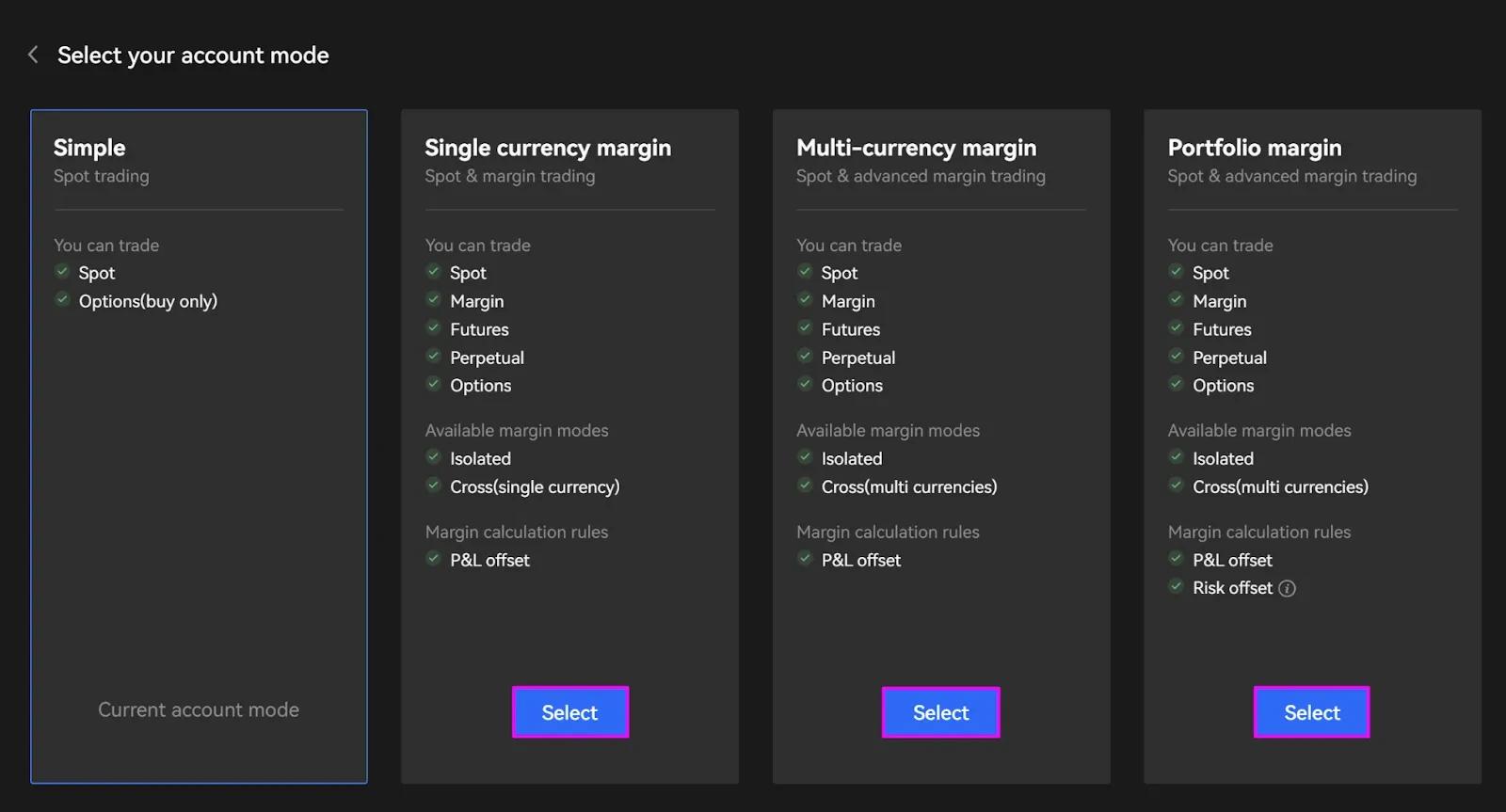
According to OKX's official documentation, the Unified Trading Account offers four principal account modes: Spot Mode, Spot and Futures Mode, Multi-Currency Margin Mode, and Portfolio Margin Mode.
These modes differ in supported products, margin calculations, and risk management mechanisms. Having a unified account does not mean every user automatically qualifies for the most advanced margin features.
| Account Mode | Primary Use Case | Key Consideration |
|---|---|---|
| Spot Mode | Users primarily trading spot assets; certain options-buying activities may be supported under applicable rules | Relatively straightforward structure without margin borrowing |
| Spot and Futures Mode | Users trading spot, margin, and derivatives products | Supports isolated and single-currency cross-margin arrangements; requires active leverage and margin management |
| Multi-Currency Margin Mode | Traders holding multiple assets who want greater collateral efficiency | Different assets can affect overall account risk; collateral valuation haircuts matter |
| Portfolio Margin Mode | Eligible professional traders managing complex derivatives portfolios | Applicable risk models may recognize offsets between positions, but risk management is more demanding |
Account modes, supported products, and activation requirements depend on the user's jurisdiction and OKX's current account rules.
How Do Multi-Currency Margin and Portfolio Margin Differ?
Multi-Currency Margin Mode focuses on allowing eligible assets to contribute to margin calculations, potentially reducing the need to move collateral between different currencies.
However, holding several assets does not mean their entire market value becomes available as margin. OKX calculates available collateral according to asset eligibility, valuation rules, and account risk conditions. Price fluctuations in the collateral itself can also change the account's risk profile.
Portfolio Margin Mode goes further by considering the risk relationships between multiple derivatives positions.
Consider a trader holding BTC and ETH while maintaining derivatives positions with different expirations or directional exposures. Under a fully segregated margin structure, positions may require separate collateral allocations. Under an advanced mode that recognizes qualifying risk offsets, the account may calculate certain exposures on a portfolio basis.
This can be attractive for capital-intensive strategies, but it does not mean every combination of long and short positions automatically receives lower margin requirements.
Whether a risk offset applies depends on product type, underlying asset, position direction, account eligibility, and the exchange's risk model.
More importantly, shared collateral changes how losses can spread across an account. A substantial loss in one market may reduce the collateral available to support other positions. Improved capital efficiency can therefore come at the expense of the natural separation between trading strategies.
Are There Eligibility Requirements for Advanced Account Modes?
Yes. OKX's official Unified Account documentation describes eligibility and activation conditions for advanced modes, including an account equity requirement equivalent to USD 10,000, along with relevant assessments and activation procedures.
This does not mean that holding the required amount automatically guarantees access to every advanced feature. Regional restrictions, product permissions, risk assessments, and account-specific conditions may still apply.
OKX also states that users cannot directly switch account modes while open orders or positions remain outstanding. Those orders or positions must first be addressed according to the applicable rules.
A professional assessment of OKX should therefore go beyond asking whether the exchange offers a Unified Trading Account. The more important question is whether traders understand the margin mode they are using.
The real benefit of UTA is that it enables experienced, eligible traders to organize capital and positions more flexibly—not that it automatically reduces trading risk.
5.5 Options Trading: Risk Management Beyond Market Direction
OKX's product ecosystem also includes options. One of the fundamental differences between options and perpetual futures is that options allow traders to construct different payoff and risk profiles through strike prices, expiration dates, and premiums.
For example, an investor holding spot assets might consider protective put options to limit downside exposure over a specified period. Traders familiar with volatility strategies may instead examine pricing differences between expirations or strike prices.
However, options trading requires more than deciding whether an asset's price will rise or fall. Time decay, implied volatility, liquidity, and exercise and settlement rules can all affect the outcome.
The risks associated with buying options and selling options are also fundamentally different and should not be treated as equivalent.
In more sophisticated strategies, options may be combined with spot holdings, perpetual futures, or expiry futures to create broader risk management structures. In such cases, traders must consider not only the profit or loss of individual positions, but also how the overall portfolio responds to price movements, volatility changes, and the passage of time.
OKX's advantage here is that options form part of a wider trading ecosystem, rather than requiring users to move to an entirely separate set of tools to explore them.
Nevertheless, available options markets, trading eligibility, and advanced margin support remain subject to the user's jurisdiction and account permissions.
5.6 Trading Bots: Automated Execution Does Not Guarantee Profits
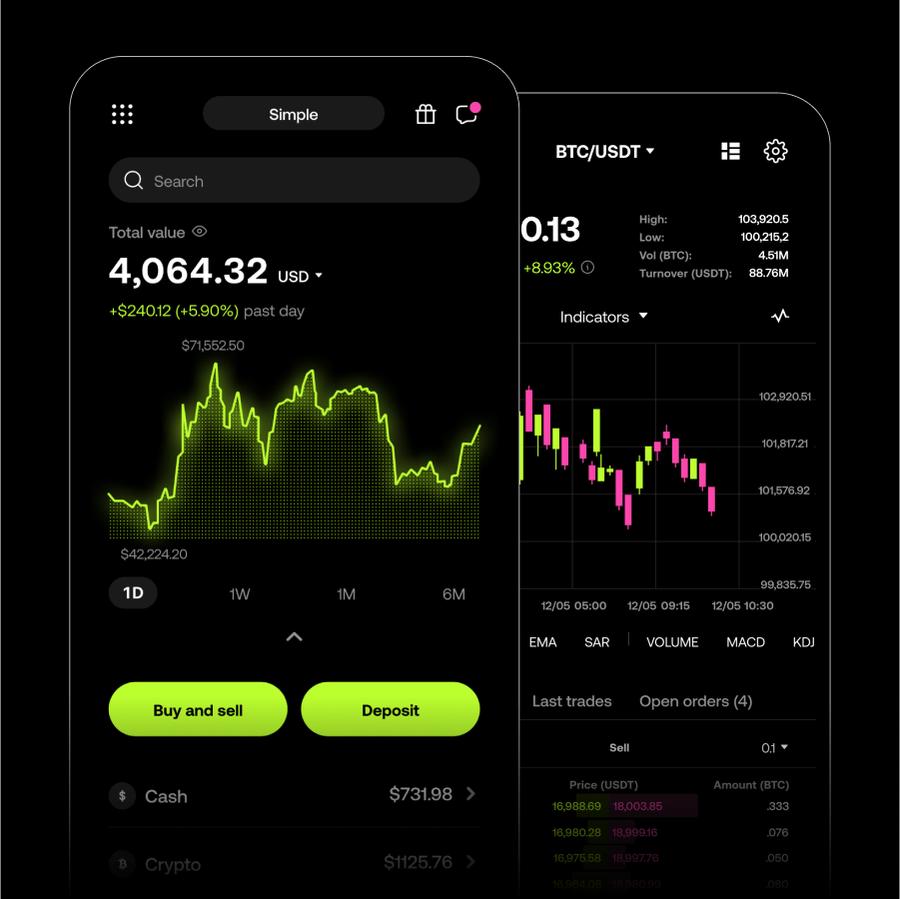
OKX offers a range of automated strategy tools, including Spot Grid, recurring investment strategies, TWAP, and Iceberg Orders. Additional derivatives-related strategy tools may also be available in certain regions.
These tools serve different purposes.
| Strategy Tool | Primary Purpose | Main Considerations |
|---|---|---|
| Spot Grid | Places layered orders within a predefined price range to execute range-trading strategies | One-directional markets, unrealized losses, grid settings, and trading fees |
| Recurring Investment and DCA | Builds positions incrementally according to predefined rules, reducing reliance on choosing a single entry point | Does not guarantee asset appreciation or eliminate market risk |
| TWAP | Divides orders over time to manage the execution of larger trades | Price changes during execution and actual transaction costs |
| Iceberg Orders | Breaks large orders into smaller visible portions to reduce the visibility of total order size | Execution quality, market depth, and unfilled order exposure |
OKX's official Spot Grid documentation describes parameters such as upper and lower price boundaries, grid count, and arithmetic or geometric grid configurations. Users can configure these settings themselves or refer to strategy parameters offered by the platform.
One important distinction is often overlooked: a bot's reported grid profit is not necessarily the same as the strategy's total profit or loss.
A bot may accumulate realized trading gains through repeated purchases and sales while the underlying assets it continues to hold decline in value. The overall account can therefore remain at a loss.
Funds allocated to an active strategy may also be reserved for the bot, reducing the capital available to support other positions.
For OKX, the practical advantage of built-in bots is that they lower the technical barrier to automated execution. Users do not need to develop software from scratch to deploy a rules-based trading strategy.
For professional traders, however, TWAP and Iceberg Orders may offer more direct value than conventional grid bots. These tools focus on execution quality and market impact rather than predicting price direction.
This illustrates a defining feature of OKX's product ecosystem: it combines accessible rule-based strategies with tools designed for larger orders and more demanding execution requirements.
5.7 APIs and Professional Trading Interfaces
OKX provides REST APIs and WebSocket interfaces for programmatic trading, covering market data subscriptions, account information, order management, and order book data.
Its official API documentation recommends WebSocket connections for market data and depth feeds, while establishing limits on connections, subscriptions, and request frequency.
For quantitative traders, APIs make it possible to connect trading signals, risk monitoring, and order execution without relying entirely on manual interfaces.
However, reliable implementation must account for rate limits, connection interruptions, reconnection procedures, order-state synchronization, data latency, and abnormal market conditions.
For example, submitting an order request does not mean the order has been successfully filled. A robust automated trading system must continuously verify order status, actual filled quantities, and account balances.
For traders running multiple strategies simultaneously, account modes and API integration must also be considered together. Being able to retrieve account balances programmatically does not remove the need to account for collateral haircuts, position risk, or product-specific permissions.
OKX also maintains jurisdiction-specific API access arrangements and service requirements. Developers should not assume that accounts in every region operate under identical API environments.
These considerations help distinguish professional trading infrastructure from a basic automated order-placement script.
5.8 OKX Wallet: Extending Centralized Trading into On-Chain Markets
Another recognizable component of the OKX ecosystem is its Web3 wallet.
An exchange account and a self-custody wallet can serve the same user, but they represent fundamentally different models of asset control.
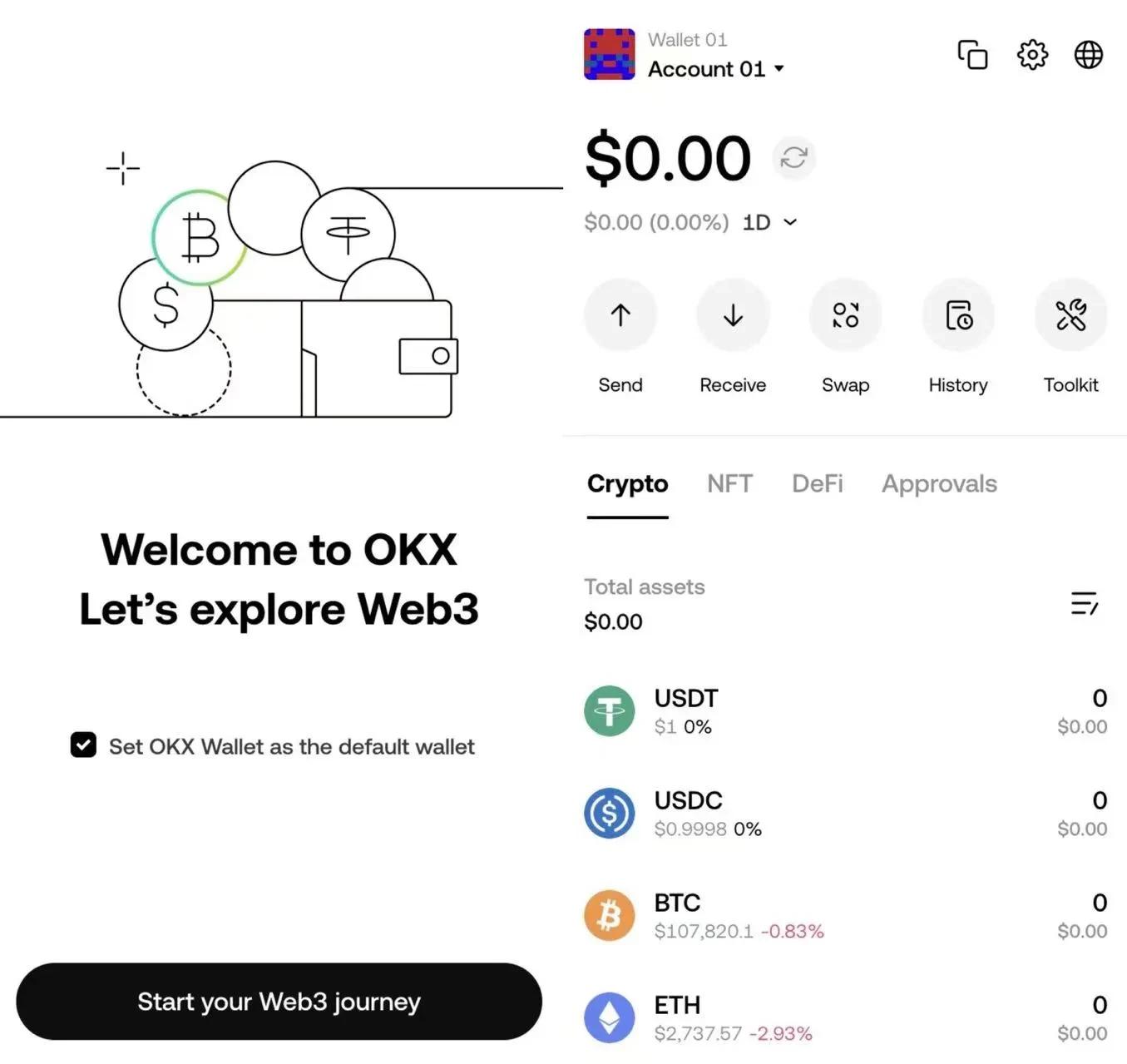
| Comparison | OKX Centralized Exchange Account | OKX Wallet Self-Custody |
|---|---|---|
| Asset Control | Relies on the exchange's custody arrangements | Users are responsible for wallet keys and authorizations |
| Trade Execution | Primarily through the exchange's trading infrastructure | Through blockchain transactions and relevant on-chain protocols |
| Main Costs | Trading fees, spreads, and applicable charges | Network gas fees, protocol fees, on-chain slippage, and related costs |
| Main Risks | Custody, platform operations, account security, and regulatory risks | Private keys, malicious approvals, smart contracts, and on-chain execution risks |
| Suitable Uses | Centralized trading and order management | On-chain asset management and decentralized application interactions |
This combination can be useful for users who participate in both centralized trading and decentralized finance.
For example, a trader may use OKX Exchange for spot or futures trading while managing on-chain assets, connecting to decentralized applications, or accessing eligible blockchain trading services through OKX Wallet.
However, these two products should not be treated as a single pool of funds.
Once assets are withdrawn from the exchange into a self-custody wallet, security responsibilities and transaction rules may change significantly. Identity verification, order management, and custody arrangements within the exchange cannot replace private-key protection, smart-contract approval reviews, or transaction-signing security in a Web3 wallet.
Likewise, using OKX Wallet does not mean every on-chain transaction receives liquidity, execution guarantees, or asset protection from the centralized OKX exchange.
For users who frequently move between centralized exchanges and DeFi, the OKX ecosystem may reduce the operational complexity of using multiple tools. It does not eliminate cross-chain transfer risks, malicious contracts, unsafe approvals, or on-chain slippage.
The value of OKX Wallet lies in expanding how users can manage and interact with digital assets—not in transferring self-custody risks to the exchange.
5.9 Huayu Exchange Verdict: Where Does OKX's Product Advantage Really Lie?
OKX's product advantage does not come from offering features that no other exchange has. Spot trading, perpetual futures, trading bots, and Web3 wallets are also available in various forms across other major cryptocurrency platforms.
What matters is how these tools work together within a trader's capital management and execution workflow.
For everyday spot investors, OKX provides a relatively comprehensive trading environment, although advanced Unified Trading Account features may offer little immediate benefit.
For active futures traders, the combination of spot markets, perpetual futures, expiry futures, and multiple margin modes provides more flexibility in organizing positions.
For professional traders, Portfolio Margin, options, TWAP, Iceberg Orders, and APIs make OKX closer to an integrated trading infrastructure than a basic cryptocurrency buying and selling application.
For users participating in both centralized trading and on-chain markets, OKX Exchange and OKX Wallet offer two distinct approaches to managing digital assets.
However, greater product integration also increases the importance of understanding account modes, eligible collateral, shared margin exposure, and self-custody responsibilities. More features do not automatically make a platform easier to use or reduce its risks.
Overall, OKX's most distinctive product strength is its integration of professional derivatives trading, unified margin management, automated execution tools, and Web3 asset management within one broader ecosystem. It is particularly relevant to users seeking to develop a more comprehensive trading workflow, rather than those choosing an exchange solely by the number of products available.
6. Language Support & User Experience
A platform designed for different levels of trading complexity
OKX serves a broad international audience, with multilingual interfaces and region-specific services.
Its user experience needs to accommodate two very different types of activity: relatively simple spot transactions and professional trading workflows involving multiple instruments, orders and collateral calculations.
That creates a design challenge.
A new user generally wants to understand balances, prices, orders and deposits with minimal friction.
An experienced derivatives trader may need order-book depth, funding information, margin ratios, position exposure and advanced order controls visible at the same time.
The features that make a platform attractive to one group can make it feel complicated to another.
OKX addresses this partly through different trading interfaces, account modes and product-specific tools. Nevertheless, the learning curve becomes more significant as users move beyond ordinary spot trading.
Language availability and regional access
OKX maintains international and regional versions of its website, with help materials adapted to different audiences.
This can make its extensive product documentation easier to navigate for customers who prefer languages other than English.
However, language support and legal eligibility must be assessed separately.
The availability of an English-language page does not mean a product is offered in every English-speaking country. Likewise, access to a translated interface does not establish that the associated service is authorised in a customer's jurisdiction.
This distinction is particularly important for derivatives, margin products and fiat payment services.
A useful evaluation of OKX's international experience therefore considers not only whether the interface is understandable, but whether the relevant help materials, product terms and support arrangements apply to the user's actual account.
Desktop trading and mobile account management
OKX's wider product range creates different expectations for desktop and mobile use.
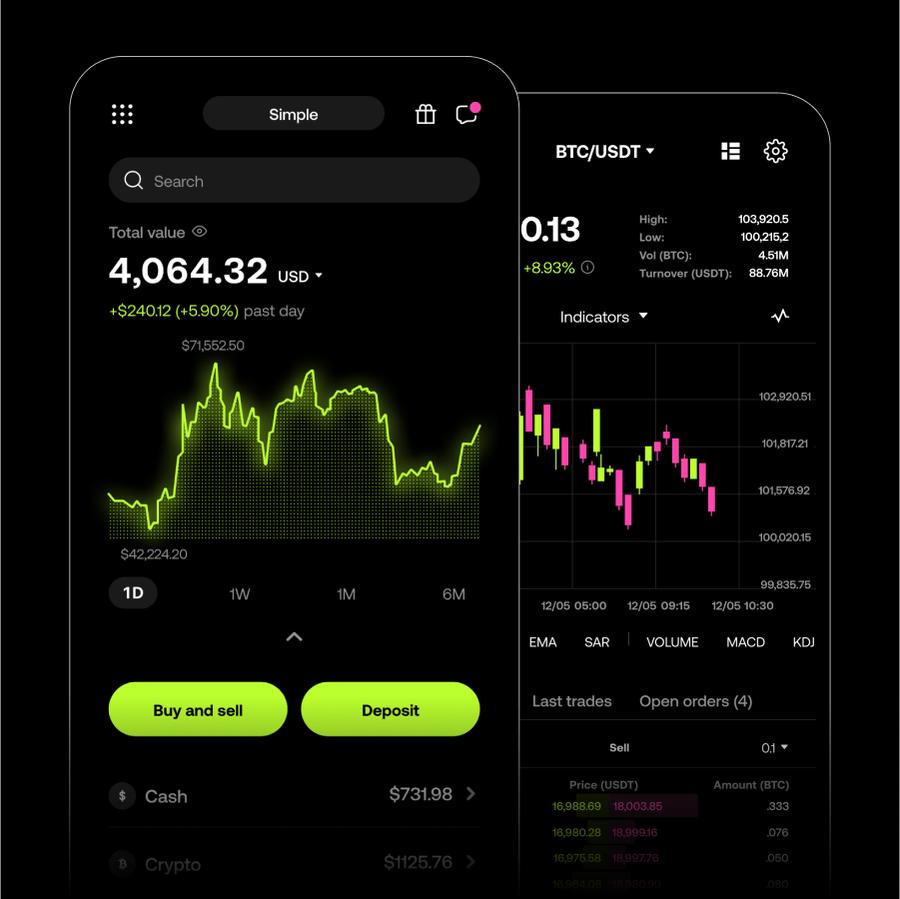
Mobile interfaces are useful for monitoring balances, reviewing open orders, managing straightforward transactions and responding to market developments.
More complex activities often benefit from a larger workspace.
For example, a trader comparing perpetual funding rates, order-book depth and several related positions may need to monitor multiple data sets simultaneously.
A desktop environment generally makes this easier than a small mobile screen.
Similarly, options analysis and complex portfolio-margin monitoring require attention to several variables at once. These are not activities that should be reduced to a single directional price chart.
For users relying on trading bots, mobile access can be particularly useful for monitoring strategies already configured. More detailed strategy design may be easier in a larger interface.
Customer support and documentation
OKX's Help Center covers account operations, trading rules, strategies and technical subjects.
The depth of documentation is valuable because some of the platform's most important features require more than basic interface instructions.
For example, a user selecting Multi-Currency Margin needs to understand how collateral is valued. Someone operating a bot needs to distinguish strategy-level profit from total P&L.
Good documentation can reduce misunderstandings, but it is not equivalent to verified customer-support performance.
This review did not conduct a documented live-support test, so it does not assign a response-time rating or claim firsthand experience resolving an account issue.
The more defensible observation is that OKX maintains extensive public technical and help materials, while the quality of individual support interactions remains a separate question.
Managing complexity without sacrificing control
For active traders, OKX's information-rich environment is a meaningful advantage.
Its appeal comes from giving users access to multiple order types, markets, account configurations and execution tools within one ecosystem.
Yet the best interface is not necessarily the one with the greatest number of features.
It is the one that allows the trader to understand the consequences of each action.
On OKX, that means paying particular attention to the selected account mode, available collateral, order type and product eligibility before moving into advanced trading.
The platform's usability improves as the user's trading process becomes more clearly defined.
7. Community Reputation & User Adoption
7.1 OKX's reputation is closely connected to its trading products
OKX has an established international brand and a product ecosystem that attracts several distinct communities.
Spot investors, derivatives traders, algorithmic developers and Web3 users do not necessarily evaluate the exchange in the same way.
A derivatives trader may prioritise execution quality, margin flexibility and funding costs.
A bot user may focus on strategy configuration, reporting and the reliability of automated orders.
A Web3 participant may be more interested in wallet functionality, supported networks and interactions with decentralised applications.
This diversity makes it difficult to reduce OKX's reputation to a single community sentiment score.
7.2 Brand reach and verified adoption are different measures
OKX's European website currently describes the wider platform as serving more than 120 million traders worldwide. That is a company-published marketing figure, not an independently audited count of currently active customers.
OKX Europe
Several different metrics are often grouped under the term user adoption:
- Registered accounts.
- Verified customers.
- Monthly active users.
- Trading customers.
- Geographic reach.
- Social media followers.
These measures are not interchangeable.
A large cumulative registration figure does not reveal how many users trade regularly, how trading activity is distributed across markets or what proportion of customers use advanced features.
For evaluating OKX as a trading platform, product adoption is most meaningful when linked to actual market participation and customer behaviour.
7.3 OKX Global Brand Partnerships: McLaren F1, Manchester City and Tribeca Festival
Beyond its trading products and technical infrastructure, OKX has expanded its global brand presence through partnerships with major international sports and cultural organisations. Notable examples include the McLaren Formula 1 Team, Manchester City Football Club, and the Tribeca Festival in the United States.
OKX began its multi-year partnership with McLaren F1 in 2022, with its branding appearing on race cars, team apparel and promotional campaigns. The exchange also established a partnership with Manchester City in 2022 and became the club's official sleeve partner in 2023.
In the cultural sector, OKX has collaborated with the Tribeca Festival to support initiatives involving film, digital creativity and Web3.
7.4 How to interpret community feedback
Exchange reviews frequently rely on social media discussions to describe user satisfaction. Such material can be informative, but it is also vulnerable to selection bias.
Customers who experience account problems may be more likely to post publicly than customers whose routine transactions complete without incident.
At the same time, referral campaigns and promotional accounts can generate large volumes of positive content that do not necessarily reflect independent experience.
A credible assessment should therefore distinguish between documented operational incidents, individual customer allegations and promotional statements.
For OKX, the most useful community questions concern identifiable aspects of its product ecosystem: order execution, derivatives mechanics, account verification, trading bots and wallet security.
Claims about systematic misconduct or exceptional performance require evidence beyond isolated screenshots or unverified testimonials.
7.5 Institutional and developer relevance
OKX's professional API documentation and advanced account modes also give the platform relevance beyond casual retail trading.
These features support workflows associated with systematic traders, market-data analysts and organisations that need programmable access to trading infrastructure.
Their existence is not proof of any particular institutional market share.
It does, however, show that OKX invests in tools intended for customers with more demanding execution and account-management requirements.
This is consistent with the platform's broader positioning as a multi-product trading environment.
7.6 Community engagement and the conversion decision
For prospective users, community familiarity can make a platform easier to research. Tutorials, product discussions and shared technical knowledge may reduce the time needed to understand a new trading environment.
But familiarity should not replace product evaluation.
OKX is most compelling when a user can identify a specific benefit—such as its margin architecture, automated execution tools or Web3 ecosystem—rather than relying on broad claims about popularity.
The platform's reputation is best assessed through documented capabilities, transparent disclosures and observable market behaviour, supported by community feedback where reliable evidence is available.
8. Deposits & Withdrawals
8.1 OKX Funding Is More Than a Deposit Address
For active OKX traders, moving funds onto the exchange is only the beginning. The more consequential questions are where the assets are credited, whether they are available for trading, and what restrictions apply when the customer wants to move them elsewhere.
OKX distinguishes between Funding and Trading accounts, with internal transfers available under the applicable account arrangements.
This structure supports different capital-management workflows. Assets can be held for funding purposes, allocated to trading, or transferred externally when eligible.
But a visible account balance is not necessarily an immediately withdrawable balance.
Funds supporting open derivatives positions, committed to other products, or subject to account restrictions may not be freely transferable.
That distinction matters particularly to customers using OKX's Unified Trading Account, where collateral allocation and portfolio risk can affect how much capital remains available.
8.2 Funding and Trading Accounts: Where Should Deposits Go?
OKX's official account-transfer documentation explains that eligible customers can move assets between Funding and Trading accounts without an internal transfer fee.
Certain account configurations also allow customers to select the destination account when making a blockchain deposit.
Crediting a deposit directly to Trading can reduce the operational step of transferring funds before placing orders. Using Funding instead can be useful when a customer wants to hold assets separately before allocating them to particular strategies.
The flexibility has limits.
OKX documents several reasons why funds may not be transferable, including assets committed to open positions, frozen balances, outstanding margin obligations and assets subscribed to products that require redemption.
For professional traders, this is an important operational distinction. Capital can appear in the account while remaining unavailable for a new position or an external withdrawal.
The Funding/Trading separation is therefore a useful part of OKX's trading infrastructure, but it should not be confused with unrestricted access to every displayed balance.
8.3 On-Chain Deposits and Withdrawals: Network Selection Determines Whether Funds Arrive
OKX supports cryptocurrency deposits and withdrawals over eligible blockchain networks. The available combinations depend on the asset, service entity and account.
The key requirement is compatibility between the sending and receiving networks.
For example, transferring USDT requires more than selecting the correct token name. Both platforms or wallets must support the specific network being used.
Some assets also require a Memo or Tag. If the receiving service requires one, omitting it can prevent the transfer from being credited correctly.
Minimum deposit and withdrawal thresholds matter as well. OKX's documentation advises customers to confirm these limits and the destination's requirements before submitting a transfer.
Withdrawal fees vary by asset and network. The relevant amount is displayed in the withdrawal interface rather than represented by a single universal charge.
For someone regularly moving stablecoins between platforms, the cheapest-looking network is not necessarily the most useful choice. Compatibility, total cost and the intended destination all matter.
8.4 Internal Transfers Versus Blockchain Withdrawals
One practical advantage of OKX is its distinction between external blockchain withdrawals and transfers to other eligible OKX users.
| Consideration | On-Chain Withdrawal | Internal Transfer to OKX User |
|---|---|---|
| Destination | External blockchain address or another exchange | Eligible OKX recipient |
| Processing | Requires blockchain transfer | Processed within OKX |
| Fee | Applicable withdrawal/network charge | Described by OKX as free |
| Timing | Depends on processing and blockchain confirmations | Described as instant, subject to applicable conditions |
| Main checks | Network, address, Memo/Tag and minimum amount | Recipient details, eligibility and transfer limits |
Internal transfers can be particularly useful when both parties use OKX and there is no need to move assets onto a blockchain.
However, an internal transfer is not the same as a free withdrawal to an arbitrary self-custody address.
OKX also distinguishes between withdrawal processing and final receipt. Its documented withdrawal statuses include Requested, Pending, Withdrawing and Completed.
A Completed status means the assets have left OKX. It does not necessarily mean another exchange has already credited the recipient's account.
This distinction is useful when diagnosing delayed deposits: the sending platform, blockchain and receiving platform represent separate stages of the transfer.
8.5 Why Might a Balance Be Temporarily Unavailable for Withdrawal?
OKX's withdrawal documentation requires identity verification under the relevant service arrangements.
Additional restrictions can arise from account-security changes, risk controls, frozen assets or insufficient available balances.
For example, regional OKX help materials describe a possible 24-hour withdrawal restriction after certain login-password changes.
For derivatives traders, collateral tied to open positions can create another limitation. The amount displayed as total equity is not necessarily the amount that can be withdrawn without affecting margin requirements.
The applicable withdrawal limits also depend on verification status, jurisdiction and product eligibility.
A reliable assessment of OKX withdrawals must therefore distinguish between a technical failure, an account-level security restriction and capital that is legitimately committed to an existing position.
8.6 Moving From OKX Exchange to OKX Wallet Changes the Custody Model
OKX's combination of centralised trading and a self-custody wallet makes exchange-to-wallet transfers a particularly relevant workflow.
On the exchange, customers rely on OKX's custody and account infrastructure. Once assets move into a self-custody wallet, the wallet holder becomes responsible for the relevant credentials and transaction authorisations.
The shared OKX branding does not eliminate that change in responsibility.
There is also a practical funding problem that can arise after the transfer: network gas.
A user may hold USDT in OKX Wallet but lack the native token needed to send it or interact with a decentralised application.
OKX documents a gas top-up workflow that, in supported configurations, allows a linked wallet to request the required native asset from the Exchange.
This can simplify moving between centralised and on-chain environments. However, the feature depends on the wallet configuration, account linkage and available interface. It should not be assumed to work identically across every OKX Wallet application or network.
The broader benefit is operational convenience, not a removal of blockchain fees, self-custody responsibilities or transfer risks.
8.7 Fiat Funding and the Real Cost of Moving Capital
Fiat deposits, crypto purchases and withdrawals to traditional payment methods depend heavily on the jurisdiction and legal entity serving the customer.
Available methods may include supported bank transfers, cards or third-party payment services, with different eligibility requirements, fees and settlement conditions.
An EEA customer may therefore have access to payment arrangements that are unavailable to an OKX customer in another market.
For a trader who already holds cryptocurrency, this may be a secondary consideration.
For someone who frequently converts between local currency and crypto, it can be decisive. A strong derivatives platform is less useful if the customer's preferred banking route is unavailable or expensive.
The appropriate comparison includes the entire funding journey: payment-provider charges, conversion spreads, deposit eligibility, transfer costs and withdrawal arrangements.
Huayu Exchange verdict: OKX offers a relatively integrated capital-movement workflow across Funding, Trading, eligible internal transfers and self-custody wallet services. This is especially relevant to traders operating across spot, derivatives and on-chain markets. Its practical value depends on understanding available balances, withdrawal eligibility, network compatibility and the point at which custody responsibility changes.
9. Who Is This Exchange Best Suited For?
OKX is particularly compelling for traders whose requirements extend beyond occasional spot transactions. Its strongest advantages emerge when several products or execution tools form part of a consistent trading process.
Active spot and derivatives traders
Traders who regularly move between spot markets, perpetual swaps and other eligible derivatives can benefit from OKX's integrated trading environment.
The Unified Trading Account provides a framework for managing these activities without treating every product as an entirely separate workflow.
For traders who understand collateral management, the ability to choose between different account modes is a significant attraction.
The combination of advanced orders, derivatives and detailed account information makes OKX a serious platform to consider for active market participation.
Multi-strategy and portfolio-oriented traders
OKX is well suited to users managing several related positions or strategies.
A trader might combine a longer-term spot allocation with shorter-term derivatives exposure, while using separate execution algorithms for position adjustments.
More advanced account modes can provide additional flexibility where collateral eligibility and risk calculations permit.
The value lies in bringing position management, execution and risk monitoring into a connected environment.
For users with sufficiently sophisticated strategies, this integration can be more useful than simply having access to a large number of trading pairs.
Systematic traders and automation users
OKX offers a practical progression from built-in trading bots to API-based automation.
A user can begin with a grid or recurring-purchase strategy, explore TWAP or iceberg execution, and eventually build custom systems using the exchange's technical interfaces.
This makes OKX attractive to traders who want to reduce repetitive manual operations.
The range of tools also allows users to select an automation method that matches their objectives rather than forcing every strategy into a single bot format.
Advanced derivatives and options traders
For eligible traders who work with futures, perpetual swaps and options, OKX provides a broader toolkit for constructing market exposure.
Its professional account modes are especially relevant to users who understand margin methodology, contract specifications and portfolio-level risk.
The platform's appeal here is not simply leverage availability. It is the combination of instruments, account infrastructure and execution tools.
Traders active in both centralised and on-chain markets
OKX's exchange and wallet ecosystem is relevant to users who participate in both CEX trading and Web3 applications.
A trader may prefer centralised order books for active execution while maintaining separate self-custody assets for blockchain-based activity.
Having products under the same wider brand can simplify discovery and navigation, even though the underlying custody models remain different.
For this audience, OKX offers a combination of trading infrastructure and Web3 access that can support several distinct workflows.
10. Final Verdict: Is OKX Worth Using?
OKX stands out for the depth and integration of its trading infrastructure.
The Unified Trading Account is its clearest differentiator. Rather than presenting spot, futures and options as entirely disconnected products, OKX provides account structures that allow eligible traders to manage different exposures within a broader capital-management framework.
Its automation ecosystem adds another layer of utility. Grid and DCA strategies offer accessible ways to implement predefined rules, while TWAP, iceberg execution and API connectivity support more specialised workflows.
OKX Wallet extends the ecosystem into self-custody and on-chain activity, giving users a separate route into decentralised markets.
The security and regulatory picture is more nuanced. OKX's recurring Proof of Reserves disclosures provide useful transparency, and its European MiCA authorisation represents a meaningful regulatory development. The 2025 US compliance case remains an important part of its history and should be considered alongside those improvements.
For active traders, derivatives specialists and users managing multiple strategies, OKX is a strong candidate for a primary trading platform, provided the relevant products are available through their account and jurisdiction.
Its most persuasive advantage is not a single promotional fee or headline feature. It is the ability to support increasingly sophisticated trading workflows within one ecosystem.
Traders interested in exploring those capabilities can review the relevant products through OKX's official channels. Huayu Exchange readers can also consult the Offers (优惠) tab on the corresponding OKX review page for any currently verified registration offers or trading rebates.
Sources and References
- OKX Official Website — Exchange products, trading markets and official platform information.
- OKX Trading Fee Rules FAQ — Spot, futures and options fees, maker/taker rules and funding rates.
- OKX Fee Details — VIP tiers, trading-volume requirements and account-based fee structures.
- OKX Proof of Reserves — Reserve disclosures, asset coverage and cryptographic verification.
- OKX Proof of Reserves Details — Reserve ratios and publicly available verification data.
- OKX API Documentation — Market data, order books, trading interfaces and Unified Trading Account documentation.
- OKX Shield — Official Announcement
- OKX Shield — Activation and User Guide
- OKX Shield — European FAQ
- OKX official Help Center and Unified Trading Account documentation — Margin modes, account equity, trading rules and deposit/withdrawal requirements.
- Public records from relevant regulatory authorities — Legal entities, authorisations and jurisdictional restrictions.
Affiliate Disclosure: Huayu Exchange may earn commissions through partnership links to certain trading platforms. Our reviews are based on independent research and publicly available information. Commercial partnerships do not constitute guarantees of exchange security or investment returns.
Risk Disclaimer: Crypto assets and leveraged derivatives involve price volatility, liquidity, custody and liquidation risks. This article provides research information about trading platforms only and does not constitute personalised investment advice.


