 Bybit
Bybit Review: Trading Fees, Liquidity, Security, Futures & Trading Features
 HuaYu ExchangePublished Updated
Bybit — A global cryptocurrency trading platform specializing in derivatives trading, offering a wide range of trading tools, including perpetual futures, spot trading, Unified Trading Account (UTA), and copy trading. It is particularly well-suited for traders focused on futures trading and advanced trading strategies.
Bybit is a centralized cryptocurrency exchange founded in 2018, best known for its derivatives trading platform. While many exchanges compete through token listings or simplified investing experiences, Bybit has built much of its identity around perpetual futures, advanced order execution, margin management, and trading infrastructure.
Its product offering has expanded beyond derivatives to include spot markets, options, trading bots, copy trading, and the Unified Trading Account (UTA). This combination allows eligible traders to manage multiple strategies within a single trading environment rather than constantly transferring capital between separate accounts.
Bybit is particularly relevant to active traders who need more than basic cryptocurrency buying and selling. Its derivatives ecosystem and portfolio management tools are substantial advantages, although the platform's history of custody-related security risks and jurisdiction-specific restrictions remain important considerations.
- Extensive derivatives offering, including perpetual futures, dated futures, and options.
- Unified Trading Account integrates multiple products and margin management capabilities.
- Advanced order types, API connectivity, and automated trading tools.
- Competitive published derivatives maker fees, with additional VIP pricing tiers.
- Trading bots and copy trading provide alternatives to fully manual execution.
- Multiple cryptocurrency funding methods and supported blockchain networks.
- A major security breach in February 2025 exposed significant custody and operational risks.
- Advanced margin systems can be difficult for inexperienced derivatives traders.
- Funding payments, borrowing interest, and slippage can increase trading costs.
Detailed Review
1. Bybit Platform Overview
| Field | Details |
|---|---|
| Exchange Name | Bybit |
| Founded | 2018 |
| KYC Requirements | Mandatory identity verification (KYC required). Some unverified accounts may still be permitted to withdraw funds under certain limits, but KYC is required for new trading activity. |
| Main Trading Products | Spot trading, margin trading, USDT/USDC perpetual futures, delivery futures, options, and earning products |
| Regulation & Compliance | Austria FMA (MiCA), Dubai VARA, Austria FMA (EMI) |
| Standard Futures Maker Fee | 0.02% |
| Standard Futures Taker Fee | 0.055% |
| Maximum Trading Leverage | Up to 125× on selected cryptocurrency futures contracts, subject to trading-pair and position-tier limits |
| Trading & Strategy Tools | Spot Grid, Futures Grid, Dollar-Cost Averaging (DCA), arbitrage strategies, copy trading, and API-based trading |
| Deposit & Withdrawal Methods | On-chain cryptocurrency deposits and withdrawals, internal transfers, P2P trading, and fiat purchase or payment options in supported regions |
| Quick Verdict / Best For | Bybit stands out for its derivatives trading capabilities, Unified Trading Account, and copy trading features. It is particularly suited to active futures traders, users interested in automated trading strategies, and those exploring copy trading. Users should independently assess the risks associated with leverage and following other traders' strategies. |
| Official Website | Bybit |
Data notes: Standard futures fees are based on Huayu Exchange's CEX Ranking records. Actual fees may vary by account tier, contract type, and applicable promotions. Regulatory entries reflect the owner-approved information recorded in the Ranking and do not imply that every affiliated entity holds identical authorizations across jurisdictions. Product availability and payment methods depend on regional restrictions and account eligibility.
2. Trading Fees & Costs
Bybit's pricing structure reflects its derivatives-focused business model. The exchange offers conventional maker and taker pricing for spot trading, while its futures fee schedule provides a more pronounced difference between liquidity-providing and liquidity-taking orders.
For active traders, that distinction matters. Trading expenses are not determined solely by the percentage advertised on a fee schedule. Execution style, holding period, funding payments, collateral borrowing, and market liquidity can all affect the final cost of a strategy.
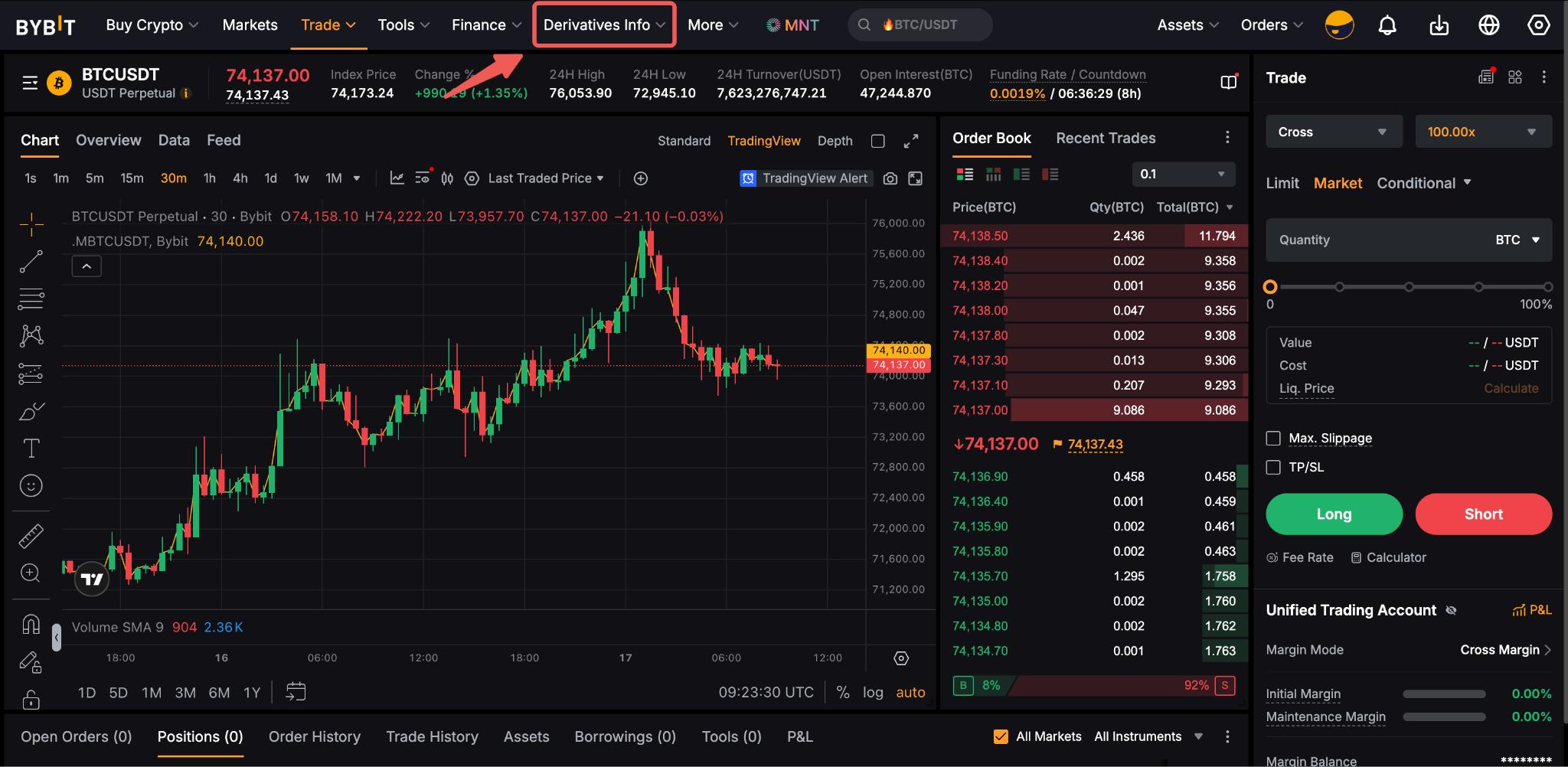
Spot, futures, and options fees
Bybit's published standard VIP 0 fee schedule provides the following baseline rates:
| Market | Maker fee | Taker fee |
|---|---|---|
| Spot | 0.1000% | 0.1000% |
| Perpetual and dated futures | 0.0200% | 0.0550% |
| Options | 0.0200% | 0.0300% |
At the standard spot tier, maker and taker fees are identical. A trader placing a passive limit order does not automatically receive a lower percentage fee, although the order may achieve a better execution price.
Futures pricing creates a different incentive.
A maker order adds liquidity to the order book when it rests and subsequently executes. A taker order removes available liquidity, typically by matching against existing orders immediately.
The difference between the two published standard futures rates is 0.035 percentage points.
Consider a trader opening a $40,000 notional BTC perpetual position and later closing the same notional amount.
| Execution method | Opening fee | Closing fee | Total |
|---|---|---|---|
| Maker on both sides | $8 | $8 | $16 |
| Taker on both sides | $22 | $22 | $44 |
This illustration excludes funding payments, price movement, spread, and slippage.
The $28 difference is meaningful for strategies that frequently enter and exit positions. Over repeated transactions, execution costs can materially affect net performance.
However, a maker order offers no guarantee of execution. During a rapidly moving market, the opportunity cost of an unfilled limit order may exceed the fee saved.
Professional execution therefore involves balancing transaction costs against fill probability, market impact, and the urgency of the trade.
VIP fee discounts
Bybit operates a tiered VIP program under which qualifying users may receive reduced trading fees.
Published tiers include progressively lower maker and taker rates for eligible spot and derivatives activity. Qualification may depend on trading volume, asset balances, or other applicable program conditions.
| VIP level | Spot maker/taker | Futures maker/taker |
|---|---|---|
| VIP 0 | 0.1000% / 0.1000% | 0.0200% / 0.0550% |
| VIP 1 | 0.0675% / 0.0800% | 0.0180% / 0.0400% |
| VIP 3 | 0.0625% / 0.0750% | 0.0140% / 0.0350% |
| VIP 5 | 0.0400% / 0.0500% | 0.0100% / 0.0320% |
| Supreme VIP | 0.0300% / 0.0450% | 0.0000% / 0.0300% |
The VIP program is particularly relevant to traders with sustained transaction volumes.
A lower futures taker fee can reduce the cost of strategies requiring immediate execution. Reduced maker fees may be attractive to traders who routinely supply liquidity through resting limit orders.
Nevertheless, the lowest advertised rate should never be confused with the price available to an ordinary account. Supreme VIP pricing is conditional, and a zero maker fee at that tier does not mean futures trading is universally free.
Perpetual futures funding costs
Perpetual futures do not have a conventional expiration date. Instead, funding mechanisms help maintain a relationship between perpetual contract prices and the underlying reference market.
When the funding rate is positive, long positions generally pay short positions. When it is negative, the payment direction generally reverses.
The actual amount depends on the applicable position value, funding rate, and settlement schedule.
A position that remains open for several days can accumulate funding costs exceeding its initial execution fees, particularly during periods of strongly directional market sentiment.
Funding may also become a source of income for the receiving side, but that payment does not eliminate exposure to price movements, basis changes, or liquidation.
For strategies involving extended holding periods, funding history and expected variability deserve at least as much attention as the advertised opening commission.
Borrowing interest and additional expenses
Bybit's spot margin arrangements may involve borrowing interest. Its official documentation describes hourly interest calculations, with rates depending on the borrowed asset and applicable account conditions.
Other costs include bid-ask spreads, market impact, withdrawal charges, and third-party fiat processing fees.
A trader using a market order in a thinly traded altcoin may incur substantially greater effective execution costs than the visible trading commission suggests.
This is why Bybit's competitive futures fee structure should be assessed alongside the liquidity of the specific contract being traded.
Editorial assessment: Bybit's pricing is particularly relevant to active derivatives traders, especially those able to use maker execution efficiently or qualify for higher VIP tiers. Its cost advantage is less clear when funding payments, borrowing interest, or execution slippage dominate the strategy.
For readers comparing potential account benefits, Huayu Exchange's Bybit review includes a dedicated Offers section intended for verified promotions and eligible fee-rebate arrangements. No particular discount or rebate should be assumed without confirmed terms.
3. Liquidity & Market Depth
Liquidity is one of the most consequential factors in evaluating a derivatives exchange, and Bybit's trading-focused positioning makes this dimension especially important.
A liquid market enables participants to enter or exit positions with limited price disruption. That becomes critical when trading leveraged contracts, executing larger orders, or managing positions during sudden volatility.
However, an exchange's reported trading volume does not independently establish how much liquidity is available at a particular moment.
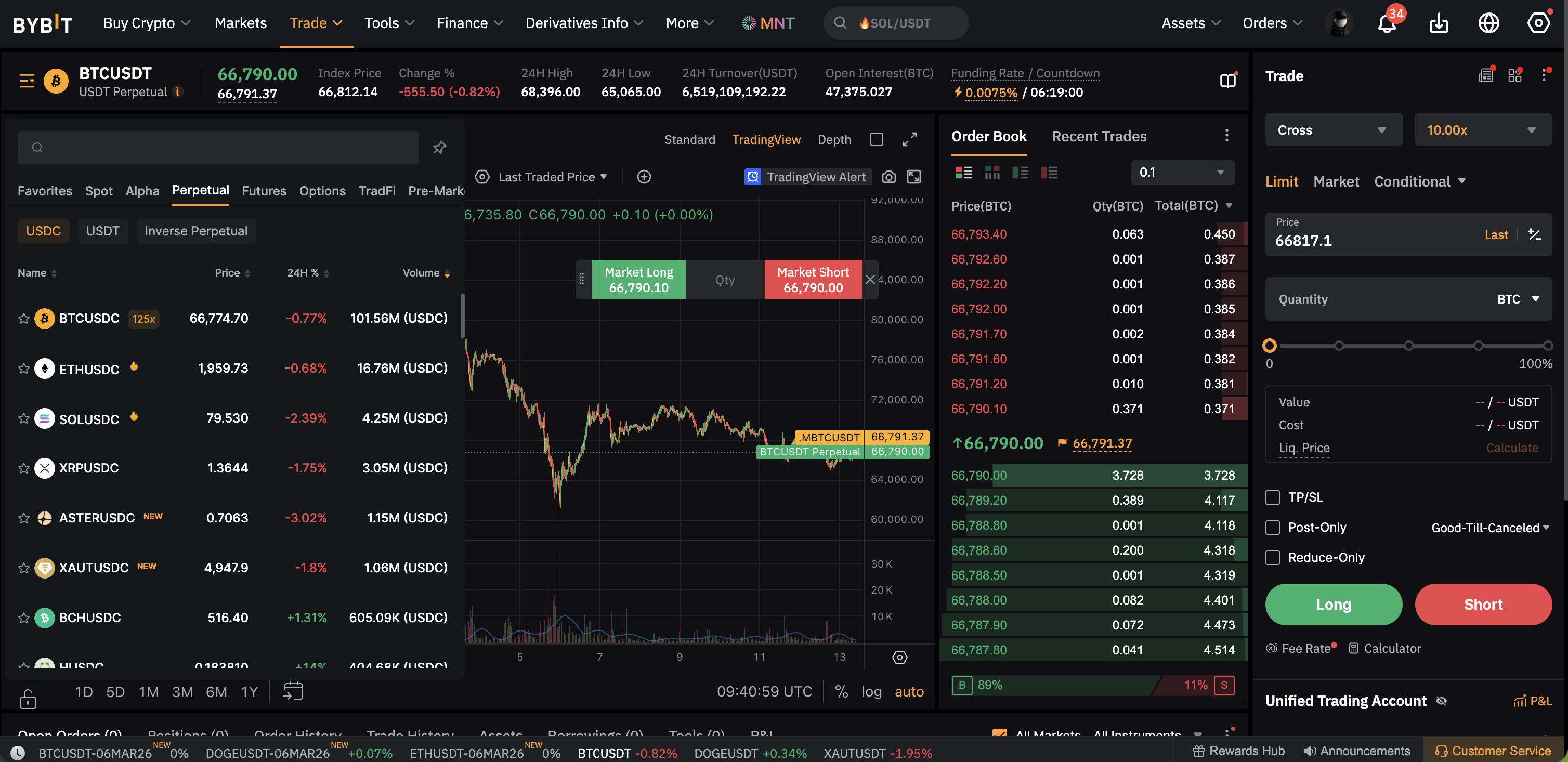
Trading volume is not the same as executable liquidity
A market may report substantial daily turnover while offering relatively limited depth within a narrow range of the best bid and ask.
Four measures deserve separate consideration.
Trading volume describes completed transactions over a specified period.
Open interest measures outstanding derivatives positions. It provides information about market participation and positioning but does not measure available resting orders.
Bid-ask spread measures the difference between the best available buy and sell quotations.
Order book depth indicates the quantity available within defined price intervals.
These metrics describe related but distinct aspects of market structure.
| Metric | What it indicates | What it cannot prove |
|---|---|---|
| 24-hour volume | Trading activity | Current order book depth |
| Open interest | Outstanding derivatives exposure | Immediate execution capacity |
| Bid-ask spread | Quoted transaction friction | Depth for large orders |
| Order book depth | Resting liquidity within a price range | Guaranteed future availability |
| Realized slippage | Actual execution deviation | Performance across all market conditions |
For example, a trader entering a large BTCUSDT perpetual position may exhaust the liquidity available at the best offer.
The remaining order must execute against progressively higher prices, increasing the average entry cost.
Even a relatively small percentage of slippage can become material when the position uses leverage or operates with a narrow expected profit margin.
Mainstream derivatives versus smaller contracts
Bybit's derivatives ecosystem makes it a relevant venue for traders comparing BTC and ETH perpetual markets.
These contracts generally attract more market participation than many smaller cryptocurrency derivatives.
However, it would be inappropriate to assume that every Bybit-listed contract offers comparable execution quality.
Less actively traded contracts can exhibit wider spreads, shallower depth, and greater sensitivity to concentrated order flow.
The distinction becomes particularly important when a trader attempts to close a leveraged position quickly.
A contract may appear attractive because of its price volatility, but that same volatility can be difficult to trade profitably when market impact is substantial.
Liquidity during market stress
Order book conditions can change abruptly.
During sharp market movements, liquidity providers may cancel quotations, widen spreads, or reduce displayed size.
Simultaneously, liquidation activity can increase aggressive order flow.
This combination may create a temporary imbalance in which demand for immediate execution rises precisely when available liquidity falls.
Bybit's advanced trading tools can help users manage order instructions, but they cannot guarantee execution at a predetermined price.
Stop-market orders may experience slippage. Stop-limit orders may remain unfilled if prices move beyond the permitted limit.
These are market structure risks, not necessarily evidence of a malfunctioning exchange.
What can be concluded about Bybit's liquidity?
Bybit's derivatives specialization makes it a serious candidate for traders seeking actively traded perpetual markets.
Its product infrastructure is consistent with the needs of active derivatives participants, but a definitive liquidity ranking would require synchronized comparisons of specific contracts across competing exchanges.
A rigorous test should record the trading pair, observation timestamp, order book depth at defined price bands, spread, and hypothetical execution impact for standardized order sizes.
Verification limitation: No reproducible November 2026 order book snapshot or independent slippage test is available in the research material supporting this draft. Accordingly, this review does not claim that Bybit has the deepest BTCUSDT order book or the lowest execution slippage among major exchanges.
4. Security & Regulatory Compliance
Security is the most consequential qualification in an otherwise strong product-focused assessment of Bybit.
The exchange provides account protection features and reserve transparency mechanisms, but its February 2025 security breach demonstrated that institutional custody arrangements can fail even when transactions involve sophisticated authorization procedures.
Regulatory developments, including Bybit's European authorization, must also be assessed at the level of the specific legal entity and permitted service.
The February 2025 security breach
On February 21, 2025, Bybit suffered a major cryptocurrency theft involving Ethereum-related assets.
On February 26, the United States Federal Bureau of Investigation publicly attributed the approximately $1.5 billion theft to North Korean actors associated with the TraderTraitor activity cluster.
The incident was particularly significant because it involved the asset authorization process rather than a conventional retail-account compromise.
Security investigations described how malicious transaction behavior was introduced through weaknesses in the signing workflow, allowing attackers to redirect assets despite the presence of multisignature authorization.
The broader lesson is important.
Cold storage and multisignature wallets can substantially strengthen asset security, but their effectiveness still depends on the integrity of transaction construction, signing interfaces, operational procedures, and the surrounding software environment.
Multiple approvals do not provide meaningful protection if authorized signers are misled about what they are approving.
How Bybit responded
Following the theft, Bybit publicly reported efforts to restore its affected asset reserves through external liquidity support, institutional arrangements, borrowing, and other asset acquisition measures.
The exchange stated that it had replenished the relevant ETH reserve shortfall within approximately 72 hours.
This response is relevant to assessing operational resilience.
Obtaining substantial liquidity following a major incident requires access to counterparties and financial resources. It also suggests the exchange was able to coordinate an unusually large crisis response.
However, reserve replenishment is not the same as recovery of stolen funds.
Nor does restoring customer asset coverage demonstrate that the original security weaknesses were immaterial.
The appropriate assessment recognizes both the scale of the security failure and the significance of the subsequent recovery measures.
Proof of Reserves
Bybit publishes Proof of Reserves information intended to improve transparency around assets held on behalf of users.
Reserve verification systems may use blockchain addresses, liability calculations, and Merkle-tree mechanisms to allow users to examine whether certain balances are included in a published snapshot.
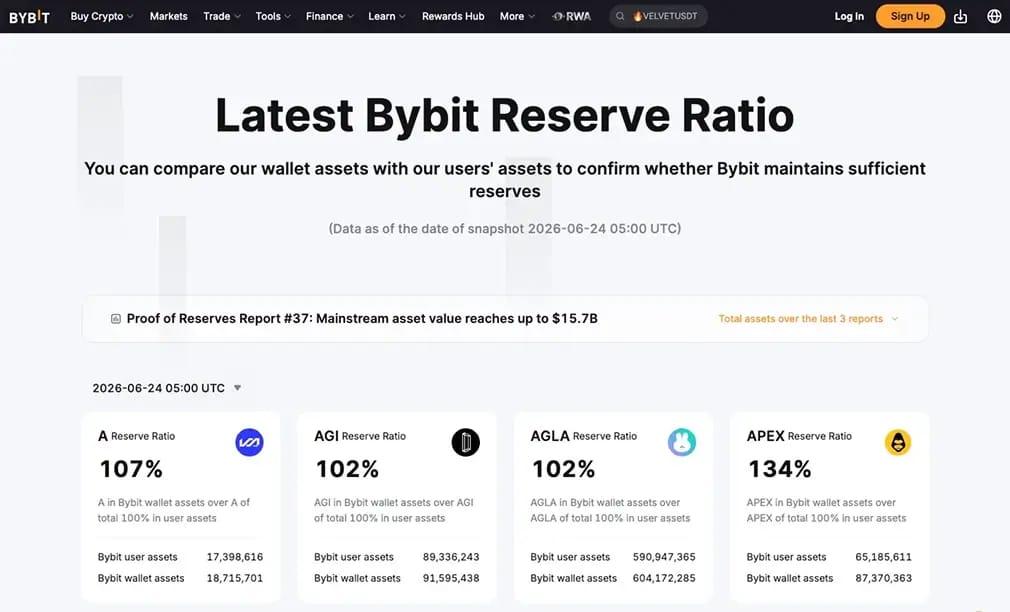
This is useful, but its scope must be understood.
A reserve snapshot does not necessarily establish the completeness of every liability, the absence of undisclosed encumbrances, or the effectiveness of internal controls.
It also does not replace a comprehensive financial statement audit.
An exchange can demonstrate that specified assets existed at a particular time without proving that all future withdrawals will be honored under every market condition.
For Bybit, reserve transparency is especially relevant after the 2025 incident. Nevertheless, historical reserve reports should not be presented as current November 2026 balances.
Account-level protection
Bybit provides account security controls, including authentication and withdrawal-related safeguards.
For active traders, API permissions are another important security boundary.
An API key created for market data or order placement should not receive unnecessary withdrawal privileges.
Similarly, users should distinguish trading capital from assets intended for long-term storage.
Keeping funds on a centralized exchange introduces counterparty and custody exposure that remains present even when an account has strong authentication.
Regulatory status and legal entities
Bybit's regulatory position is not uniform across jurisdictions.
One independently documented development occurred in the European Union.
Austria's Financial Market Authority announced that Bybit EU GmbH received authorization under the Markets in Crypto-Assets Regulation (MiCAR) on May 28, 2025.
The authorization covers specified crypto-asset services, including custody and administration, exchange services, and certain transfer-related activities.
This is a meaningful development for eligible European customers.
It places defined services of the authorized entity within a formal European regulatory framework.
However, the authorization must not be interpreted as a global license covering every Bybit product.
In particular, MiCAR authorization for specified crypto-asset services does not automatically authorize all derivatives activities.
Bybit's European payment-related entities and their authorizations must also be distinguished from the exchange entity providing crypto-asset services.
Geographic restrictions
Bybit's official restricted-jurisdiction policy includes several major markets, among them the United States, mainland China, Hong Kong, Singapore, and Canada.
The exact restrictions can depend on the service, account entity, and applicable terms.
This matters because language accessibility is not equivalent to legal eligibility.
A user may be able to view the exchange's website or documentation without being permitted to register or trade.
Similarly, a user living in an eligible jurisdiction may encounter different product permissions from someone using another Bybit legal entity.
Bybit's regulatory development and sophisticated trading infrastructure are positive considerations, but neither eliminates custody risk or makes the exchange universally available.
5. Products & Trading Features
Bybit's most compelling differentiator is the integration of derivatives products with its Unified Trading Account.
A conventional exchange may offer spot trading, futures, and other products as largely separate experiences. Bybit's account architecture is designed to bring multiple trading activities into a more closely connected capital-management framework.
This is particularly relevant to traders who hold underlying assets, hedge exposures, trade volatility, and automate parts of their execution.
Spot trading
Bybit's spot markets support direct purchases and sales of supported cryptocurrencies.
For a straightforward investor, the basic spot trading experience is familiar: select a market, choose an order type, and exchange one asset for another.
Its additional value emerges when spot holdings form part of a broader trading strategy.
A trader holding ETH, for example, may use an ETH perpetual short position to reduce some of the portfolio's directional exposure without immediately selling the underlying asset.
The effectiveness of that hedge depends on contract size, funding, collateral requirements, and the relationship between spot and derivatives prices.
A hedge can also create new risks if the derivatives position is liquidated before the underlying portfolio recovers.
Bybit provides the tools for these strategies, but their success remains dependent on portfolio construction and execution.
Perpetual and dated futures
Bybit offers several derivatives structures, subject to market and regional availability.
| Product | Core mechanism | Typical application |
|---|---|---|
| USDT perpetual futures | Stablecoin-settled contracts without fixed expiry | Directional trading and hedging |
| USDC perpetual futures | USDC-based settlement | Stablecoin-denominated derivatives exposure |
| Inverse perpetual contracts | Settlement in the underlying cryptocurrency | Coin-denominated position management |
| Dated futures | Contracts with defined settlement dates | Basis and term-structure strategies |
| Options | Nonlinear exposure defined by contract terms | Hedging and volatility strategies |
Perpetual contracts are central to Bybit's identity.
They allow eligible users to obtain long or short exposure without directly purchasing or selling the underlying asset.
However, leverage changes the relationship between collateral and position value.
A relatively small collateral balance may support a much larger notional position, causing price movements to have a magnified effect on account equity.
Inverse contracts introduce additional complexity because the settlement asset itself changes in market value.
For traders measuring performance primarily in stablecoins, this can complicate profit-and-loss calculations.
Unified Trading Account
The Unified Trading Account, commonly called UTA, is one of Bybit's most distinctive features.
Its purpose is to consolidate supported spot, margin, derivatives, and options activities within a unified account framework.
Depending on the applicable margin mode, eligible assets can contribute to account collateral calculations across supported products.
This can reduce the operational friction associated with maintaining separate balances for different strategies.
For example, a trader managing spot holdings and derivatives hedges may be able to use qualifying account collateral more efficiently than under a fully segregated account structure.
The advantage becomes more significant as the number of positions and instruments increases.
However, the system also introduces complexity.
Account equity, collateral value, available margin, initial margin, and maintenance margin are not interchangeable concepts.
Some assets may receive collateral haircuts. Unrealized gains may be treated differently from settled balances, and open positions can restrict the amount available for withdrawal.
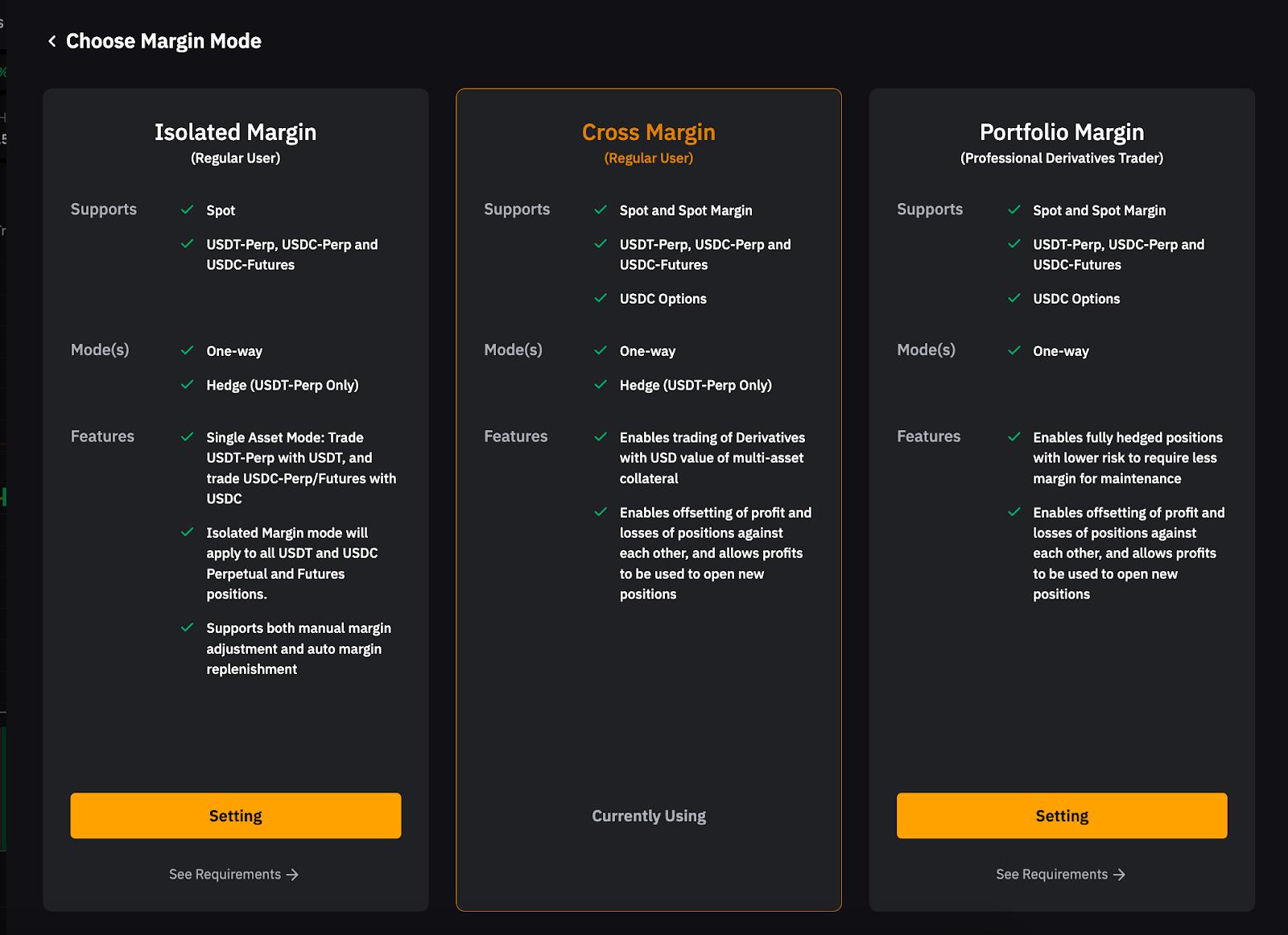
Isolated, cross, and portfolio margin
Bybit's UTA supports different margin approaches.
| Isolated (Margin mode) | Position-focused risk allocation: Margin is allocated to specific positions, making the immediate capital commitment easier to identify and manage. |
|---|---|
| Cross (Margin mode) | Shared account collateral: Eligible account collateral can support multiple positions, potentially improving flexibility while exposing more account equity to losses. |
| Portfolio (Margin mode) | Risk-based margin calculation: Eligible positions are assessed using portfolio risk methodology, potentially recognizing offsets between related instruments. |
Portfolio margin is especially relevant to sophisticated derivatives strategies.
Consider a portfolio combining ETH spot exposure, an ETH futures hedge, and options positions.
The portfolio's overall risk cannot be determined by simply adding the standalone notional amounts of every position.
Some exposures may offset one another, while others introduce sensitivity to volatility, time decay, or changes in the relationship between instruments.
A portfolio margin framework can recognize certain qualifying offsets and adjust collateral requirements accordingly.
But margin efficiency should not be mistaken for risk elimination.
Correlations can change abruptly, and a portfolio that appears hedged under normal conditions may experience unexpected losses during extreme market movements.
For a trader using only one futures position, isolated margin may provide a simpler operational framework.
For a professional managing several interrelated instruments, portfolio margin may offer a more meaningful capital-efficiency advantage.
Advanced order execution
Bybit supports trading instructions designed to give users greater control over execution and position management.
One particularly useful example is the Reduce-Only order.
A Reduce-Only instruction is intended to prevent an order from increasing or reversing an existing position.
Suppose a trader places a limit order to close a short position but subsequently exits through a separate stop order.
Without appropriate safeguards, the original closing order could potentially create unintended exposure if it remains active.
Reduce-Only helps address that problem by restricting the order's effect on the existing position.
Other order-management capabilities, including take-profit and stop-loss functionality, help traders define execution rules in advance.
These tools are valuable, but they do not guarantee a particular exit price.
A stop-market order prioritizes execution after triggering, potentially accepting slippage. A stop-limit order constrains the permitted price but may not execute.
Understanding that distinction is essential when trading leveraged products.
Options trading
Options broaden Bybit's derivatives offering beyond straightforward long and short futures exposure.
An option's value depends on several factors, including the underlying asset price, strike, expiration, and implied volatility.
This allows traders to construct strategies that respond differently to directional movements, volatility changes, and the passage of time.
A purchased call option, for example, provides upside exposure while generally limiting the buyer's direct loss on that option to the premium and associated costs.
Selling options introduces a different risk profile, potentially including losses substantially greater than the premium received.
Options can be useful for hedging, volatility trading, and multi-leg portfolio construction.
However, the existence of an options market does not establish that every strike and expiry offers sufficient liquidity.
Traders must consider spreads, available depth, margin rules, and the practical cost of entering and unwinding multi-leg positions.
Trading bots
Bybit offers automated trading tools designed to execute predefined strategies.
These include spot grid, futures grid, and recurring-purchase strategies, with availability depending on the product and region.
A spot grid strategy places orders across a defined price range, attempting to capture repeated price fluctuations.
A futures grid applies similar logic to leveraged derivatives, introducing liquidation and funding considerations.
A dollar-cost averaging strategy purchases an asset at scheduled intervals according to predefined parameters.
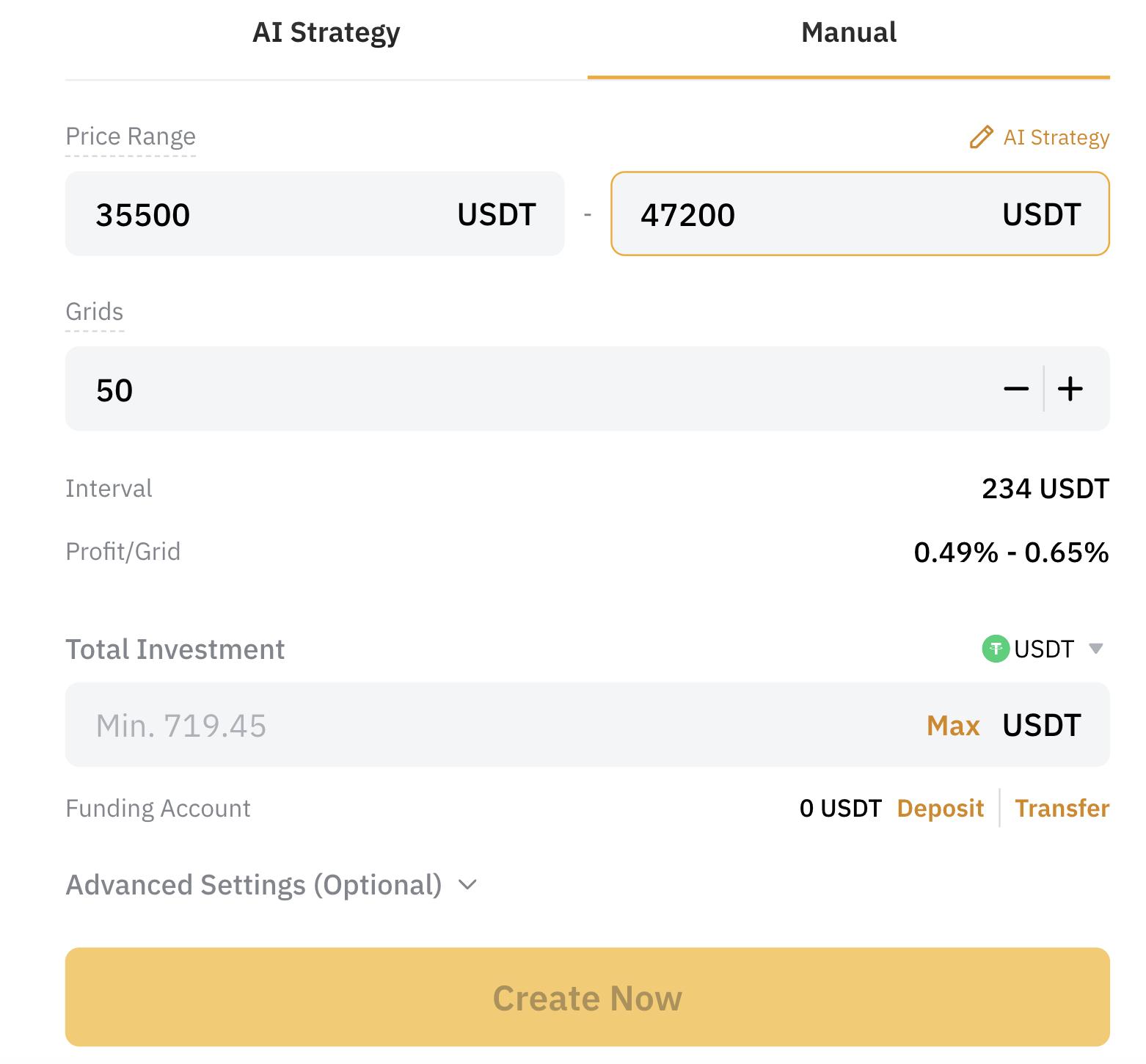
Each addresses a different trading problem.
Grid strategies reduce the need to place repetitive orders manually, while recurring purchases help standardize the timing and amount of asset accumulation.
But automation does not create a profitable strategy by itself.
A grid configured for sideways markets may perform poorly during a sustained trend. Leveraged grid strategies may accumulate increasingly unfavorable exposure.
Likewise, recurring purchases can reduce timing dependence without protecting against a prolonged decline in the underlying asset.
The relevant evaluation questions are strategy assumptions, risk limits, transaction costs, and stopping conditions.
Copy trading
Bybit also offers copy trading functionality through which eligible users can follow trading activity associated with selected lead traders.
The appeal is operational simplicity: followers can participate in strategies without independently entering every order.
However, copying trading activity does not guarantee identical performance.
Differences in account balances, execution timing, leverage, slippage, and position allocation can produce different results.
A lead trader may avoid liquidation while a follower with different account parameters experiences a forced exit.
Historical performance figures should therefore be interpreted alongside drawdown, concentration, leverage, and the consistency of the underlying strategy.
Copy trading is most useful when followers understand what is being replicated and retain meaningful control over their own risk exposure.
API and algorithmic trading
Bybit provides API infrastructure for developers and systematic traders.
APIs can support market-data retrieval, automated order submission, position monitoring, and execution management.
For a professional trading operation, the important questions extend beyond whether an API exists.
Rate limits, WebSocket behavior, order acknowledgments, error handling, and recovery after disconnections all influence reliability.
Execution-sensitive strategies must also account for network latency and changes in order book conditions between signal generation and order confirmation.
This review does not claim independently measured API latency or throughput.
Bybit's API ecosystem is relevant to systematic traders, but a production trading system should be evaluated against the specific endpoints, limits, and failure conditions it intends to use.
6. Language Support & User Experience
Bybit serves an international audience through a multilingual platform and documentation environment.
Its user experience is best evaluated in the context of the tasks it is designed to support: derivatives execution, portfolio monitoring, collateral management, and automated strategy configuration.
A trading-oriented interface
Bybit's interface provides access to charts, order books, position information, order controls, and account metrics.
For experienced derivatives traders, the ability to view these elements together can be more important than a visually minimal design.
A trader monitoring multiple positions may need to examine unrealized profit and loss, maintenance margin, funding information, and pending orders within the same workflow.
Bybit's product architecture supports this kind of active account management.
The trade-off is complexity.
New users may find the distinction between wallet balances, account equity, available margin, and withdrawable funds difficult to understand initially.
These are not merely interface labels; they represent different financial calculations.
Unified accounts improve workflow but increase responsibility
UTA reduces some of the friction associated with moving funds between separate trading accounts.
That convenience becomes valuable when traders maintain multiple positions or strategies.
However, it also makes account-level risk awareness more important.
A user may see substantial account equity while having relatively little available collateral because existing positions and orders consume margin.
Collateral haircuts and unrealized losses can further change account risk.
The interface must therefore be understood as a portfolio risk dashboard, not simply a wallet balance display.
Mobile and desktop trading
Bybit supports both browser-based and mobile trading workflows.
Mobile access is useful for monitoring positions, reviewing market conditions, receiving notifications, and making routine adjustments.
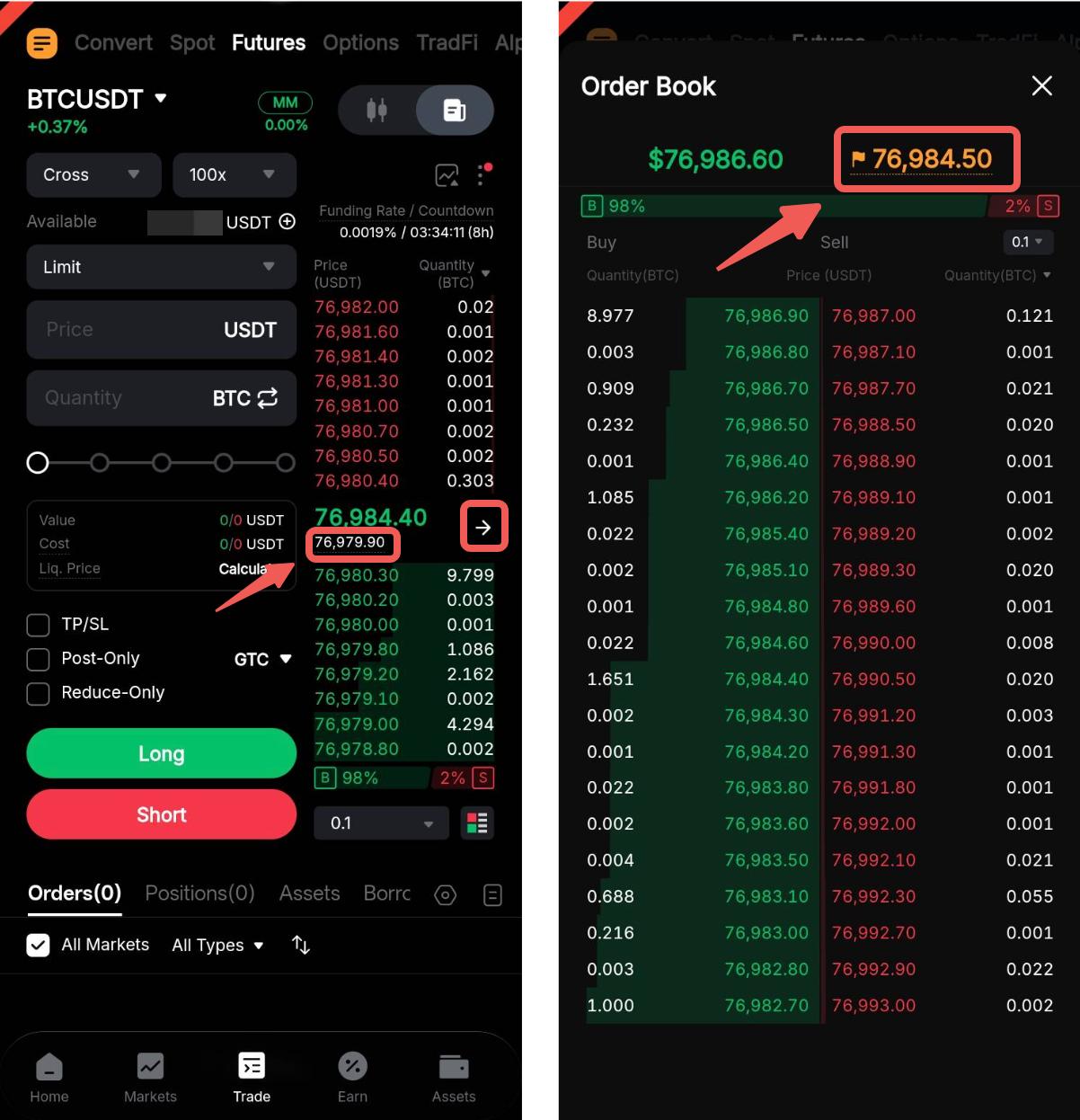
Desktop trading is generally better suited to workflows requiring several charts, order books, and portfolio indicators simultaneously.
For active derivatives traders, screen space and the visibility of risk metrics can have a direct operational benefit.
This review does not include independent device-specific performance testing, so it does not assign unsupported rankings for application responsiveness, stability, or order-entry speed.
Customer support and localization
Bybit offers multilingual support resources, including English and Chinese-language documentation.
However, the availability of translated interfaces should not be confused with identical customer service arrangements across all jurisdictions.
Service eligibility, supported payment methods, and available products can differ according to the relevant legal entity and account location.
For international users, Bybit's strongest usability advantage is its integrated trading workflow rather than the simplicity of its onboarding experience.
Its advanced functionality is particularly valuable once users understand the account and margin concepts underlying the interface.
7. Community Reputation & User Adoption
Bybit's reputation is closely connected to its derivatives products and trading-oriented ecosystem.
Unlike exchanges whose public identity primarily centers on early token listings or social trading, Bybit is frequently considered in discussions involving perpetual futures, advanced order execution, margin efficiency, and trading automation.
However, community visibility and actual user adoption are different measures.
Bybit and Red Bull Racing: A Former F1 Partnership
Bybit entered a three-year partnership with Oracle Red Bull Racing in 2022, bringing its brand into one of the world's most visible motorsport competitions.
The agreement gave Bybit exposure through Formula 1 team branding and related promotional activities, providing a way to reach audiences beyond cryptocurrency trading.
However, the partnership expired after the 2024 Formula 1 season. Bybit should therefore be described as a former Red Bull Racing partner, not a current sponsor.
The distinction matters because a high-profile sponsorship can remain prominent in search results long after the commercial relationship has ended.
Product relevance and trader attention
Bybit's derivatives features create several natural areas of user interest.
Active traders may focus on funding rates, maker/taker costs, execution behavior, and liquidation mechanics.
Portfolio-oriented traders may be more interested in UTA collateral rules and the treatment of hedged positions.
Users exploring automation may compare grid bots, copy trading, and API-based strategies.
These are identifiable use cases based on the exchange's product offering, not a quantified ranking of community discussion topics.
The effect of the 2025 security incident
The February 2025 theft is an important historical factor in evaluating Bybit's reputation.
Custody failures can affect user confidence even when trading infrastructure continues operating.
Bybit's subsequent reserve replenishment and crisis-response disclosures provide relevant context, but they do not establish that every user considered the matter resolved.
A balanced reputation assessment should distinguish verified operational events from individual sentiment.
The incident is a documented fact. Claims about the percentage of users who lost confidence or subsequently returned would require independent research.
Interpreting online reviews
Cryptocurrency exchange discussions often contain affiliate promotions, referral incentives, and campaign-related content.
Positive reviews may reflect genuine satisfaction, commercial incentives, or both.
Negative reports can also vary considerably in evidentiary quality.
For example, a withdrawal complaint may involve a blockchain delay, an unsupported network, an account verification issue, or an actual platform processing problem.
Without the relevant transaction details, these situations should not be treated as equivalent.
The most useful community evidence is specific, dated, and reproducible.
8. Deposits & Withdrawals
Bybit supports cryptocurrency deposits and withdrawals across eligible assets and blockchain networks, alongside selected fiat purchasing and payment services.
For derivatives traders, the funding process matters because capital may need to move between external wallets, exchange accounts, and margin-supported positions.
Cryptocurrency deposits
Bybit generally does not charge a separate platform fee for standard cryptocurrency deposits, although network costs may apply to the sending transaction.
Users must select a supported asset and blockchain network.
A cryptocurrency such as USDT may exist on multiple networks, but not every network is necessarily available for every account or at every moment.
Incorrect network selection can cause funds to become inaccessible or require a recovery procedure that may not be available.
Some assets also require a destination tag or memo.
The practical considerations include minimum deposit requirements, network confirmation thresholds, and temporary maintenance restrictions.
Cryptocurrency withdrawals
Bybit displays applicable withdrawal fees and minimum amounts according to the selected asset and network.
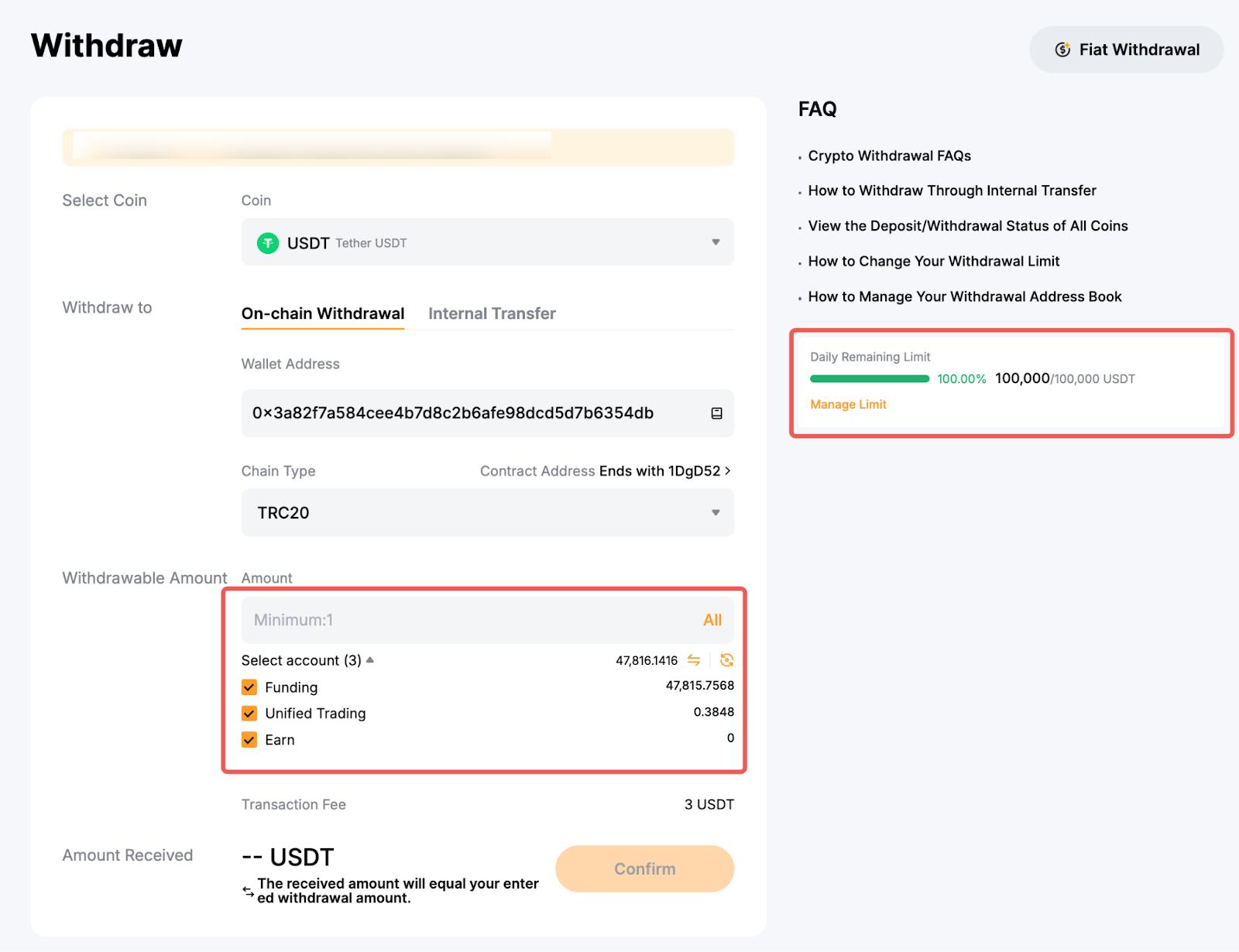
Withdrawal fees are commonly specified as fixed amounts for a particular network rather than as a percentage of the total withdrawal.
This means that a fixed network fee has a proportionally larger impact on a small withdrawal than on a large one.
Users should also confirm that the receiving wallet or exchange supports the selected network.
Choosing a cheaper blockchain is not beneficial if the destination cannot correctly receive the asset.
Source: Bybit Crypto Withdrawal FAQ.
Identity verification and withdrawal limits
Bybit's published identity-verification framework requires users to complete the applicable standard verification level for access to its services.
Additional verification may be required for higher limits or particular products.
Actual withdrawal eligibility can depend on verification status, account security changes, risk reviews, and applicable regional rules.
A published maximum withdrawal allowance should not be interpreted as a guaranteed immediately available limit for every account.
UTA and withdrawable balances
One important feature of Bybit's funding workflow is the relationship between account collateral and available withdrawals.
Assets supporting open positions may not be fully withdrawable.
Removing collateral can change the account's margin ratio and potentially increase liquidation risk.
A trader with a large total account balance may therefore have a smaller amount available for transfer.
This distinction is particularly relevant when using cross or portfolio margin.
Fiat funding and P2P services
Bybit offers certain fiat-related services through supported payment arrangements and third-party providers.
Availability depends on the jurisdiction, payment method, currency, and relevant service provider.
P2P trading introduces additional counterparty and payment-dispute considerations.
The existence of fiat funding options should not be interpreted as universal support for local bank transfers or payment cards.
For users primarily operating in cryptocurrency markets, supported on-chain transfers may provide the most straightforward funding route, provided the asset and network requirements are met.
Verification limitation: No live deposit or withdrawal was performed for this review. Processing times and transaction reliability are therefore described from published platform procedures, not personal transaction testing.
9. Who Is This Exchange Best Suited For?
Bybit is best understood as a trading platform for users who need derivatives functionality and integrated account management.
Its advantages become more meaningful as the complexity of a trading strategy increases.
Active perpetual futures traders
This is Bybit's clearest target audience.
Traders who regularly use BTC, ETH, or other eligible perpetual contracts may benefit from its maker/taker pricing, conditional orders, and position management tools.
The exchange is particularly relevant to strategies requiring frequent execution, partial position adjustments, or systematic risk controls.
The final choice should still depend on the liquidity and effective execution costs of the specific contract.
Multi-asset and hedging-oriented traders
Bybit's UTA is well suited to eligible users who manage spot assets alongside derivatives positions.
A trader combining long-term holdings with short-term hedges may benefit from a unified account structure.
Cross-margin and portfolio-margin functionality can provide additional flexibility when used with a sound understanding of collateral and liquidation mechanics.
These benefits are more substantial for users managing several instruments than for those making occasional spot purchases.
Options and volatility traders
Bybit's options offering makes it relevant to users who trade volatility, construct multi-leg positions, or seek alternatives to linear futures exposure.
Options can support strategies with different risk profiles and settlement characteristics.
Professional users will need to examine contract liquidity, spreads, margin requirements, and expiry-specific conditions before determining whether the venue suits their strategies.
Systematic and automated traders
Bybit's bots and API infrastructure can appeal to traders who prefer predefined execution rules.
Grid strategies, scheduled purchases, and custom algorithmic systems address different needs.
The common benefit is reduced dependence on repetitive manual order entry.
The quality of the trading strategy, however, remains separate from the reliability of its automation.
Copy trading participants
Bybit may also appeal to users interested in following selected traders while managing their own allocation parameters.
Its copy trading system provides a framework for replicating activity, but the follower's realized performance can differ from the lead trader's results.
Users who understand drawdown, leverage, and execution differences are better positioned to evaluate the feature responsibly.
10. Final Verdict: Is Bybit Worth Using?
Bybit's strongest proposition is not simply access to leveraged cryptocurrency trading. It is the integration of perpetual futures, dated contracts, options, execution tools, and multi-asset margin management into a connected trading environment.
The Unified Trading Account is central to that proposition.
For eligible traders managing multiple positions or combining spot and derivatives exposure, the account structure can reduce operational friction and potentially improve capital efficiency.
Its published futures pricing, advanced order functionality, and automation tools strengthen its relevance to active market participants.
However, the exchange's February 2025 security breach remains a major consideration. The subsequent replenishment of reserves demonstrated an important operational response, but it did not erase the underlying custody risk.
Regulatory eligibility is another decisive factor. Authorizations held by specific Bybit entities apply only within their defined legal scope, and the platform is unavailable in several significant jurisdictions.
Huayu Exchange's editorial verdict is that Bybit deserves serious consideration from experienced cryptocurrency derivatives traders, particularly those who value integrated margin management and a broad selection of trading instruments.
For traders whose strategies genuinely benefit from those capabilities, Bybit offers more than a conventional spot exchange. Its value lies in the interaction between products, execution tools, and account architecture.
Eligible users can explore the exchange's official product offering and consult the Offers section of Huayu Exchange's Bybit review for any currently verified registration promotions or fee-rebate opportunities.
Source & Main References
- Bybit Official Website — Spot trading, derivatives, Unified Trading Account, and other trading products.
- Bybit Help Center — Trading fees, contract rules, account modes, KYC requirements, and deposit and withdrawal procedures.
- Bybit API Documentation — V5 API, order management, market data, and algorithmic trading interfaces.
- Bybit Unified Trading Account Official Guide — Official documentation covering the Unified Trading Account, cross-currency margin, and portfolio margin mechanisms.
- Bybit Official Trading Fees and VIP Tiers — Reference information for spot, perpetual futures, dated futures, and options trading fees.
- Bybit Proof of Reserves Reports — Official reserve disclosures and user asset verification mechanisms.
- Bybit Security Incident Timeline and Investigation Materials — Information on the February 2025 security breach, emergency response measures, and subsequent restoration of asset reserves.
- Bybit Regulatory and Compliance Information — Information on operating entities, regulatory licences, and jurisdictional restrictions.
Affiliate Disclosure: Huayu Exchange may earn commissions through affiliate links to certain trading platforms. Our reviews are based on independent research and publicly available information. Commercial partnerships do not constitute guarantees of exchange security or investment returns.
Risk Disclaimer: Crypto assets and leveraged derivatives involve price volatility, liquidity risk, custody risk, and the risk of forced liquidation. This article is provided for informational and research purposes only and does not constitute personalised investment advice.


