 Bitget
 Review: Inside the Copy-Trading Ecosystem
 HuaYu ExchangePublished Updated
Bitget is best known for its copy trading features and automated trading bots. With spot trading, perpetual futures, and a range of trading tools, Bitget appeals to users who want to follow experienced traders' strategies or automate their own trading activities.
Founded in 2018, Bitget is a cryptocurrency exchange that has built its reputation around futures trading and copy trading. Unlike exchanges that primarily compete on the number of listed cryptocurrencies or spot trading volume, Bitget places greater emphasis on connecting experienced traders, their strategies, and everyday users through integrated trading tools. Copy trading has become a central part of the platform's offering rather than simply an additional feature.
In recent years, Bitget has expanded beyond its core trading services to become a more comprehensive trading platform. Alongside spot trading, perpetual futures, and trading bots, it has introduced a broader ecosystem that includes Web3 wallets, tokenized assets, and products linked to traditional financial markets. Bitget refers to this strategy as its Universal Exchange (UEX) model, aiming to bring different asset classes and trading opportunities together within a single ecosystem.
For users interested in futures trading, exploring strategies developed by experienced traders, or automating parts of their trading activity, Bitget offers a well-rounded set of tools. However, copy trading does not eliminate market risk, and the major security incident the platform experienced in September 2026 raises important questions about asset custody and risk management that prospective users should carefully consider.
- Comprehensive copy trading features supporting both spot and futures strategies.
- Dedicated copy trading accounts with flexible capital allocation and profit-sharing mechanisms.
- Futures trading, trading bots, and strategy tools that work together within the same platform.
- Publicly available Proof of Reserves (PoR) with tools for verifying asset holdings.
- An expanding product ecosystem covering Web3 and selected traditional finance-related assets.
- Experienced a major security incident in September 2026, with estimated losses of approximately $387.5 million.
- Some traders' historical returns may not accurately reflect their underlying risk exposure.
- Services and trading products are restricted or unavailable in certain countries and regions.
Detailed Review
1. Bitget Platform Overview
| Field | Bitget Details |
|---|---|
| Platform Name | Bitget |
| Founded | 2018 |
| KYC Requirements | Identity verification required |
| Main Trading Products | Spot trading, perpetual futures, delivery futures, spot and futures copy trading, and selected TradFi-related products |
| Regulation & Compliance | El Salvador CNAD registration; Australia AUSTRAC and South Africa FSCA entries recorded in Huayu Ranking, with independent verification pending |
| Standard Futures Maker Fee | 0.02% |
| Standard Futures Taker Fee | 0.06% |
| Maximum Trading Leverage | Up to 125x on the specified BTCUSD Coin-M perpetual contract; limits vary by product |
| Trading & Strategy Tools | Copy Trading, Elite Portfolio, Spot Grid, Futures Grid, Auto-Invest, and Signal Bot |
| Deposit & Withdrawal Methods | Cryptocurrency deposits and withdrawals; P2P, bank transfers, cards, and third-party payment options where supported |
| Quick Verdict / Best For | Best suited to traders interested in futures, copy trading, and automated strategies, particularly those comfortable managing leveraged positions |
| Official Website | bitget.com |
2. Trading Fees
Bitget's standard futures fee structure is straightforward: 0.02% for maker orders and 0.06% for taker orders. The more important question is how those fees affect actual returns when traders use copy trading, enter and exit positions frequently, or hold perpetual futures over longer periods.
This is where evaluating Bitget differs from assessing a conventional spot-focused exchange. Copy trading is a core part of the platform, and followers may incur profit-sharing costs in addition to standard trading fees. A trader's advertised historical return is not necessarily the return a follower will take home.
2.1 Standard Spot and Futures Trading Fees
According to Bitget's official fee guidance published on August 20, 2026, and the standard futures fees recorded in HuaYu's CEX Ranking, the baseline rates are:
| Trading Market | Maker Fee | Taker Fee |
|---|---|---|
| Spot trading | 0.10% | 0.10% |
| Futures trading | 0.02% | 0.06% |
| Category | Maker Fee (%) | Taker Fee (%) |
|---|---|---|
| Spot | 0.1 | 0.1 |
| Futures | 0.02 | 0.06 |
For regular spot accounts, maker and taker fees are identical. Switching from a market order to a limit order therefore does not automatically reduce the standard fee, although limit orders can still give traders greater control over their execution price.
The difference is more significant in futures trading. The standard taker fee is three times the maker fee, making order execution especially relevant for active traders.
Consider a futures position with a notional value of 20,000 USDT. Assuming both entry and exit have the same notional value:
| Execution Method | Entry Fee | Exit Fee | Total Trading Fees |
|---|---|---|---|
| Maker on entry and exit | 4 USDT | 4 USDT | 8 USDT |
| Taker on entry and exit | 12 USDT | 12 USDT | 24 USDT |
These figures exclude funding payments, slippage, and other applicable costs.
A trader who repeatedly enters and exits with market orders can see fees steadily erode the profits of a short-term strategy. Where the expected profit per trade is small, execution costs may determine whether the strategy is profitable at all.
That does not mean maker orders are always preferable. A limit order may remain unfilled during a fast-moving market, and traders may eventually need to cross the spread to execute.
The objective should be to minimize total execution cost, not simply to obtain the lowest advertised maker fee.
2.2 VIP Tiers and BGB Fee Discounts
Bitget offers tiered trading fees. Depending on the applicable program, trading volume, account assets, and BGB holdings may affect a user's fee tier or discount eligibility.
Bitget's published fee schedule lists standard VIP 0 spot fees of 0.10% for both maker and taker orders. Eligible users who pay fees using BGB may qualify for a reduced rate of 0.08%.
For a 10,000 USDT spot transaction:
| Fee Scenario | Rate | Fee per Trade |
|---|---|---|
| Standard VIP 0 spot fee | 0.10% | 10 USDT |
| Eligible BGB discount | 0.08% | 8 USDT |
| Savings | 0.02 percentage points | 2 USDT |
If the entry and exit trades both qualify and each has the same notional value, the total saving would be 4 USDT.
That difference may be modest for occasional traders, but it becomes more meaningful when repeated across a large number of monthly transactions.
BGB discounts, VIP fee tiers, and promotional offers have separate eligibility rules. Traders should not assume that discounts can be stacked or that a spot trading discount automatically applies to every futures product.
For higher-volume traders, the fee tier they can realistically maintain is often more useful than the lowest promotional rate displayed on a marketing page.
2.3 Perpetual Futures Funding Fees
Funding payments are one of the main costs that distinguish perpetual futures from spot trading.
According to Bitget's futures fee documentation, funding is calculated using the position's notional value and the applicable funding rate. Some contracts use an eight-hour funding interval, although settlement schedules can differ by product and market conditions.
When the funding rate is positive, long positions generally pay short positions. When it is negative, short positions generally pay long positions.
Suppose a trader holds a long position worth 30,000 USDT and the funding rate at settlement is +0.01%.
30,000 x 0.01 % = 3 USDT
If the position maintains the same notional value across three funding settlements and the rate remains +0.01% each time, the cumulative payment would be 9 USDT.
In practice, both funding rates and position values can change. It would therefore be misleading to take a single observed rate and extrapolate it across several days as though future payments were fixed.
For intraday traders, funding costs depend partly on whether positions remain open at the relevant settlement times. For traders holding positions over multiple days, cumulative funding can become a significant part of the overall return.
This is particularly important when market positioning becomes heavily concentrated in one direction.
2.4 Copy Trading: Why a Profitable Lead Trader May Produce Lower Returns for Followers
Copy trading deserves separate attention when evaluating Bitget's costs.
In futures copy trading, followers replicate trading actions. They do not automatically receive the same returns that a lead trader has already achieved.
Differences in execution timing, fill prices, position sizing, and account costs can produce materially different results, even when the lead trader and follower eventually close positions in the same direction.
A follower's costs may include standard futures trading fees, funding payments, execution slippage, and profit sharing with the Elite Trader when applicable.
Bitget's updated futures copy trading documentation also identifies insufficient balances, slippage limits, and order restrictions as potential reasons why a copy trade may fail.
This means a follower can experience a different return from the lead trader, and some trades may not be copied at all.
For illustration, consider a copy trading account that generates 150 USDT in gross trading profit but retains only 108 USDT after all applicable costs.
| Item | Amount |
|---|---|
| Gross trading profit | +150 USDT |
| Combined trading costs and profit sharing | −42 USDT |
| Net profit retained by the follower | 108 USDT |
Illustrative calculation only. The approved source does not preserve a breakdown of the 42 USDT into individual fee categories.
Looking only at the lead trader's gross return would overstate the follower's actual result.
Two followers copying the same trader may also achieve different outcomes because of their account balances, copying modes, execution restrictions, and the point at which they begin following the strategy.
When evaluating an Elite Trader, historical ROI should therefore be considered alongside follower profitability, drawdowns, and the rules governing profit sharing.
2.5 High-Water Mark: How Copy Trading Profit Sharing Works
Bitget's updated futures copy trading system uses a high-water mark mechanism to calculate eligible profit sharing.
The basic principle is to avoid charging profit sharing repeatedly on the same previously settled gains.
Suppose a follower's account has already completed profit-sharing settlement on 100 USDT in cumulative net profit. The account subsequently loses 60 USDT and later earns that 60 USDT back.
At that point, the account has merely recovered to its previous profit level. Under the high-water mark principle, that recovery does not represent new profit above the previously settled benchmark.
Additional eligible profit beyond that benchmark may generate a new profit-sharing amount.
This approach is more consistent with cumulative account performance than charging a share of every profitable trade independently.
However, a high-water mark does not require the lead trader to reimburse followers for losses, nor does it guarantee that losses will eventually be recovered.
According to Bitget's January 2026 futures copy trading guidance, profit sharing is generally settled at 00:00 (UTC+8) each day, provided the relevant positions have been fully closed. Stopping a copy trading relationship or being removed by the lead trader may also trigger settlement.
Followers should not assume that displayed profits are already fully settled or immediately withdrawable while positions remain open.
2.6 Do Trading Bots Charge Additional Fees?
Bitget offers automated trading tools, including spot and futures grid bots.
These tools execute orders according to predefined rules, but automation does not eliminate ordinary trading costs.
A spot grid bot may repeatedly buy and sell within a selected price range. Every executed trade can incur the applicable trading fee. If the grid spacing is too narrow, the profit from an individual price movement may be insufficient to cover those costs.
Futures grid strategies may also incur funding payments and are subject to leverage and margin requirements.
The number of completed grid trades is therefore not a reliable measure of profitability on its own. What matters is the strategy's overall result after fees and changes in the value of its holdings.
Bitget provides separate fee guidance for copy trading, bots, and other products. Any additional subscription, service, or settlement charge should be checked against the terms of the specific product rather than assumed to apply universally.
2.7 Where Does Bitget Offer a Cost Advantage?
Bitget publishes clear standard futures maker and taker rates, but the figures alone do not establish that it is cheaper than competing exchanges in every trading scenario.
Futures traders who regularly provide liquidity may benefit from the difference between maker and taker fees. Spot traders may reduce costs through eligible BGB discounts or VIP tiers.
For copy trading users, however, the most meaningful figure is the return remaining after trading fees, funding payments, execution differences, and profit sharing.
That is the key distinction in Bitget's cost structure: it makes strategy replication more accessible, but the convenience of copying another trader does not make the underlying execution free.
Readers can review verified registration and trading fee promotions in the Offers tab on HuaYu Exchange's Bitget review page. Eligibility and promotional conditions depend on the applicable terms.
3. Liquidity and Market Depth
Bitget's trading activity is particularly concentrated in derivatives. For traders primarily interested in futures and copy trading, total trading volume is only the starting point. The more important question is whether the order book can absorb incoming orders without forcing execution prices too far away from expectations.
This distinction matters especially for Bitget. A discretionary trader needs to account for their own order execution. A copy trading system must also account for differences between a lead trader's execution and the orders placed by multiple followers.
A strategy that works well with a relatively small account may become more expensive to execute as the amount of capital following it increases.
3.1 Trading Activity: Derivatives Are Bitget's Main Market
Bitget's derivatives market is a major source of its trading activity.
Two metrics are particularly useful when evaluating its scale: 24-hour trading volume and open interest.
Trading volume measures the cumulative value of completed transactions over a rolling period. The same capital can be used to open and close positions repeatedly, so a high volume figure does not necessarily mean an equivalent amount of new money has entered the market.
Open interest measures the outstanding value of positions that have not yet been closed. It helps indicate the amount of active derivatives exposure but does not represent immediately executable liquidity.
A market can have substantial open interest and still experience thin order books at certain price levels.
For futures traders, a more complete assessment should combine trading volume, open interest, bid-ask spreads, and order book depth.
3.2 BTC and ETH Futures: Trading Activity Is Concentrated in Major Assets
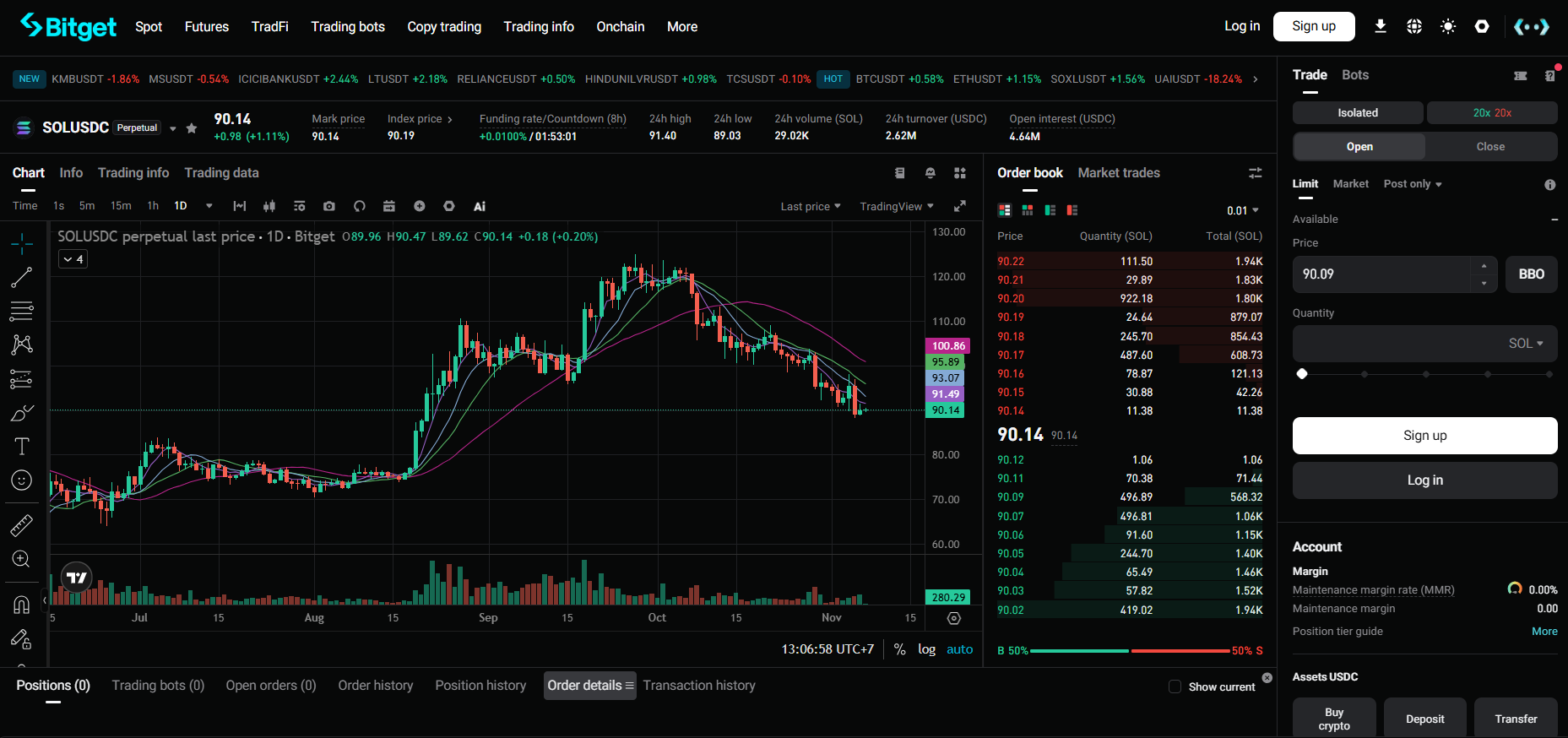
BTC/USDT and ETH/USDT futures are useful benchmarks for evaluating Bitget's derivatives liquidity.
In the CoinGecko observation cited in the approved Chinese review, these two contracts generated approximately $6.432 billion in combined 24-hour trading volume, representing around 51.6% of the reported Bitget Futures total at that time.
This indicates a substantial concentration of trading activity in the two largest cryptocurrencies.
Active BTC and ETH markets generally provide more opportunities for buyers and sellers to transact. However, high trading volume does not guarantee that an order of any size can be executed at a single price.
A large market order can consume liquidity across several order book levels, particularly during sharp price movements.
This becomes more important in copy trading. The lead trader's historical position sizes may be much smaller than the combined capital of their followers. As more accounts attempt to replicate the same trades, execution costs may increase.
3.3 Spot Order Book Depth: Differences Between BTC, ETH, and Smaller Assets
CoinGecko's spot market data includes bid-ask spreads and the cumulative value of orders within 2% of the market price.
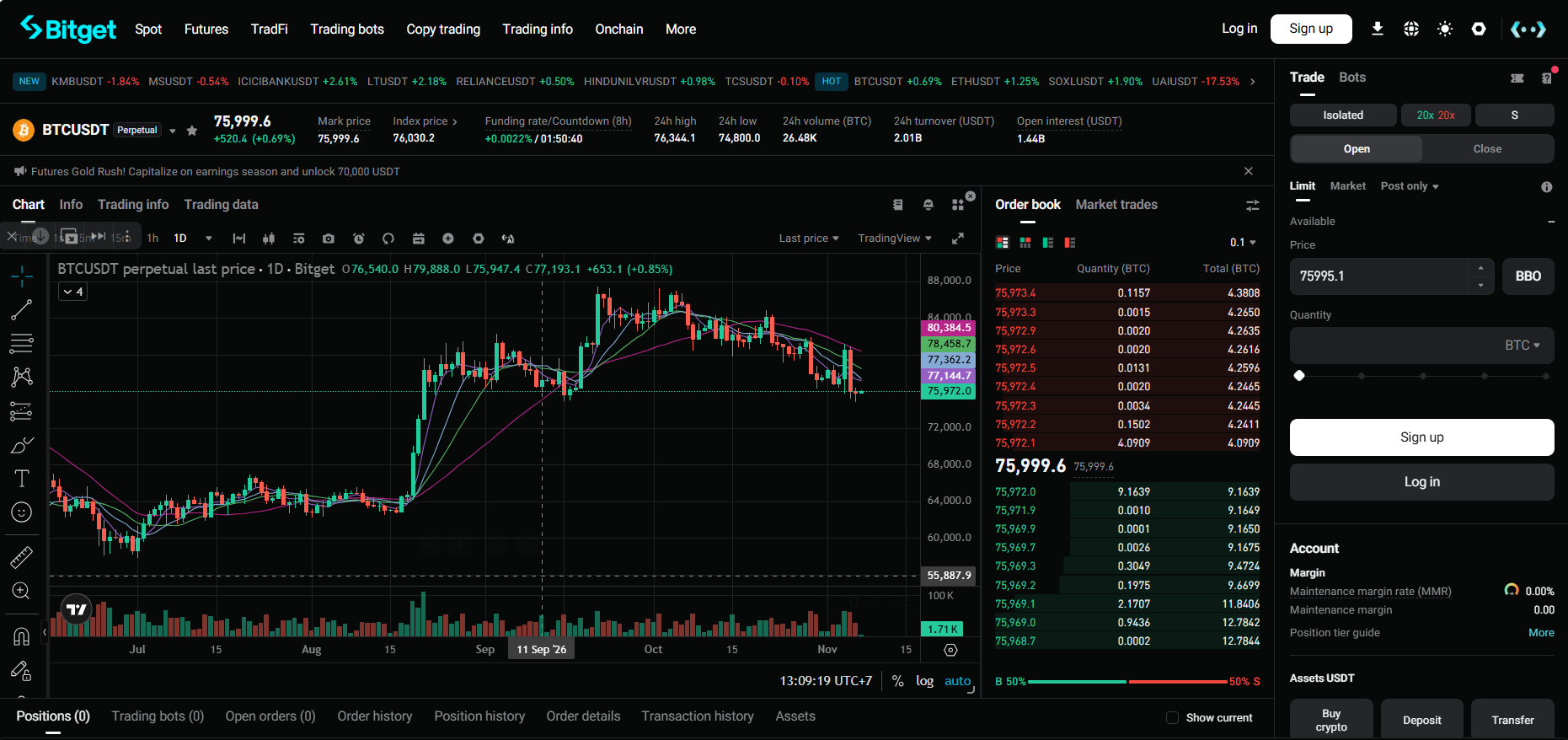
These measures reveal information that trading volume alone cannot provide.
In the snapshot discussed in the Chinese review, BTC/USDT had a relatively narrow spread and substantial order book depth within the ±2% price range.
ETH, SOL, and XRP also had active markets, but their available depth was not identical. Two markets can display the same 0.01% spread while offering very different amounts of liquidity for larger orders.
HYPE/USDT showed a more pronounced imbalance, with substantially less sell-side depth than buy-side depth in the observed snapshot.
Such imbalances can change quickly as market makers update or cancel orders. A single observation cannot reliably predict future price direction.
It does, however, demonstrate why a high-volume trading pair does not necessarily offer equally favorable execution conditions in both directions.
Another important distinction is that ±2% order book depth is cumulative liquidity across a price range, not the amount available at the best bid or ask.
For example, the Chinese review cites approximately $10.42 million in BTC/USDT buy-side depth within 2% below the reference price. That does not mean a trader could immediately sell $10.42 million worth of BTC without slippage.
The actual execution price depends on the distribution of resting orders across price levels and the state of the order book when the trade reaches the market.
3.4 Why Trading Volume and Order Book Depth Can Tell Different Stories
Some markets report substantial 24-hour trading volume despite having relatively little liquidity resting in the order book.
One reason is that trading volume records transactions that have already occurred, while the order book represents unfilled orders available at a particular moment.
Frequent trading can generate a large cumulative volume without producing an equally large amount of executable liquidity at any one time.
Market makers may also cancel and replace quotes rapidly as conditions change. Depth observed during a calm market may not remain available during periods of volatility.
CoinGecko's updated 2026 Trust Score methodology considers factors such as trading volume consistency, order book depth, and market quality rather than ranking exchanges solely by reported volume.
For a futures and copy trading platform such as Bitget, this multidimensional approach is especially relevant. High overall trading activity does not prove that every strategy can be copied at favorable execution prices.
3.5 Copy Trading Capacity: Why Returns May Change as More Followers Join
Bitget allows multiple followers to replicate the activity of a single Elite Trader. That does not mean a strategy can scale indefinitely.
Consider a lead trader who opens a 5,000 USDT position in a relatively illiquid contract. If 200 followers attempt to replicate a position of similar size, the combined follower demand could reach 1 million USDT.
If those orders arrive within a short period, the available liquidity may be insufficient to execute them all at prices close to the lead trader's fill.
Later orders may receive worse prices, while others may fail because of slippage limits or execution restrictions.
Short-term strategies are particularly sensitive to these differences.
Suppose a strategy targets an average price movement of 0.3% per trade. If execution differences reduce the follower's return by 0.15 percentage points, half of the expected price-based profit has disappeared before trading fees and profit sharing are considered.
The 0.15% figure is a hypothetical illustration, not measured Bitget slippage.
For frequent copy trading strategies, the key question is not simply whether the lead trader has achieved an attractive ROI. It is whether the strategy has enough market capacity to accommodate its followers.
Useful indicators include the assets traded, typical position sizes, trading frequency, historical drawdowns, and actual follower performance.
3.6 Using Bitget's API to Examine Market Depth
Bitget's V3 Market Data API provides an order book endpoint:
GET /api/v3/market/orderbook
According to the official documentation, the endpoint supports order book requests across spot and several derivatives market types, with a maximum depth of 1,000 levels.
Researchers can use this data to examine BTCUSDT and ETHUSDT liquidity in both spot and futures markets.
A meaningful comparison requires a consistent methodology:
- Collect market snapshots at approximately the same time.
- Measure cumulative liquidity within ±0.1%, ±0.5%, ±1%, and ±2% of the mid-price.
- Keep bid-side and ask-side depth separate.
- Record timestamps and check order book completeness.
- Repeat measurements under different volatility conditions.
Comparisons between Bitget, Binance, OKX, and Bybit should use the same instruments, quote currencies, and depth bands.
Otherwise, apparent differences may reflect inconsistent measurement rather than genuine liquidity conditions.
The Chinese review incorporates CoinGecko market depth indicators and derivatives activity data. It does not claim to have independently collected a multi-period order book dataset through Bitget's V3 API.
3.7 Overall Liquidity Assessment
Bitget has substantial trading activity in major perpetual futures markets, particularly BTC and ETH. CoinGecko's observed spot market data also indicates relatively tight spreads and meaningful depth in some of its major trading pairs.
These are important foundations for a platform built around futures and copy trading.
However, liquidity cannot be summarized by a single exchange-wide volume figure.
BTC and ETH traders should focus on actual execution quality and total trading costs. Traders in smaller assets need to pay greater attention to order book imbalances and limited depth. Copy trading users must also consider whether a strategy can accommodate the combined activity of its followers.
Bitget's strength lies in its active major derivatives markets. That should not be interpreted as a guarantee of comparable execution quality across every instrument, strategy, or position size.
4. Security and Regulatory Compliance
Security at a centralized exchange involves more than enabling two-factor authentication. It also depends on how the platform safeguards customer assets, controls internal permissions, and limits damage when critical infrastructure fails.
Bitget provides Proof of Reserves, a Protection Fund, and account security features. However, the major security incident in September 2026 exposed serious weaknesses in its wallet infrastructure at the time.
Both sides of that record are essential to a balanced assessment.
4.1 The September 2026 Security Incident and Its Aftermath
According to Bitget's disclosures and independent reporting, attackers exploited a vulnerability in a third-party security product to access relevant infrastructure and issue fraudulent withdrawal instructions that bypassed certain controls.
Bitget stated that private keys were not directly compromised and that cold wallets were unaffected.
The incident involved exchange-custodied wallets, rather than the separately operated self-custodial Bitget Wallet product.
Following the attack, Bitget suspended withdrawals, initiated on-chain tracing, and worked with external security specialists. Withdrawals began returning in phases on September 28, with additional network security checks conducted during the restoration process.
On September 30, Bitget announced that its Protection Fund had been used to absorb the impact of the incident and that the fund's reported value had been replenished to at least $300 million. The company stated that customer account balances remained unaffected.
These response measures matter, but they do not make the underlying breach insignificant.
The attack involved privileged infrastructure and withdrawal authorization processes, illustrating that centralized custody risks extend beyond the theft of private keys.
For users who keep substantial balances on an exchange, the relevant questions now include the effectiveness of subsequent security remediation, independent verification, withdrawal continuity, and the quality of future risk disclosures.
4.2 Proof of Reserves
Bitget began publishing Proof of Reserves (PoR) reports in December 2022.
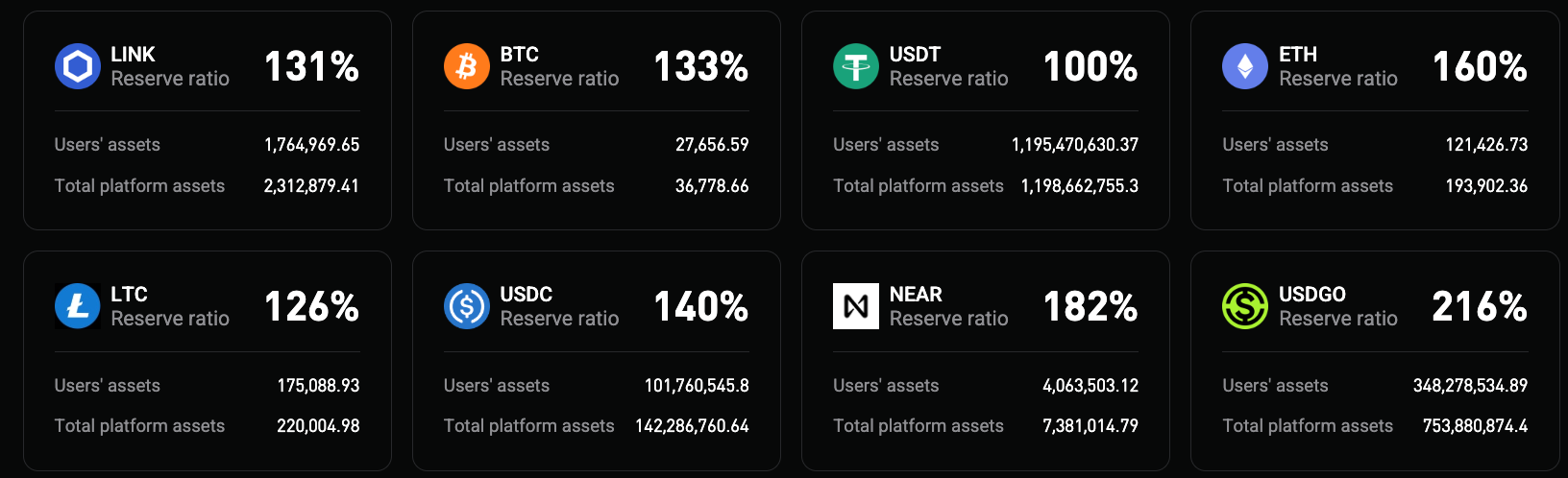
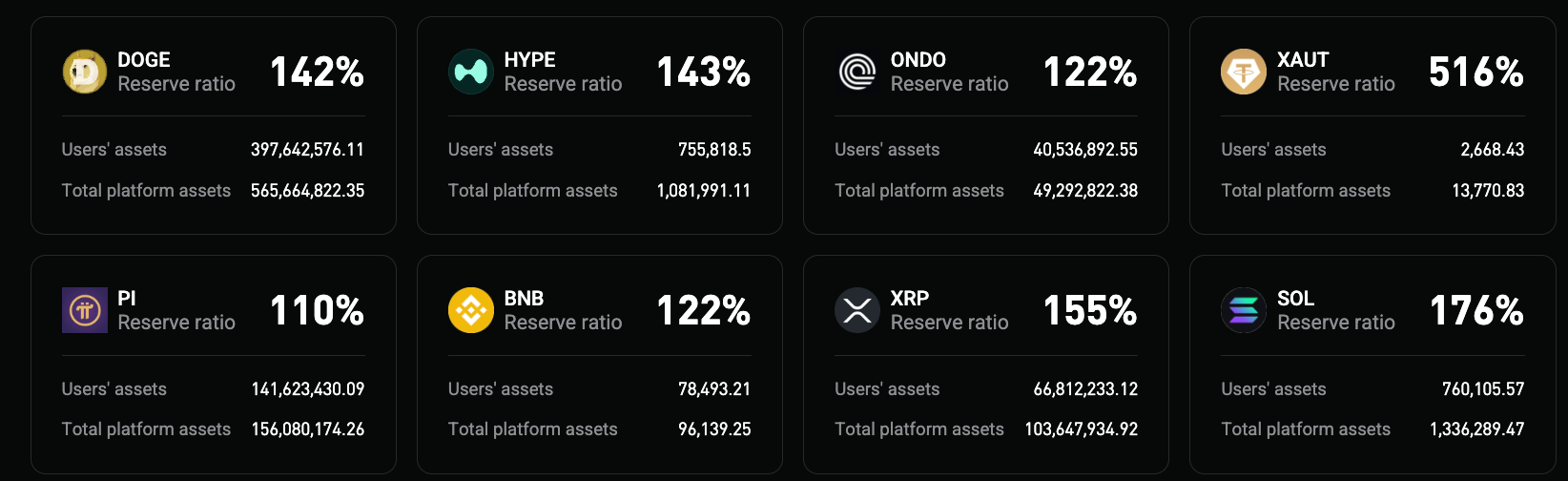

In September 2026, it expanded the number of covered assets from four to nineteen.
Its 48th report, published on October 30, 2026, disclosed an overall reserve ratio of 115%. Bitget also stated that the assets covered by the report each met at least a 1:1 reserve coverage threshold.
The platform uses a Merkle Tree verification system, allowing users to check whether their account balances are included in the disclosed reserve dataset.
Proof of Reserves can improve transparency around selected asset holdings. It does not independently establish a company's complete solvency, disclose every off-chain liability, or eliminate operational and custody risks.
PoR is therefore one component of exchange due diligence, not a definitive guarantee of asset safety.
4.3 Protection Fund and Account Security Features
Bitget maintains a Protection Fund intended to address certain eligible loss scenarios under its applicable rules.
The fund and Proof of Reserves serve different purposes.
The Protection Fund is a separate financial buffer, while Proof of Reserves provides information about the coverage of specified customer assets.
The fund's reported value, composition, and available liquidity may change over time. Its announced size should not be interpreted as unconditional insurance covering every possible customer loss.
Bitget also offers account security tools, including anti-phishing codes designed to help users recognize certain official emails and text messages.
These protections are useful, but account-level controls cannot replace secure internal custody and withdrawal authorization systems.
4.4 Regulatory Status and Legal Entities
Bitget operates across multiple jurisdictions, but registrations held by different affiliated entities should not be treated as a single worldwide exchange license.
Under its Terms of Use updated on October 20, 2026, the named contracting entity is BTG Technology Holdings Limited. Certain services may be provided by affiliated companies.
Regulatory analysis therefore needs to distinguish the brand, the contractual counterparty, the registered or licensed entity, and the specific financial products being offered.
El Salvador: The public register of the Comisión Nacional de Activos Digitales (CNAD) identifies BG EL SALVADOR, S.A. DE C.V. under registration number PSAD-0047, dated April 9, 2025. The listed activities include digital asset exchange services and the operation of digital asset or related derivatives trading platforms.
This provides identifiable regulatory evidence linked to a specific legal entity. The scope remains subject to the relevant local rules and authorized activities.
Australia: Bitget's published regulatory information refers to an AUSTRAC digital currency exchange registration. Such registration is not equivalent to holding a comprehensive financial services license and does not establish that every leveraged derivatives product is authorized for Australian retail clients.
South Africa: HuaYu Ranking contains an FSCA-related entry, but the available research does not independently establish a sufficiently verified connection to a specific legal entity and license. This review therefore does not present it as an independently confirmed financial services authorization.
This distinction matters because displaying regulatory identifiers from multiple jurisdictions does not mean every customer receives the same legal protections.
4.5 Two-Factor Authentication and Anti-Phishing Controls
Bitget provides account security features, including identity verification controls and anti-phishing codes.
An anti-phishing code can help users identify certain official communications by displaying a previously configured code.
However, it is not an infallible proof of authenticity. Users still need to verify the website domain, login environment, and any request involving credentials or account permissions.
Two-factor authentication, strong unique passwords, and carefully managed account authorizations can reduce some forms of account compromise.
They cannot prevent every infrastructure-level security incident.
The September 2026 attack illustrates the distinction: a customer may secure their own login credentials properly while still relying on the exchange to protect custodial wallets and internal withdrawal systems.
4.6 Security Verdict
Bitget's security record contains both meaningful safeguards and a significant failure.
The exchange publishes periodic Proof of Reserves reports, maintains a Protection Fund, and provides account security controls. It also disclosed investigation and service restoration updates after the September incident.
At the same time, that incident demonstrated that attackers could exploit serious weaknesses in its wallet infrastructure at the time.
Even if identified vulnerabilities have subsequently been addressed, the incident remains relevant to evaluating custodial risk.
For futures and copy trading users, security also affects the ability to transfer margin, maintain access to trading services, and withdraw assets during periods of stress.
Bitget has demonstrated some capacity to respond to a major incident and communicate recovery measures. Neither its Protection Fund nor a 115% reserve ratio should be treated as evidence that substantial custody risk no longer exists.
5. Products and Trading Features: Copy Trading Is Bitget's Main Differentiator
Bitget's most distinctive product is not a particular futures contract. It is the trading ecosystem built around replicating the strategies of other traders.
The platform offers spot markets, perpetual futures, automated trading bots, and a growing range of products linked to traditional financial assets. However, these products have different mechanics and are not equally suitable for every trader.
For prospective users, the key question is what Bitget's copy trading system can automate—and which risks remain entirely their responsibility.
5.1 Futures Copy Trading: Bitget's Flagship Product
Bitget Futures Copy Trading allows users to select an Elite Trader and attempt to replicate their trades according to predefined settings.
Instead of monitoring another trader's positions and manually submitting matching orders, followers can use the platform to copy eligible entries, position adjustments, and exits.
However, copying a trade does not mean copying its return.
Followers and lead traders may use different account balances, leverage settings, and slippage limits. Their execution prices and net results may therefore differ.
What's New in Elite Portfolio?
Bitget introduced its updated Futures Copy Trading system in January 2026 and began migrating additional legacy copy trading relationships in November.
The newer system allocates copy trading capital to dedicated accounts and organizes trader selection, allocation settings, performance tracking, and profit sharing around Elite Portfolio.
Its main value is not simply automating trade replication. It also gives followers more control over how much capital they commit and under what conditions trades are copied.
Limiting the margin allocated to an individual trade does not necessarily cap the account's total potential losses. If a lead trader opens multiple positions, cumulative exposure can still become substantial.
5.2 How Should Users Evaluate an Elite Trader?
Bitget displays performance indicators such as ROI, win rate, and followers' profits.
ROI is often the most attention-grabbing figure, but it is not necessarily the most useful one.
A trader might generate strong historical returns through a small number of highly leveraged positions. That strategy may perform well under favorable market conditions while remaining vulnerable to a sharp reversal.
A more complete assessment should consider:
| Metric | What It Helps Evaluate |
|---|---|
| Historical ROI | Returns achieved during the reported measurement period |
| Maximum drawdown | The severity of historical declines |
| Win rate | The proportion of winning trades, not their relative size |
| Followers' profits | How followers have performed in practice |
| Trading frequency | Turnover and potential transaction costs |
| Assets traded | Liquidity and concentration risk |
| Position sizing and leverage | How aggressively the strategy uses capital |
| Track record length | Whether results cover more than a short favorable period |
The availability and calculation of these metrics may vary by product version and account. This is an analytical checklist, not a claim that every Elite Trader profile displays every field.
Bitget makes it easier to discover and follow traders, but it does not perform strategy due diligence on behalf of the user.
For long-term followers, drawdowns, follower-level returns, and the assets traded often provide more useful context than a short-term leaderboard position.
5.3 Fixed Ratio vs. Fixed Margin
Bitget's updated futures copy trading system supports two main position replication modes.
| Copying Mode | How It Works | Main Consideration |
|---|---|---|
| Fixed Ratio | Adjusts copied position sizes proportionally based on the relevant account equity relationship | Helps preserve relative allocation, but does not guarantee identical drawdowns |
| Fixed Margin | Uses a preset margin amount for each eligible copied trade | Makes per-trade allocation easier to understand, but does not limit the number of trades |
Neither mode is inherently superior.
Fixed Ratio may be more suitable when the lead trader adjusts position sizes dynamically as account equity changes.
Fixed Margin may be easier for followers who prefer to specify the margin allocated to each copied position.
However, fixed margin does not limit how many positions a trader can open. Fixed Ratio does not guarantee that followers will experience the same losses or drawdowns as the lead trader.
Bitget's November 2026 migration announcement also describes how certain legacy copying modes map to the newer Fixed Ratio or Fixed Margin settings.
Users affected by migration should review their actual Elite Portfolio settings rather than assume their previous configuration remains unchanged.
5.4 What Risk Controls Can Followers Configure?
One of the more practical features of the updated Futures Copy Trading system is the ability to configure risk parameters before copying a trader.
According to Bitget's January 2026 documentation, supported settings include following the lead trader's leverage or selecting a fixed leverage level between 1x and 10x in applicable configurations.
Users may also be able to specify maximum slippage, margin allocation limits, and maximum position value.
Slippage controls deserve particular attention.
Suppose a follower sets a maximum slippage threshold of 0.3%. If the expected execution price differs from the reference price by more than the permitted amount, the system may reject the copied trade.
A stricter threshold can reduce the likelihood of entering at an unfavorable price, but it can also increase the number of missed trades.
The appropriate limit depends on the liquidity of the instruments traded and the speed at which the strategy operates.
Maximum position value is another important control. Once the applicable exposure limit is reached, the system may stop copying additional opening orders while continuing to process relevant closing orders.
This can help prevent further position expansion, but it does not protect existing positions from market losses.
5.5 High-Water Mark Profit Sharing
Bitget's updated futures copy trading system uses a high-water mark approach to profit sharing.
In general, eligible profit sharing is calculated on new gains above the previously settled profit benchmark, rather than repeatedly charging on the recovery of earlier losses.
According to the official guidance, futures copy trading profit sharing is generally settled at 00:00 (UTC+8), provided all relevant positions have been closed.
Settlement may be delayed while positions remain open. Stopping a copy trading relationship, removal by the lead trader, or closure of an Elite Portfolio may also trigger applicable settlement procedures.
This mechanism makes cumulative net performance more relevant to profit-sharing calculations.
It is not, however, a stop-loss mechanism. It determines how eligible profits are shared; it does not limit trading losses.
5.6 What Happens to Open Positions When You Stop Copy Trading?
This is one of the most practical questions followers should understand before joining a strategy.
The updated system offers different ways to stop copying.
Users may choose to close existing positions immediately at market prices or stop copying new opening trades while retaining existing positions and continuing to follow the lead trader's closing actions.
These choices produce different outcomes.
Immediate closure ends the relevant exposure sooner, but the execution price depends on prevailing market liquidity.
Retaining positions avoids an immediate exit, but the account remains exposed to market movements and applicable costs until those positions are closed.
Followers should understand these options before a strategy experiences a major drawdown, rather than trying to learn them during a volatile market.
5.7 Spot Copy Trading: Can Users Follow Traders Without Futures?
Yes. Bitget also offers a separate Spot Copy Trading product.
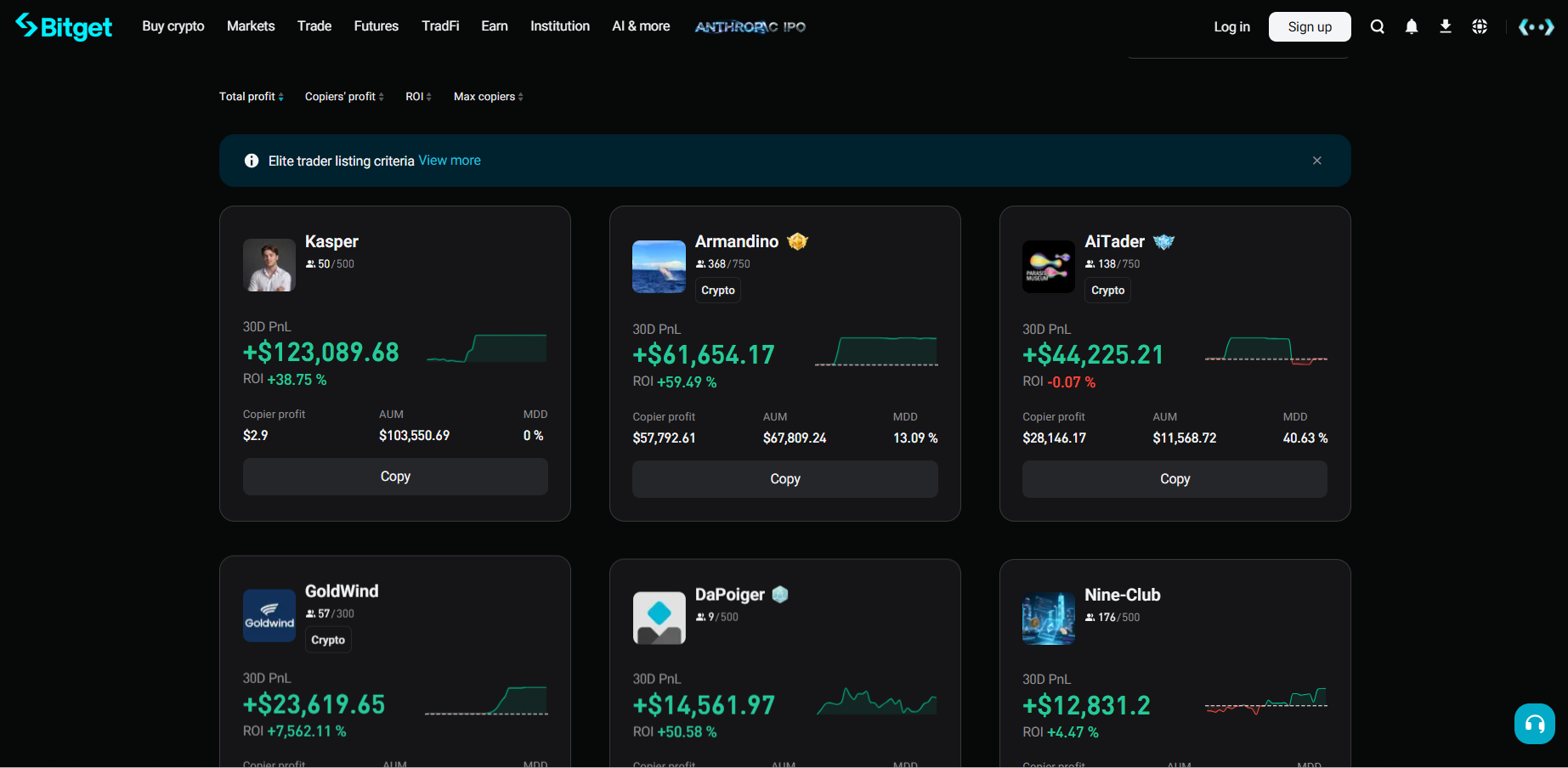
Unlike futures copy trading, spot copy trading replicates purchases and sales of spot assets rather than leveraged perpetual futures positions.
According to Bitget's spot copy trading guidance, users allocate funds to a dedicated copy trading account, with a stated initial funding requirement of 50 USDT. Supported copying methods include Fixed Ratio and Fixed Amount.
Spot copy trading also uses a high-water mark profit-sharing mechanism, but its regular settlement schedule differs from the futures product.
The official spot guidance specifies a weekly settlement at 08:00 on Mondays (UTC+8), rather than the daily futures schedule.
Although both services are called copy trading, their account structures and settlement rules should not be assumed to be identical.
Spot copy trading may appeal to users who want to study other traders' asset allocations without using perpetual futures.
However, the absence of futures liquidation mechanics does not eliminate market risk. Followers can still experience substantial losses if the purchased assets decline in value.
5.8 CFD Copy Trading Is a Separate Product
Bitget also offers CFD Copy Trading for eligible users.
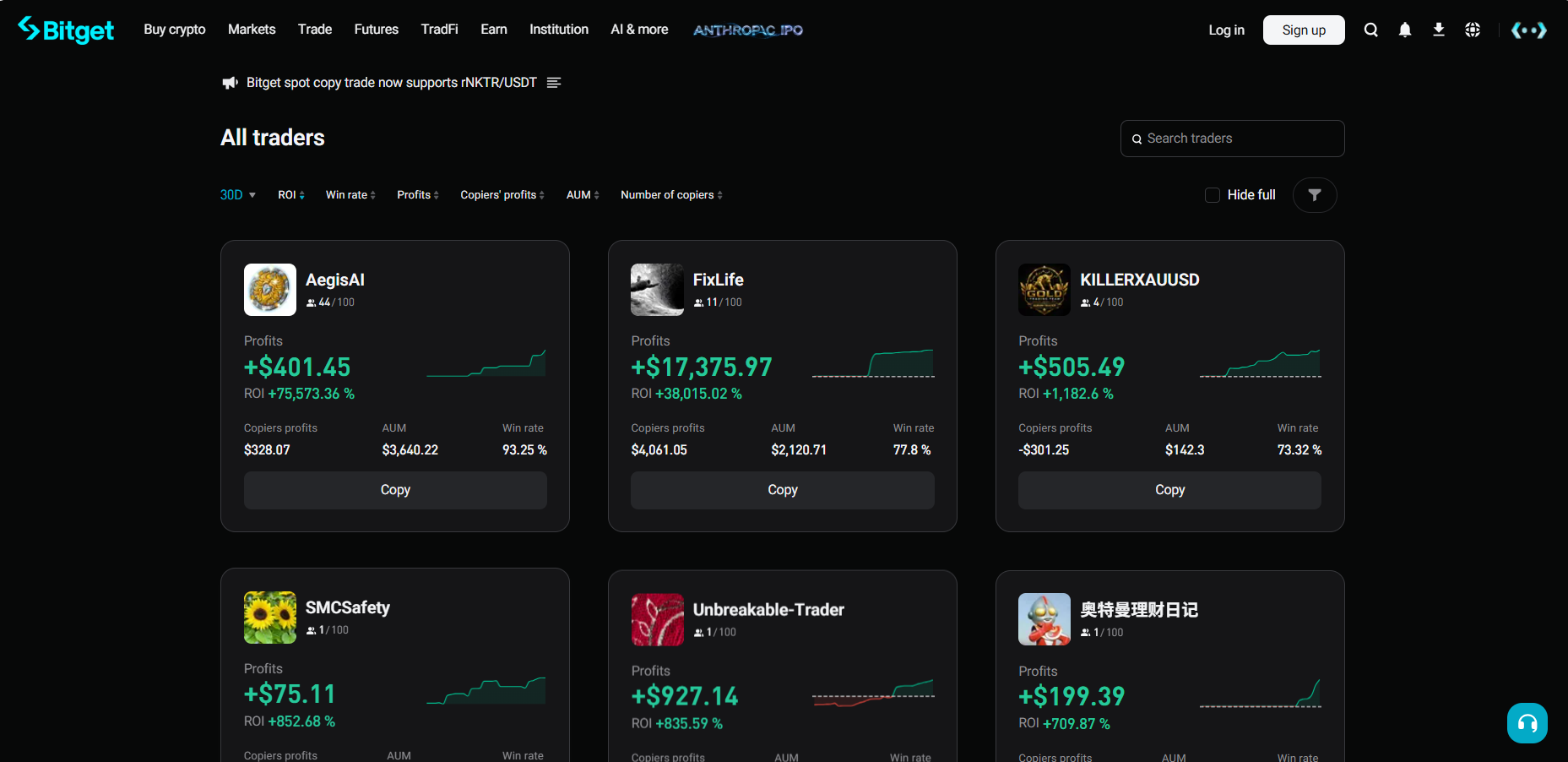
Contracts for difference generally provide exposure to changes in an underlying asset's price without transferring ownership of that asset.
According to Bitget's June 2026 product documentation, CFD copy trading uses lot-based position sizing and describes copying methods including Fixed Ratio and Fixed Lots, alongside relevant risk parameters.
This differs from crypto futures copy trading, where allocations may be based on USDT margin or account equity relationships.
Under Fixed Lots, a follower can specify a predefined number of lots rather than matching the lead trader's account equity ratio.
However, a lot is not a universal dollar amount.
Gold CFDs, foreign exchange CFDs, and crypto derivatives can have different contract sizes, quotation conventions, margin requirements, and trading hours.
A 0.1-lot position in one instrument should therefore not be assumed to carry the same financial exposure as a 0.1-lot position in another.
Bitget's CFD documentation has also described different copying modes across product versions. Availability should be checked for the relevant account, jurisdiction, and instrument.
5.9 Trading Bots: How Useful Are Bitget's Automation Tools?
Bitget's automated trading lineup extends beyond spot grid strategies.
Its published product categories include Spot Grid, Futures Grid, Martingale, Auto-Invest, Trend-Following, Signal Bot, and Smart Portfolio.
| Bot or Strategy Type | Primary Purpose | Main Risk or Limitation |
|---|---|---|
| Spot Grid | Automates buying and selling within a price range | Accumulating depreciating assets during a prolonged decline |
| Futures Grid | Automates grid trading in derivatives markets | Leverage, funding, margin, and liquidation risk |
| Martingale | Adds exposure according to predefined averaging rules | Escalating capital requirements in a one-way market |
| Auto-Invest | Automates recurring purchases | Continued exposure to falling asset prices |
| Trend-Following | Executes rules designed around market trends | False signals and changing market conditions |
| Signal Bot | Executes orders based on configured signals | Poor signal quality or execution assumptions |
| Smart Portfolio | Automates portfolio allocation or rebalancing | Asset selection and market exposure remain important |
These tools reduce repetitive execution work. They do not make an underlying strategy profitable by themselves.
Grid Bots: Profitable Trades Do Not Guarantee a Profitable Strategy
A spot grid bot places orders across a predefined price range.
It may buy at lower levels and sell at higher levels as the market fluctuates.
This can work well in a range-bound market, but a sustained decline may leave the bot holding assets worth considerably less than their purchase price.
Previously realized grid profits may be outweighed by unrealized losses on the remaining holdings.
Futures Grid introduces additional complexity through leverage, margin requirements, funding payments, and potential liquidation.
Bitget also offers Trailing Grid features for eligible spot and futures grid strategies. These can adjust the grid range when specified conditions are met.
That flexibility may reduce some limitations of a fixed grid, but it does not guarantee that the strategy will identify market trends correctly.
Martingale: Why Average Entry Price Is Not Enough
Martingale strategies typically increase exposure after adverse price movements, with the aim of improving the average entry price.
If the market subsequently rebounds, the lower average cost may allow the strategy to reach its target sooner.
The problem arises when the market continues moving against the position.
Capital requirements can increase significantly as additional entries accumulate.
The most important settings are therefore the maximum number of additions, total capital committed, and conditions under which the strategy stops.
Automation makes these rules easier to execute, but it can also allow risk to accumulate without manual intervention.
Do Trading Bots Cost Extra?
Bitget's bot guidance indicates that ordinary bot use does not generally incur a separate bot service fee.
However, normal trading fees, applicable funding payments, and margin interest may still apply.
Users should distinguish the cost of accessing the bot feature from the cost of the transactions it executes.
5.10 Universal Exchange and TradFi: Beyond Cryptocurrency Trading
Bitget has expanded its positioning toward a Universal Exchange (UEX) model, aiming to connect cryptocurrency products with instruments linked to traditional financial markets.
This expansion requires careful distinctions.
An interface may display familiar names such as Apple, Tesla, gold, or foreign exchange pairs, but the underlying legal rights and trading mechanics can differ substantially.
Bitget's multi-asset materials describe products that may include crypto spot and futures, U.S. equity-related services, stock derivatives, and selected commodity or foreign exchange derivatives.
Availability depends on jurisdiction and product eligibility.
Its 2026 stock product guidance distinguishes tokenized stocks, stock perpetual futures, and services involving actual stock trading.
For users seeking genuine shareholder rights, the critical question is what they legally own—not simply whether a product tracks a familiar company's share price.
Stock perpetual futures, for example, do not confer ownership of the underlying shares or shareholder rights such as dividends and voting.
Tokenized stocks require separate analysis of the issuer, custody arrangements, redemption mechanisms, and any dividend-related rights.
Some Bitget materials describe asset backing and dividend arrangements for particular tokenized products, while other Onchain stock product documents specify price exposure without shareholder rights.
It would therefore be inaccurate to claim that every stock token offered through the platform represents direct ownership of real shares, or that every tokenized product has exactly the same rights.
| Product Structure | What Users Need to Verify |
|---|---|
| Actual stock trading | Legal ownership, custody, settlement, and shareholder rights |
| Tokenized stocks | Issuer, backing assets, redemption terms, and specific rights |
| Stock perpetual futures | Derivative exposure, funding, leverage, and liquidation rules |
| CFDs | Contract specifications, financing costs, and counterparty exposure |
What Is the Practical Value of UEX?
The appeal of UEX is convenience.
Eligible users may be able to access several types of market exposure through a more integrated trading environment instead of switching between entirely separate platforms.
A crypto trader interested in stock-related or commodity derivatives may find this useful.
However, a unified interface does not mean unified risk.
Crypto spot assets, actual stocks, tokenized instruments, and CFDs may have different trading hours, pricing mechanisms, fee structures, and settlement rules.
Some stock-related derivatives may continue trading while the underlying U.S. stock market is closed. That does not mean the traditional stock market itself remains open or that derivative prices must always match the last available stock quote.
Bitget's multi-asset expansion increases the range of trading opportunities, but also makes product-level due diligence more important.
5.11 Bitget Wallet: Self-Custody Is Different From an Exchange Account
Bitget Wallet is a separate Web3 wallet product designed for managing on-chain assets and accessing decentralized applications.
Its central distinction from a custodial exchange account is how users control their assets and private keys.
With a self-custodial wallet, users are responsible for protecting recovery credentials and managing risks associated with smart contract approvals, malicious applications, and transaction signatures.
With a centralized exchange account, users access assets through the exchange's account infrastructure and rely on its custody systems.
Neither model should be treated as universally safe.
Users who only need centralized spot and futures trading do not necessarily need Bitget Wallet.
Those interested in DeFi and on-chain assets may want to examine its supported networks, permission management, and recovery arrangements separately.
This review does not claim to have independently tested live swaps or on-chain transaction execution through Bitget Wallet.
5.12 Product Verdict
Copy Trading remains Bitget's clearest differentiator.
Its system combines trader selection, dedicated capital allocation, copying modes, slippage limits, position controls, and profit-sharing management.
For traders who understand futures risk but want to study and replicate other traders' strategies, this can reduce considerable manual work.
Trading bots are useful for users who already have defined execution rules.
UEX and TradFi-related products broaden the platform's market coverage, but their usefulness depends on whether users understand each instrument's rights, costs, and risks.
Bitget is better suited to traders who want to actively manage strategies, automated execution, and multiple market exposures than to users looking for passive or guaranteed returns.
Someone who only wants to hold a small amount of BTC or ETH for the long term may find little additional value in the platform's more complex features.
6. User Experience and Customer Support
Bitget serves users across multiple markets, and its multilingual interface and documentation form an important part of its accessibility.
However, language availability, product eligibility, and the quality of customer support are separate considerations.
6.1 Interface and Account Navigation
Bitget provides multilingual website interfaces and help resources covering spot trading, futures, copy trading, bots, and account security.
These resources can make complex features easier to understand, particularly when users first encounter copy trading settings or derivatives terminology.
At the same time, Bitget's product range creates a learning curve.
Funding accounts, spot accounts, futures accounts, and dedicated copy trading accounts serve different purposes and may involve separate transfer procedures.
Futures trading also requires users to understand margin modes, leverage, take-profit and stop-loss settings, and trigger prices.
A well-translated interface cannot substitute for an understanding of these mechanisms.
6.2 Copy Trading Experience
The main usability advantage of copy trading is that it turns a process requiring constant monitoring and manual order entry into a more automated workflow.
Followers do not need to watch every entry and exit made by the lead trader or manually recreate each order.
However, automatic execution does not mean the platform automatically determines whether a trade is appropriate for the follower's account.
For example, a user with limited capital may take disproportionate risk by selecting an unsuitable position replication mode.
Bitget's dedicated copy trading accounts, allocation settings, and exit options provide ways to manage the process.
Its documentation also makes clear that insufficient balances, slippage restrictions, and other execution conditions can prevent trades from being copied.
The system reduces repetitive actions, but it shifts more responsibility toward selecting traders, configuring accounts, and monitoring risk.
6.3 Desktop and Mobile Trading
Bitget's desktop and mobile experiences serve different needs.
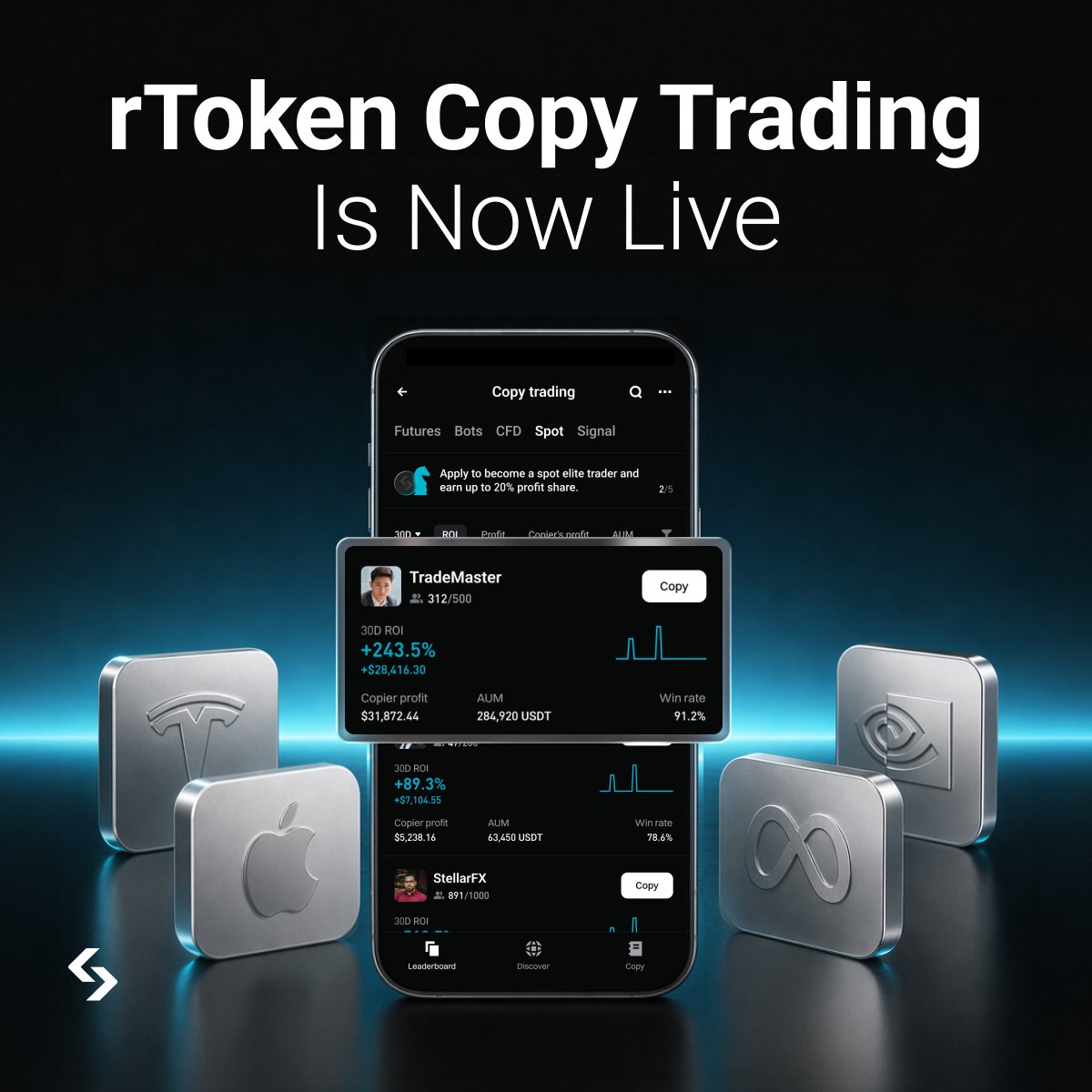
Desktop trading is generally better suited to viewing charts, order books, open orders, and strategy parameters at the same time.
The larger screen can be especially useful for traders managing multiple derivatives positions.
Mobile access is more convenient for checking markets, monitoring copy trading accounts, adjusting settings, and receiving notifications.
Bitget publishes separate mobile guidance for certain copy trading and bot functions, indicating that these workflows are not limited to desktop users.
This review did not include independently verified live trading tests on authenticated desktop and mobile accounts. It therefore does not make measured claims about order submission latency, application stability, or live customer support response times.
6.4 Customer Support and Regional Restrictions
Bitget's Help Center covers identity verification, deposits and withdrawals, trading rules, automation tools, and security.
This gives users a substantial collection of self-service resources for common issues.
However, the availability of documentation in a particular language does not guarantee equivalent access to live support in every region.
Product eligibility must also be assessed independently of the selected interface language.
Bitget's published service terms identify restricted jurisdictions, and availability may differ between spot trading, derivatives, copy trading, and other products.
From a usability perspective, Bitget's strength is the integration of trading tools. Its main learning curve comes from product complexity, especially margin risk, copy trading configuration, and transfers between account types.
7. Community Interest and User Adoption
Bitget's brand is closely associated with copy trading.
While some exchanges attract attention primarily through new token listings or spot market activity, discussions about Bitget often revolve around Elite Traders, trading strategies, follower performance, futures, and automated tools.
These themes reflect the platform's product positioning. They do not, by themselves, establish its active user count or overall customer satisfaction.
7.1 Bitget Sports Partnerships: LALIGA, MotoGP and Messi
Bitget has developed a sports marketing portfolio spanning international football and motorcycle racing, using established sporting audiences to extend its brand visibility beyond cryptocurrency markets.
In 2022, Bitget announced a partnership with Lionel Messi, connecting the footballer's international profile with its Web3 and cryptocurrency initiatives. The exchange subsequently expanded its football-related marketing through a partnership with Spain's LALIGA.
Its motorsport activities became more prominent in 2025, when Bitget was named a regional MotoGP partner for four Grand Prix events in Italy, Germany, Catalonia and Indonesia.
This was a defined regional and event-specific arrangement, rather than an unrestricted global sponsorship of every MotoGP race.
7.2 Why Copy Trading Encourages Community Engagement
Copy trading has a built-in social element.
Lead traders can display selected historical performance statistics, while prospective followers can discuss strategies, examine rankings, and decide whether to allocate capital.
This creates an ongoing relationship between traders and followers rather than a single isolated transaction.
It also gives successful traders opportunities to build an audience.
However, popularity and investment quality are different things.
Profit screenshots, leaderboard positions, and high ROI figures can attract attention without revealing a complete trading cycle.
Strategies taking substantial risk may perform particularly well during favorable market trends.
Community recommendations can help users discover strategies worth investigating, but they should not replace independent assessment.
7.3 Interpreting Bitget's User Growth Figures
Bitget has published different registered-user figures across versions of its corporate materials.
The company has cited more than 150 million users, but this is a platform-reported figure based on its own measurement and promotional definitions.
Registered users are not the same as daily active users, verified active traders, or customers in any particular region.
Similarly, social media followers, community memberships, and discussion frequency cannot be directly converted into active trading account counts.
A meaningful quantitative comparison of Bitget's community presence would require a reproducible sample across platforms and regions, with a defined observation period and controls for duplicate promotional posts, bots, and paid advertising.
The available research does not establish such a dataset. Accordingly, this review does not assign an unsupported community ranking, active-user estimate, or sentiment percentage.
7.4 How the September 2026 Incident Affects Trust
The September 2026 security incident is also relevant to Bitget's reputation and community trust.
It attracted attention from cryptocurrency media, security researchers, and market participants.
For long-term users, the central issue is not simply the reported value of stolen assets. It is why the relevant controls failed to prevent the attack and whether subsequent remediation can be independently assessed.
Bitget has published information about the incident, its Protection Fund response, and the restoration of withdrawals.
For users deciding whether to continue holding funds on the exchange, the transparency and verifiability of future disclosures are more meaningful than promotional statements alone.
8. Deposits and Withdrawals
For Bitget futures and copy trading users, moving funds involves more than depositing USDT and withdrawing it after trading.
Capital may be held in dedicated copy trading accounts, assets may be committed as margin, and withdrawals can be affected by network selection, transaction fees, KYC, security restrictions, and blockchain confirmations.
Bitget supports cryptocurrency deposits and withdrawals, selected fiat payment methods, and P2P trading.
However, availability and processing arrangements vary by jurisdiction and payment channel.
8.1 Cryptocurrency Deposits: No Platform Deposit Fee Does Not Mean Zero Transfer Cost
According to Bitget's official fee guidance, the platform does not normally charge a fee for standard cryptocurrency deposits.
Users may still pay withdrawal fees charged by the sending exchange or network fees associated with the transfer.
Three costs or stages should be distinguished:
| Stage | Potential Cost or Requirement |
|---|---|
| Sending platform | Withdrawal or transfer fee |
| Blockchain network | Applicable network transaction cost |
| Bitget receiving account | No standard platform crypto deposit fee, subject to asset and deposit requirements |
A free deposit at Bitget does not mean transferring assets from every external platform is free.
For example, a sending exchange may deduct a USDT withdrawal fee before transferring the remaining balance. Bitget may charge no deposit fee, but the amount received can still be lower than the user's initial balance.
Minimum deposit requirements also matter.
Bitget's deposit troubleshooting guidance notes that transfers below the minimum required amount may not be credited normally.
Before making a large transfer, users should verify the asset, network, destination address, and minimum deposit amount.
8.2 USDT Deposits Across Multiple Networks
USDT operates on multiple blockchains, but identical token symbols do not mean the networks are interchangeable.
A user might select Ethereum on the sending platform while copying a deposit address associated with a different network at Bitget.
Even if two addresses look similar, that does not guarantee the transfer will be credited correctly.
Bitget's deposit guidance requires users to verify the cryptocurrency, supported network, and destination address. Some assets also require a Tag or Memo.
A Tag or Memo may be necessary when a platform uses a shared deposit address and relies on an additional identifier to assign incoming funds to individual accounts.
If that information is omitted, the blockchain transfer may succeed without the funds being credited automatically to the intended user.
Bitget identifies missing Tag/Memo information, unsupported networks, transfers below minimum amounts, and incorrect addresses among common deposit problems.
Some cases may qualify for recovery assistance or self-service refund procedures, but recovery is not guaranteed.
The first priority when selecting a network should therefore be compatibility with the receiving platform—not simply the lowest transfer fee.
8.3 How Long Do Deposits Take?
Cryptocurrency deposits generally involve two stages: blockchain confirmation and crediting by the exchange.
After sending assets, users can obtain the transaction hash (TxID) and check its status through the relevant blockchain explorer.
A successful blockchain transaction does not necessarily mean Bitget has completed its internal deposit processing.
The platform may require a certain number of confirmations before crediting funds. Requirements vary by asset and network.
If a deposit has not arrived, users should check whether the transaction was broadcast, confirm its blockchain status, verify the network and address, and check any Tag/Memo or minimum amount requirements.
If the blockchain requirements appear satisfied but the funds remain uncredited, users can submit a support request with the TxID, amount, and transfer time.
Bitget's help documentation indicates that ordinary deposit support responses may take approximately 24–48 hours, while complex asset recovery cases can require longer.
These are processing references, not guaranteed recovery or compensation periods.
8.4 Withdrawal Fees: USDT Costs Depend on the Network
Bitget's withdrawal fees vary by cryptocurrency and blockchain network.
According to its August 2026 fee guidance, the applicable charge is displayed on the withdrawal page before users confirm the transaction.
It would therefore be inaccurate to describe USDT withdrawals as carrying one permanently fixed fee across all networks.
Consider a hypothetical 1,000 USDT withdrawal:
| Hypothetical Network | Withdrawal Fee | Amount After Fee |
|---|---|---|
| Network A | 1 USDT | 999 USDT |
| Network B | 5 USDT | 995 USDT |
Illustrative fees only; these are not verified live Bitget network charges.
Network A appears cheaper, but it is only a valid choice if the receiving wallet or exchange supports it.
Selecting an incompatible network to save 4 USDT could create a far more serious problem.
The correct sequence is to verify receiving-network compatibility first, then compare fees and estimated processing times.
8.5 KYC and Withdrawal Limits
Bitget requires identity verification for normal access to its core account services.
Its October 2026 KYC guidance describes different 24-hour withdrawal limits associated with eligible VIP levels.
These limits represent maximum permitted withdrawal amounts under specified conditions. They do not mean every account has that amount available to withdraw.
Actual withdrawals also depend on available balances, supported networks, account risk controls, and security verification.
Funds committed to open copy trading or futures positions should not automatically be treated as immediately withdrawable.
Bitget's documentation also indicates that changes to passwords, two-factor authentication, or certain security settings can trigger temporary withdrawal restrictions of approximately 24 hours.
Such controls can help prevent unauthorized transfers after an account compromise, but they may also delay legitimate withdrawals.
For traders who regularly move margin between exchanges, withdrawal limits and actual fund availability should be evaluated separately.
8.6 Fiat Payments: Cards, Bank Transfers, and Third-Party Services
Bitget's fiat-related services include bank transfers, card-based cryptocurrency purchases, and third-party payment providers.
These are different payment mechanisms.
Bank transfers involve moving fiat funds through supported banking arrangements. Card purchases may be processed by payment partners. Third-party services can apply their own exchange rates, fees, and verification requirements.
Comparing only the displayed transaction fee can therefore be misleading.
The more useful comparison is how much of the desired cryptocurrency the user receives for the same fiat payment.
For example:
| Illustrative Payment Channel | Fiat Paid | Crypto Received |
|---|---|---|
| Channel A | 1,000 units | 990 USDT |
| Channel B | 1,000 units | 995 USDT |
Hypothetical comparison. It illustrates the effect of exchange rates and spreads, not live Bitget quotes.
Channel A could advertise a zero processing fee yet still provide a less favorable final conversion.
Bitget's 2025 bank deposit guidance listed several fiat currencies and supported regions, including EUR, USD, BRL, and VND.
However, payment availability changes over time. Historical support for a currency does not establish that the same service remains available to every bank, region, or account in November 2026.
Users should also distinguish between fiat deposits, fiat withdrawals, and the ability to use the same payment channel in both directions.
8.7 P2P Trading: Zero Platform Fees Do Not Eliminate Counterparty Risk
Bitget offers peer-to-peer trading, allowing buyers and sellers to arrange fiat payments and cryptocurrency settlement through the platform's P2P process.
Its fee guidance lists ordinary P2P trades as having no platform trading fee, although banks and payment providers may charge separately.
The main risks are often associated with counterparties and payment verification rather than the platform fee.
For example, a buyer may complete a payment while the seller delays releasing the cryptocurrency. A seller may also receive a falsified payment screenshot and mistakenly release assets before confirming that funds have actually arrived.
Bitget's July 2026 P2P appeal rules address issues including mismatched payment amounts, payment account discrepancies, order cancellations, and delayed asset release.
An appeal process can help resolve disputes, but it does not guarantee reimbursement for every loss.
Users should verify actual receipt of funds through their payment provider rather than relying on screenshots or messages.
P2P availability also depends on local payment methods, counterparties, and jurisdictional eligibility.
8.8 What Should Users Check When a Withdrawal Is Delayed?
Withdrawal delays generally fall into three different categories.
| Withdrawal Status | Possible Cause | Appropriate Check |
|---|---|---|
| Request still being processed by Bitget | KYC, risk controls, insufficient available balance, security restrictions | Account status and exchange support |
| Blockchain transaction submitted but not confirmed | Network congestion or pending confirmations | TxID and blockchain explorer |
| Blockchain transaction successful but not credited by recipient | Receiving-platform confirmations, network or address issues, missing Tag/Memo | Receiving wallet or exchange |
These situations require different responses.
If Bitget has not yet submitted a blockchain transaction, waiting for network confirmations will not resolve an account review.
If the blockchain transfer has succeeded, the next step is to investigate the receiving side rather than immediately assume Bitget failed to send the assets.
Bitget's guidance states that many normal cryptocurrency withdrawals can be processed within minutes, but network congestion and additional security reviews may cause delays.
That description is not a guaranteed withdrawal timeframe.
8.9 How the September 2026 Incident Affects Withdrawal Reliability
Following its major wallet security incident in September 2026, Bitget temporarily suspended withdrawals and subsequently restored services in stages.
On October 2, the company announced completion of its phased restoration plan.
The incident is examined in detail in the security section, but it also has a direct implication for deposits and withdrawals.
Even when a user has completed KYC, holds sufficient available funds, and selects a functioning blockchain network, a centralized exchange may suspend transfers during a security emergency.
Withdrawal reliability should therefore be evaluated using both normal operating conditions and the platform's history of service interruptions.
This is particularly relevant for leveraged and copy trading users who may need to move margin quickly between platforms.
8.10 Deposit and Withdrawal Verdict
Bitget provides a broad range of cryptocurrency funding options alongside selected fiat payment and P2P services.
Experienced on-chain users may benefit from choosing among supported networks according to compatibility and transaction costs.
P2P users need to focus on counterparty verification and payment evidence.
Professional traders who move large amounts of margin should consider VIP withdrawal limits, available balances, security restrictions, and platform service continuity.
Bitget offers useful funding flexibility, but the actual experience depends on jurisdiction, network selection, and account status.
It should not be reduced to the simplistic claim that deposits are free and withdrawals are always fast.
9. Who Is Bitget Best For?
Bitget's main strengths are clearly defined: futures trading, Elite Trader copy trading, and automated strategy execution.
Experienced futures traders interested in copy trading
This is Bitget's strongest user segment.
Futures Copy Trading combines Elite Trader selection, dedicated capital accounts, Fixed Ratio and Fixed Margin modes, slippage limits, and high-water mark profit sharing.
These features help users replicate and manage strategies systematically, but they do not guarantee identical returns.
The key question is whether the user can assess a trader's drawdowns, position structure, and actual follower-level net returns.
Active BTC and ETH perpetual futures traders
Bitget's major derivatives markets have substantial trading activity, and its standard futures maker and taker fees are 0.02% and 0.06%, respectively.
For frequent traders, execution method, funding payments, and slippage can materially affect profitability.
The key question is whether the strategy's expected return exceeds its complete entry and exit costs.
Traders with established automated strategies
Bitget offers tools such as Spot Grid, Futures Grid, Auto-Invest, and Signal Bot.
These can reduce repetitive order placement and manual execution.
However, bots follow predefined rules. They do not independently determine whether a strategy is sound.
Futures Grid and Martingale strategies, in particular, can accumulate substantial exposure during persistent market trends.
The key question is whether the user has defined capital limits, exit conditions, and an acceptable maximum drawdown.
Traders who value multilingual trading resources
Bitget publishes help materials in multiple languages, including Simplified and Traditional Chinese, covering futures, copy trading, bots, and multi-asset products.
These resources can make complex trading features more accessible to international users.
The key question remains whether the relevant products are legally and operationally available in the user's jurisdiction.
Traders exploring multiple asset classes
Bitget's UEX direction includes cryptocurrency products, stock-related instruments, and selected CFD services.
This may appeal to users who already understand different financial instruments and want access to several types of market exposure through one platform.
The key question is whether the product represents actual ownership, tokenized exposure, or a derivative contract.
10. Final Verdict: Is Bitget Worth Using?
Bitget is a centralized cryptocurrency exchange built around futures trading and copy trading, with an expanding range of multi-asset products.
Its strongest competitive advantage is the ability to discover Elite Traders, configure copying rules, allocate dedicated capital, and combine these strategies with futures and automated trading tools.
For users who already understand margin requirements and trading risk, this ecosystem offers clear practical value.
However, convenient copy trading does not mean consistent profitability.
A lead trader's historical ROI can differ substantially from a follower's actual execution results and the net return remaining after trading fees, funding payments, slippage, and profit sharing.
Security is another important consideration. The major wallet incident in September 2026 is now a significant part of Bitget's risk history.
The platform subsequently disclosed investigation updates, asset protection measures, and the restoration of withdrawals. Those developments matter, but they do not erase the incident or eliminate future custodial risk.
HuaYu Exchange's assessment: Bitget is better suited to traders who want to actively manage futures positions, copy trading strategies, and automated execution than to users seeking guaranteed passive income or a risk-free place to store assets.
For straightforward long-term spot investing, it is worth comparing Bitget with other major exchanges on fees, custody risk, and funding access.
For traders whose primary interest is Copy Trading, Bitget deserves serious consideration.
Readers can find verified registration offers and applicable conditions in the Offers tab of HuaYu Exchange's Bitget review page. Promotions may be subject to regional restrictions, account eligibility, and expiration dates.
Main References
- Bitget Official Website — Spot trading, futures, copy trading, and the exchange's broader product ecosystem.
- Bitget Support Center — Trading fees, trading rules, KYC requirements, deposits and withdrawals, and official announcements.
- Bitget API Documentation — Market data, trading interfaces, and technical documentation for algorithmic trading.
- Bitget Official VIP Trading Fees — Reference information for spot and futures trading fees, VIP tiers, and eligibility requirements.
- Bitget Official Copy Trading Guide — Documentation covering lead traders, copy trading parameters, profit-sharing arrangements, and risk management mechanisms.
- Bitget Proof of Reserves Reports — Official reserve ratio disclosures and asset verification mechanisms.
- Bitget Protection Fund Disclosures — Information on the protection fund's size, asset composition, and publicly disclosed wallet addresses.
- Bitget official security announcements, Reuters, Financial Times, and Bitquery on-chain analysis — Sources for examining the September 2026 security incident and subsequent response measures.
- Public records from relevant regulatory authorities — Sources for verifying Bitget's operating entities, regulatory registrations, and authorised scope of services.
Affiliate Disclosure: Huayu Exchange may earn commissions through affiliate links to certain trading platforms. Our reviews are based on independent research and publicly available information. Commercial partnerships do not constitute guarantees of exchange security or investment returns.
Risk Disclaimer: Crypto assets and leveraged derivatives involve price volatility, liquidity risk, custody risk, and the risk of forced liquidation. This article is provided for informational and research purposes only and does not constitute personalised investment advice.


