 Binance
 Review: Trading Fees, Liquidity, Security, Futures and Trading Features Explained
 HuaYu ExchangePublished Updated
Binance is one of the world's leading cryptocurrency exchanges, known for its extensive user base, wide selection of cryptocurrencies, active spot and futures markets, and comprehensive crypto ecosystem. It offers spot trading, perpetual futures, Earn products, Launchpool, and a variety of trading services for users of different experience levels.
Founded in 2017, Binance is one of the world's major cryptocurrency trading platforms. Its defining strength is the breadth of its trading ecosystem. Rather than focusing primarily on copy trading, newly launched tokens or automated trading bots, Binance brings spot markets, perpetual futures, portfolio management, trading automation and developer tools into one platform.
That integration matters to active traders. A user can build a Bitcoin spot position, manage derivatives exposure, run a systematic trading strategy and monitor multiple assets without relying on a separate exchange for every activity. Fewer platform switches can simplify execution and reduce some operational friction.
Binance also offers an established fee structure, extensive market-data infrastructure and a wide range of educational resources. The trade-off is complexity: users need to understand how different wallets, margin systems and trading products interact. Its substantial October 2026 security breach also makes custody risk an especially important part of this review.
- Broad spot, futures and portfolio-management ecosystem
- Established liquidity infrastructure for major crypto markets
- Competitive standard spot fees, with BNB discounts and VIP tiers
- Built-in trading bots, advanced order types and APIs
- Multiple collateral and settlement options for derivatives
- Extensive documentation and educational resources
- Public Proof of Reserves system
- Significant custody and operational-security concerns following the October 2026 breach
- Complex interface and product structure for beginners
- Futures involve funding costs, liquidation and collateral risk
- Some discounts require BNB holdings or trading-volume thresholds
Detailed Review
1. Platform Overview
| Field | Details |
|---|---|
| Exchange Name | Binance |
| Founded | 2017 |
| KYC Requirements | Mandatory identity verification (KYC required) |
| Main Trading Products | Spot trading, margin trading, perpetual futures, delivery futures, options, and Binance Earn products |
| Regulation & Compliance | ADGM FSRA, Dubai VARA, Bahrain CBB |
| Standard Futures Maker Fee | 0.02% |
| Standard Futures Taker Fee | 0.04% |
| Maximum Trading Leverage | Up to 125× on selected perpetual futures contracts, including BTCUSDC and ETHUSDC, subject to position-tier limits |
| Trading & Strategy Tools | Spot Grid, Futures Grid, Dollar-Cost Averaging (DCA), Rebalancing Bot, TWAP, iceberg orders, and API-based trading |
| Deposit & Withdrawal Methods | On-chain cryptocurrency deposits and withdrawals, internal transfers, P2P trading, and supported regional fiat payment channels |
| Quick Verdict / Best For | Binance stands out for its broad trading ecosystem, extensive spot and derivatives markets, integrated earning products, and advanced trading infrastructure. It is particularly suitable for active traders, diversified crypto investors, and users seeking multiple trading and portfolio management services within one platform. |
| Official Website | Binance |
2. Binance Trading Fees
Binance's standard spot trading fees are straightforward. The more interesting question is how those fees interact with trading frequency, execution quality and the products a trader actually uses.
A long-term investor making occasional Bitcoin purchases has a different cost profile from a market-neutral trader managing spot and perpetual futures positions throughout the day. Both can use Binance, but the factors that determine their net returns are not the same.
Spot trading fees
Binance uses a maker-taker pricing model. A maker order generally adds liquidity to the order book, while a taker order executes against existing liquidity.
Its published standard spot fee is 0.10% for makers and 0.10% for takers. Eligible users paying fees with BNB can receive a 25% discount, reducing those rates to 0.075%.
The exchange also operates a VIP fee program based on qualifying trading activity and BNB balances.
| Account tier | 30-day trading-volume threshold | BNB requirement | Maker fee | Taker fee |
|---|---|---|---|---|
| Regular | Below VIP qualification | No minimum | 0.100% | 0.100% |
| VIP 1 | $1 million | 5 BNB | 0.090% | 0.100% |
| VIP 2 | $5 million | 25 BNB | 0.080% | 0.100% |
| VIP 3 | $20 million | 100 BNB | 0.040% | 0.060% |
Source: Binance Official Trading Fee·Verified: 2026.11.05
The 25% BNB discount can be useful for traders generating meaningful monthly volume. But holding BNB solely to save on fees introduces a separate market exposure. The value of the discount should be compared with the amount of BNB required and the user's willingness to hold it.
Binance also publishes distinct pricing for certain USDC markets and promotional pairs. Its standard fee table is therefore a baseline, not a universal price for every order.
What do those percentages mean in practice?
Consider a trader buying $25,000 worth of BTC and later selling the same notional amount.
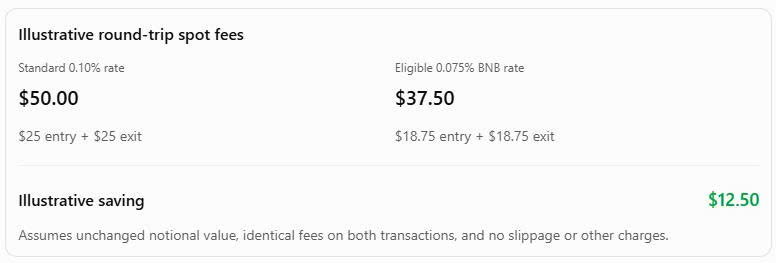
For an occasional investor, that difference may be modest. For a strategy executing many round trips each month, it can become material.
Still, the cheapest quoted commission does not necessarily produce the cheapest trade.
Maker versus taker: execution matters more than the label
At Binance's standard spot tier, maker and taker fees are equal. A limit order is not automatically cheaper simply because it is a limit order.
The more important distinction is price control.
A market order prioritizes immediate execution, potentially consuming several levels of the order book. A limit order specifies an acceptable price but may not fill.
Suppose an altcoin is quoted at $1.000, yet only a small quantity is available at that price. A larger market buy could execute additional quantities at $1.003, $1.006 or higher.
That difference is slippage, an implicit cost that can exceed the trading commission in thin markets.
This is why fee comparisons should be paired with order-book analysis, especially for smaller tokens.
Futures fees and funding rates
Binance offers several derivatives products, including USDⓈ-M and COIN-M futures. Their commission schedules differ from spot and may vary by product, account tier and promotion.
Perpetual futures introduce another consideration: funding payments.
Funding is a periodic transfer between long and short positions. Its direction depends on the funding rate and the contract's rules.
A simplified calculation is:
\[ \text{Funding Payment}=\text{Position Notional}\times\text{Funding Rate} \]
If a trader holds a $60,000 perpetual position and the applicable funding rate is +0.01%, the funding amount is $6 for that settlement. A long position would typically pay when the rate is positive, subject to the contract's specific mechanics.
The calculation may look small, but funding can accumulate during a multiday position. Rates also change with market conditions.
A strategy that appears profitable before financing costs may perform quite differently after funding, commissions and execution slippage.
The fee verdict
Binance offers a flexible pricing structure rather than a single universally low rate. Regular users receive a clear standard spot schedule; higher-volume users can benefit from tiered pricing; and BNB discounts provide another potential reduction.
For active traders, the more meaningful advantage is having multiple ways to manage total trading costs.
The relevant comparison is not just Binance's fee versus another exchange's fee. It is the total cost of executing a particular strategy on each venue.
3. Liquidity and Market Depth
Binance is widely associated with high trading activity, particularly in established crypto markets. Its appeal to active traders is closely tied to the liquidity infrastructure supporting those markets.
However, a large exchange is not automatically the best execution venue for every token, order size or market condition.
Liquidity must be evaluated at the trading-pair level.
Trading volume is not the same as market depth
Several commonly quoted metrics describe different characteristics of a market.
| Metric | What it measures | Why traders care |
|---|---|---|
| 24-hour volume | Value traded over a 24-hour period | Market activity |
| Open interest | Outstanding derivatives positions | Scale of active futures exposure |
| Order-book depth | Available bids and asks around the current price | Capacity to absorb orders |
| Bid-ask spread | Difference between best bid and ask | Immediate execution cost |
| Slippage | Difference between expected and executed price | Actual fill quality |
A market can have high daily volume yet still experience temporary gaps in its order book. Similarly, high futures open interest does not guarantee tight spreads or reliable liquidity during volatility.
For a trader moving substantial capital, order-book depth and execution consistency are often more informative than headline volume alone.
Why major pairs are an important Binance strength
BTC and ETH markets attract participation from market makers, arbitrage firms, institutional trading systems and retail traders.
Binance combines spot and derivatives markets with APIs and order-management tools that support this activity.
That structure is particularly useful when a strategy operates across related instruments.
For example, a trader holding BTC spot might want to hedge part of the position with a perpetual futures short. Both legs can be managed within the same trading ecosystem, reducing some of the operational complexity of maintaining positions across separate venues.
The hedge is not costless or automatic. Basis differences, funding payments, collateral requirements and liquidation thresholds still matter.
Nevertheless, access to related markets through one platform can be valuable.
What about large orders?
Imagine a trader planning to acquire $750,000 worth of ETH.
Submitting one market order could consume several ask levels, pushing the average execution price above the initial quote.
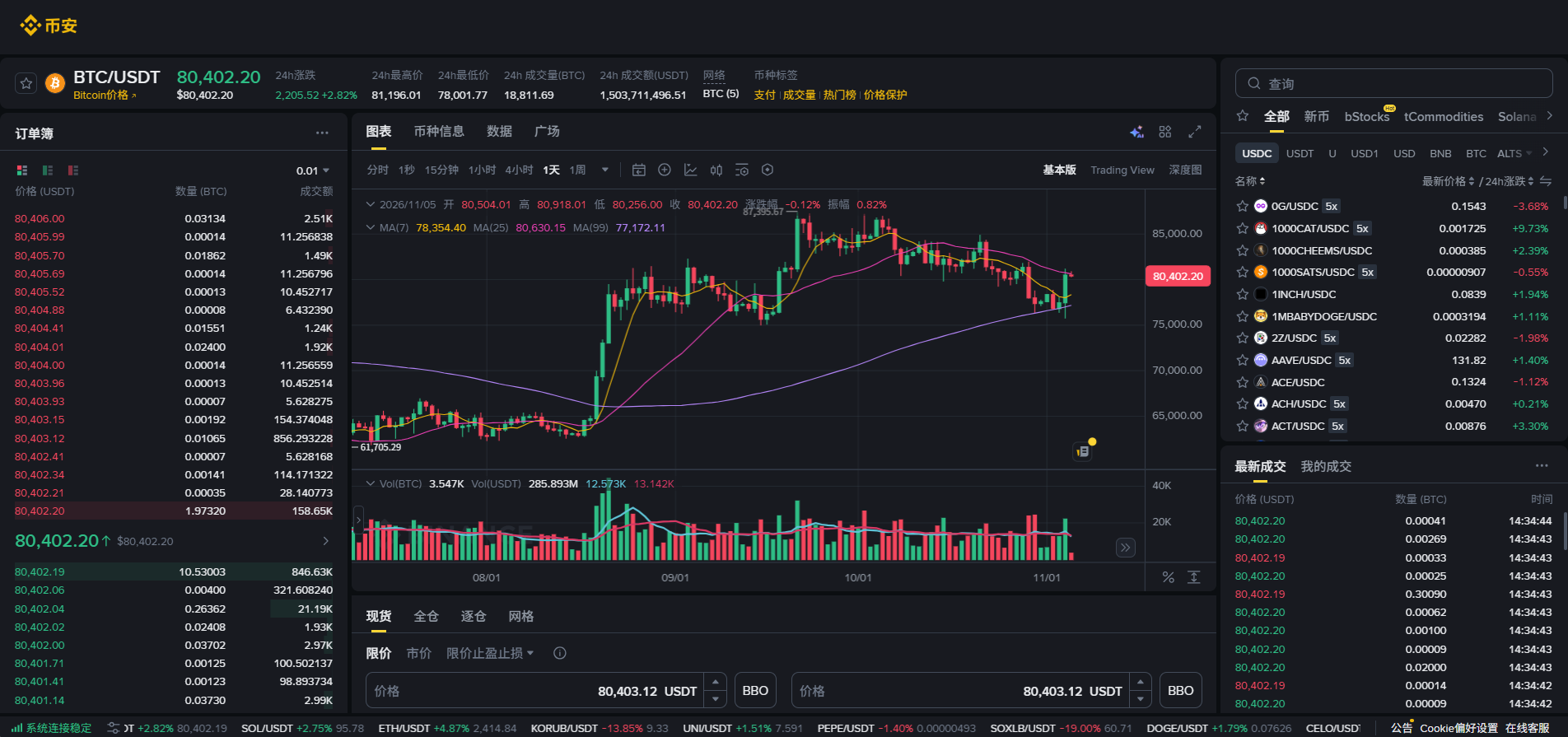
An alternative is to divide the order into smaller pieces and execute over time.
Binance's trading infrastructure and algorithmic-order capabilities can support more deliberate execution approaches, including time-based order slicing where available.
A TWAP strategy, for example, distributes execution across a period rather than concentrating it into one moment.
It can reduce immediate market impact, but it does not guarantee a better final price. If ETH rises steadily during the execution window, gradual buying may be more expensive than buying immediately.
Professional execution is therefore a trade-off among urgency, market impact and price risk.
Where Binance's liquidity advantage becomes less predictable
Liquidity varies substantially across assets.
A recently listed token may have significant initial trading activity but relatively unstable order-book depth. Market makers may widen spreads or withdraw quotes during sharp price movements.
A token's presence on Binance does not mean its execution quality resembles BTC or ETH.
Nor should a trader assume that order-book conditions observed during a quiet session will persist during a market-wide liquidation event.
This review does not assign a numerical liquidity score or claim the lowest real-time slippage across all Binance markets, because comparable timestamped order-book measurements were not established for that purpose.
The practical conclusion: Binance is a strong candidate for traders who prioritize established crypto markets and integrated spot-derivatives execution. Actual fill quality should still be evaluated for the specific pair, order size and trading session.
4. Security and Regulation
Evaluating Binance's security and reliability requires looking at several key factors: asset transparency, account protection, platform security measures, and regulatory arrangements across different jurisdictions. Together, these factors help determine what protections traders can expect and which risks remain.
Is Binance Safe and Reliable?
Overall, Binance remains a major cryptocurrency exchange worth considering, particularly for traders seeking a comprehensive trading platform. Beyond its extensive range of spot and futures trading products, Binance has established several user protection measures, including Proof of Reserves (PoR), the Secure Asset Fund for Users (SAFU), two-factor authentication (2FA), and withdrawal address whitelisting. These mechanisms provide concrete information for users to assess the exchange's security and reliability.
One of Binance's distinguishing strengths is how it combines asset transparency with a large-scale trading ecosystem. Users can independently verify relevant asset information through its Proof of Reserves system, while SAFU serves as an additional protection mechanism designed to address certain exceptional risks.
However, assessing whether Binance is suitable for long-term use requires a closer look at the scope of its Proof of Reserves, how SAFU protection works in practice, the effectiveness of its account security measures, and the regulatory arrangements applicable in different jurisdictions. The following sections examine these factors in greater detail.
Account security features
Binance provides several tools designed to reduce unauthorized account access and transfers.
| Security feature | Purpose |
|---|---|
| Two-factor authentication | Adds verification beyond the account password |
| Passkeys | Supports device-based authentication |
| Anti-phishing code | Helps users distinguish genuine Binance communications |
| Withdrawal address whitelist | Restricts transfers to approved addresses when enabled |
| Device and login management | Helps identify unfamiliar access |
| API permissions | Limits the operations authorized for trading integrations |
These protections address different threats.
A withdrawal whitelist may help contain an account compromise, while API restrictions reduce the consequences of exposing a trading-system credential. Neither mechanism can prevent every form of infrastructure-level attack.
For traders using third-party automation, API-key management deserves particular attention. A trading bot that only needs market data and order placement should not be granted unnecessary withdrawal permissions.
Similarly, API secrets should never be embedded in publicly accessible code or shared with unverified services.
What Binance's Proof of Reserves shows
Binance operates a public Proof of Reserves system using Merkle-tree structures and zk-SNARK cryptographic proofs.
The system is designed to allow users to verify that their balances were included in a particular snapshot and to support verification of the reported aggregate balances.
Users can access verification records associated with their accounts.
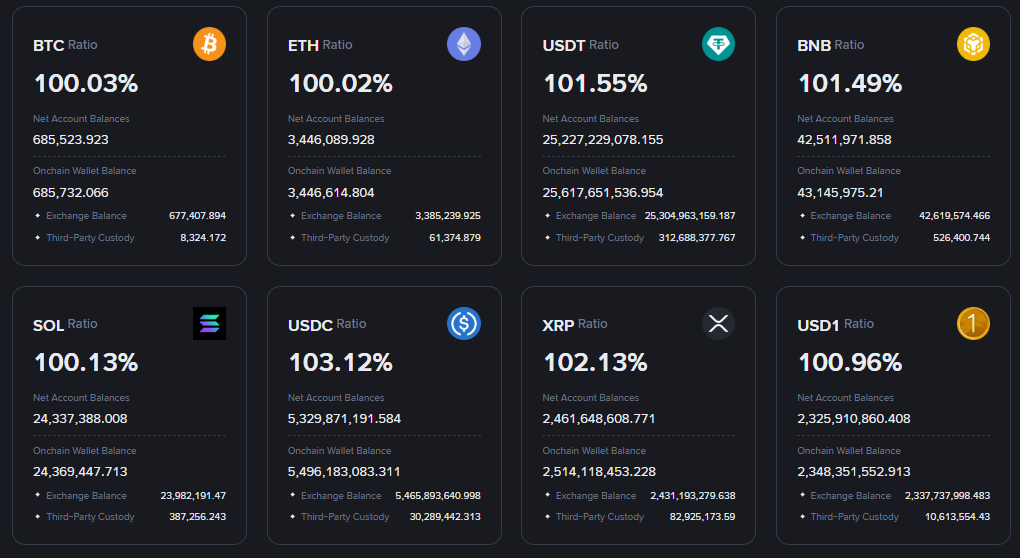
This is more meaningful than simply publishing a list of wallet addresses. It introduces a mechanism for users to check inclusion in the reserve calculation.
However, Proof of Reserves is not equivalent to a comprehensive financial audit.
A reserve snapshot does not, by itself, establish the complete financial condition of every legal entity associated with an exchange. It also cannot guarantee future solvency, uninterrupted withdrawals or immunity from cyberattacks.
The distinction is especially important when assessing a platform after a major security incident.
The October 29, 2026 security incident
On October 29, 2026, Binance experienced a major security breach involving unauthorized transfers from its hot-wallet infrastructure.
According to Binance's initial investigation, approximately $6.34 billion in digital assets was affected.
The exchange reported that attackers obtained unauthorized access to an internal wallet-signing service. The attack involved compromised employee environments and transaction-authorization mechanisms, including the misuse of Ethereum's EIP-7702 delegation functionality.
Binance temporarily suspended withdrawals as part of its containment response.
In its November 3 update, the company stated that:
- Approximately $2.85 billion in assets had been frozen or intercepted, subject to reconciliation and market-price changes.
- It had reserved funds exceeding the reported losses and would absorb the financial impact rather than pass it to users.
- As of October 31, 98% of the affected token assets had been replenished.
- Affected wallet systems and credentials had been rebuilt or replaced, with additional security controls introduced.
- The investigation remained ongoing, with further independent cybersecurity review planned.
These are Binance's reported figures and remediation claims, not a completed independent audit of the entire incident.
The scale of the breach is material to the investment and custody decision.
It exposed weaknesses in internal access controls and wallet-signing operations—areas that ordinary account-level security measures cannot address.
The company's commitment to cover losses and replenish affected assets is an important response. Its ability to mobilize substantial resources also distinguishes the situation from an exchange that cannot fund a recovery.
But financial remediation and security assurance are separate questions.
Replacing compromised infrastructure can address identified vulnerabilities; demonstrating that the broader environment is resilient requires sustained testing, governance improvements and independent scrutiny.
For traders, the implication is not necessarily to avoid every Binance product. It is to distinguish between capital needed for trading and assets intended for long-term storage.
An exchange can be a useful execution venue without being the preferred permanent custodian for an investor's entire portfolio.
Regulation and geographic availability
Binance's legal and regulatory position is not uniform across the world.
Different entities operate under different local frameworks, and the availability of spot trading, derivatives, fiat services and other products can vary by jurisdiction.
A license or registration held by one Binance entity should not be interpreted as authorization for every Binance product in every country.
This matters particularly for derivatives traders. A platform may support spot transactions in a jurisdiction while restricting futures, options or other leveraged products.
Users should identify the legal entity serving their location and the services that entity is permitted to offer.
Binance.com should also not be confused with separately operated regional platforms merely because they share part of the Binance brand.
Security assessment
Binance has meaningful account-protection infrastructure, a publicly documented reserve-verification mechanism and substantial resources for incident response.
At the same time, the October 2026 breach is too significant to treat as a routine technical disruption.
The decisive questions going forward concern independent validation of remediation, internal security governance and the durability of operational controls.
For an active trader, Binance remains a platform worth evaluating for execution and product capabilities. For long-term custody, its security history makes diversification and independent key management particularly relevant.
5. Products and Trading Features
Binance's product ecosystem is arguably its clearest competitive differentiator.
A trader can begin with spot purchases, move into systematic investing, introduce derivatives for hedging and eventually connect a custom trading application through an API.
Not every user will need that progression. But the infrastructure supports a wider range of workflows than a platform focused on one trading niche.
Spot trading: the foundation
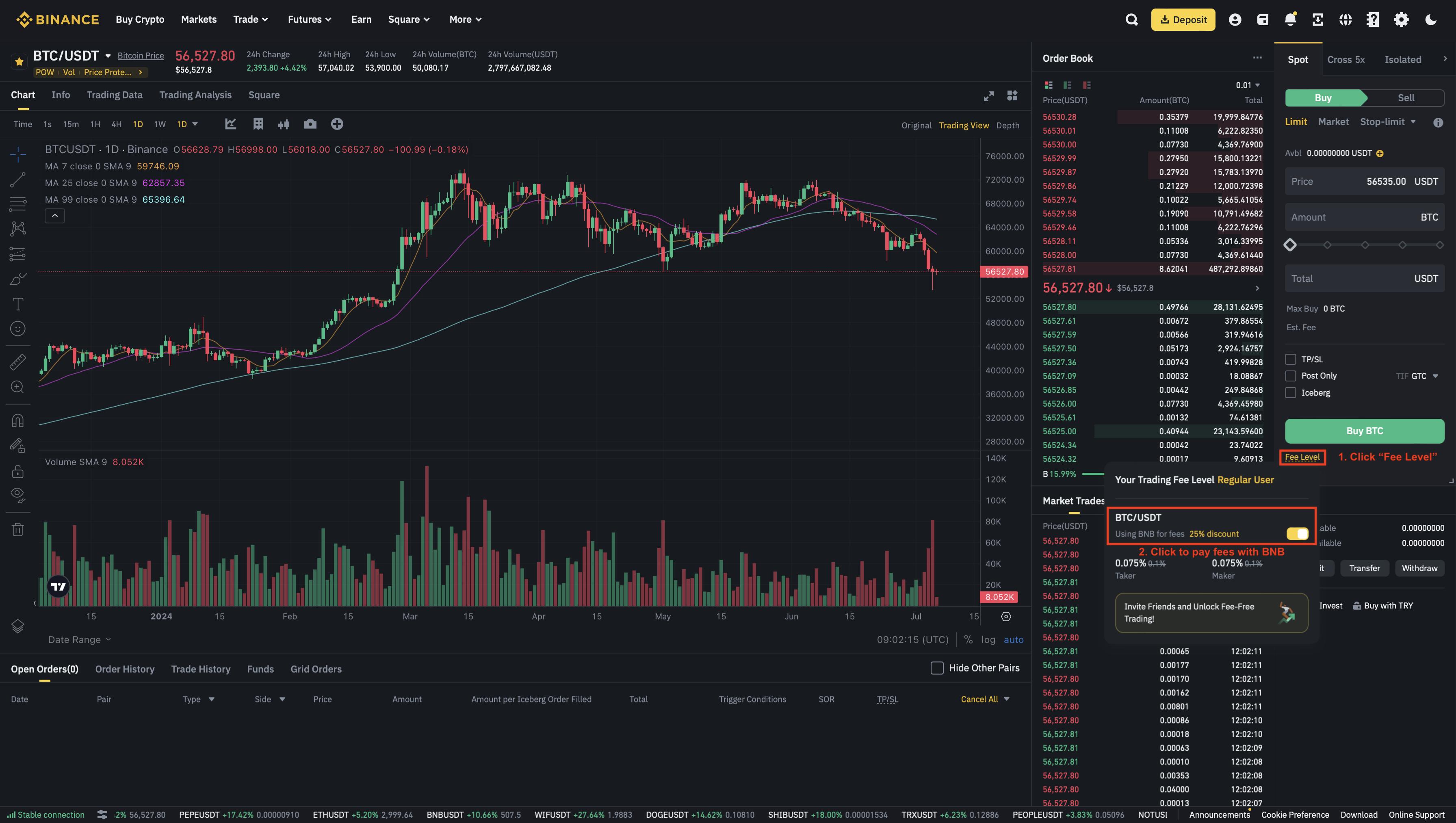
Spot trading allows users to buy and sell supported digital assets directly.
For investors building long-term BTC or ETH positions, spot is usually simpler than derivatives. There is no perpetual funding rate and no ordinary leveraged-position liquidation mechanism attached to an unleveraged spot holding.
Price volatility, custody risk and token-specific risks remain, but the position structure is more straightforward.
Binance provides market and limit orders alongside other supported order types and trading interfaces.
This makes spot suitable both for basic investing and for more deliberate execution strategies.
An investor accumulating BTC over several months might prefer scheduled purchases. An active trader managing a short-term ETH position may prioritize limit orders, stop conditions and execution costs.
The same market infrastructure serves different objectives.
USDⓈ-M versus COIN-M futures
Binance offers derivatives with different collateral and settlement arrangements.
| Product | Main characteristics | Typical use |
|---|---|---|
| USDⓈ-M futures | Generally margined and settled using supported stablecoin-denominated assets | Traders measuring exposure and P&L in stablecoin terms |
| COIN-M futures | Uses specified crypto assets for margin or settlement | Coin-denominated exposure and hedging strategies |
| Perpetual futures | No fixed expiry; funding mechanism applies | Directional trading and hedging |
| Delivery futures | Contract has a specified expiration | Term-structure and expiry-based strategies |
These products should not be selected solely by comparing commission rates.
A trader using BTC as collateral has a different risk profile from one using USDT. If BTC falls, the value of BTC-denominated collateral may also decline while a leveraged position is under pressure.
Stablecoin-margined positions make accounting in dollar-like units more straightforward, although stablecoin risks remain.
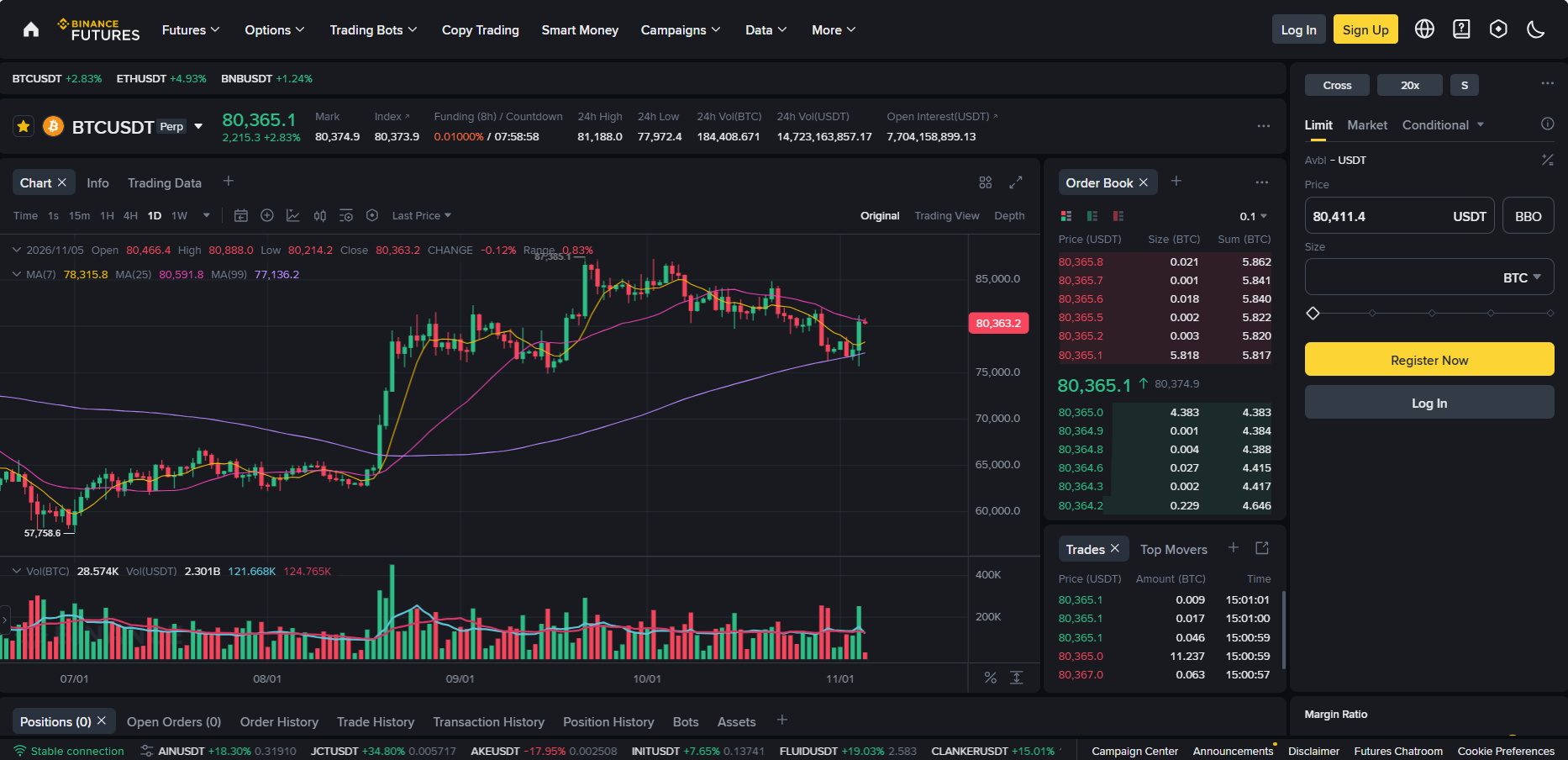
The appropriate contract depends on the trader's existing holdings, preferred settlement asset and risk-management framework.
Cross margin and isolated margin
Binance supports different margin modes for eligible derivatives products.
With cross margin, qualifying positions share collateral within the applicable margin system. This can improve capital efficiency but may expose a broader pool of account collateral to losses.
With isolated margin, a defined amount of collateral is allocated to a position. This can make position-level risk budgeting more transparent.
Neither approach is automatically superior.
A trader managing multiple hedged positions may value shared collateral, while someone who wants to limit the margin committed to an individual strategy may prefer isolation.
The relevant issue is how each mode behaves under adverse market conditions.
Advanced orders and position control
Professional derivatives trading depends on more than the ability to select a leverage multiple.
Conditional orders, stop orders, take-profit orders and reduce-only instructions help traders define how positions should be entered and exited.
Reduce-only functionality is particularly useful because it is intended to decrease an existing position rather than accidentally create exposure in the opposite direction.
For example, a trader closing a long futures position should not unintentionally end up short because a sell order exceeds the remaining position size.
That said, a stop order is not a guarantee of execution at the trigger price. During sharp market movements, the actual fill may differ significantly.
Understanding these mechanics is more important than choosing the maximum available leverage.
Trading bots: automation without building software
Binance offers several built-in automated trading tools.
Spot Grid
Automates buying and selling across a defined price range. It is designed for repeated price fluctuations, not for guaranteeing returns in a trending market.
Auto-Invest and Spot DCA
Support rule-based purchases or other scheduled transactions. These tools help standardize execution rather than predict the ideal market entry.
Rebalancing Bot
Adjusts portfolio weights according to user-defined allocation rules, helping maintain a target asset mix as prices change.
The differences between these strategies are important.
Spot Grid is built around price ranges. A trader defines upper and lower boundaries and a grid structure. The bot places orders according to those settings.
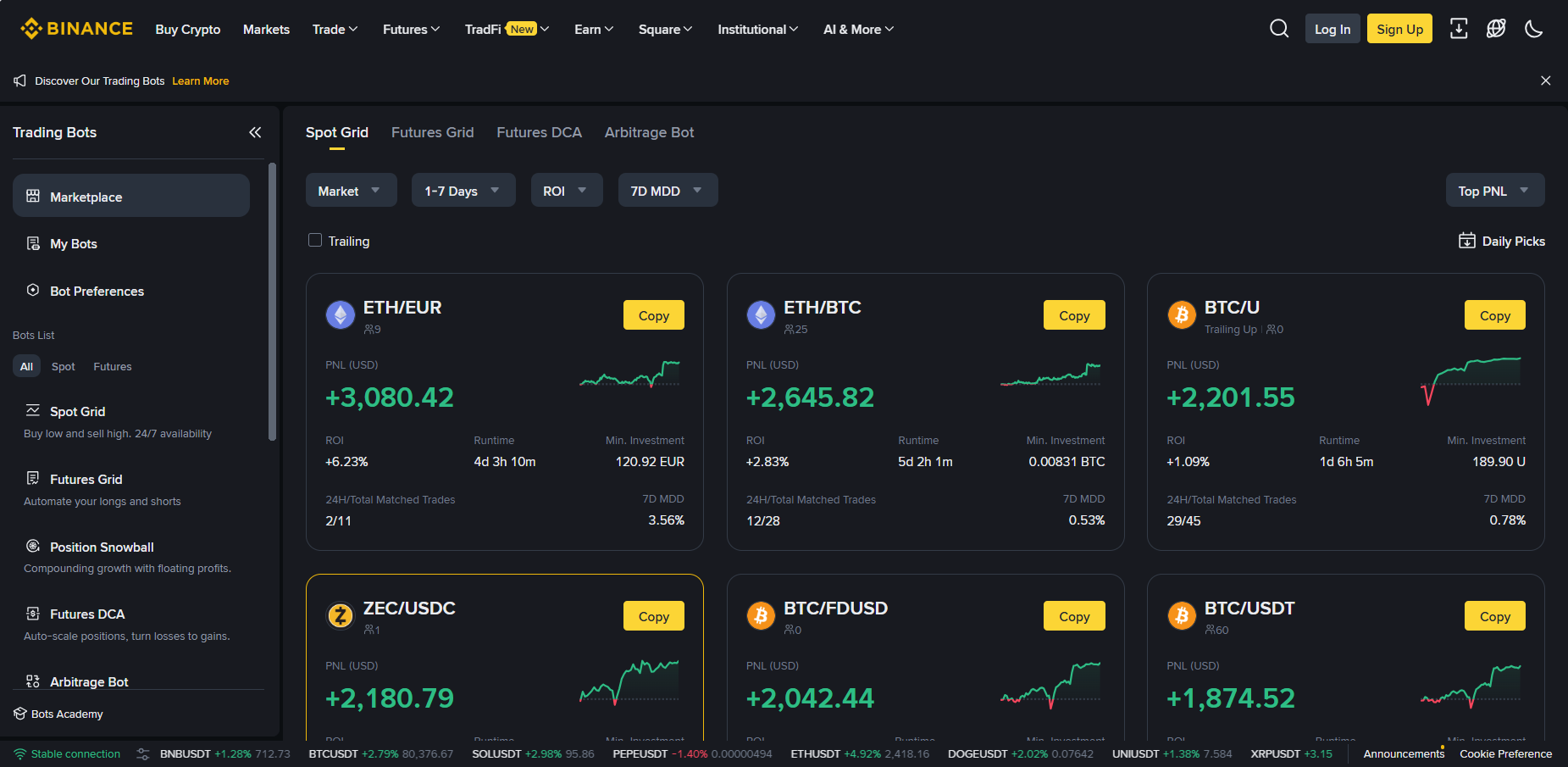
In a market that repeatedly moves between established levels, the strategy can automate transactions that would otherwise require constant attention.
In a persistent downtrend, however, the bot may accumulate an asset that continues losing value. In a strong uptrend, it may sell portions of a position too early.
Auto-Invest addresses a different problem. It allows investors to commit capital according to a schedule instead of making a new discretionary decision every time.
That can be useful for disciplined accumulation, but it does not establish that regular investing will outperform a lump-sum purchase.
Rebalancing is a portfolio-management strategy.
Suppose an investor targets a 60% BTC and 40% ETH allocation. After a period of strong BTC performance, the portfolio may shift to 72% BTC and 28% ETH.
A rebalancing strategy can sell part of the overweight asset and purchase the underweight one to move closer to the original allocation.
This preserves the intended portfolio structure. It does not necessarily maximize returns, particularly when one asset continues to outperform.
The advantage of Binance's bot ecosystem is accessibility. Users can explore several common strategy types without developing and hosting custom trading software.
The limitation is that automated execution cannot compensate for a poorly designed strategy.
Simple Earn and asset management
Binance Simple Earn offers products with different redemption arrangements, including flexible and locked options where available.
Flexible products generally prioritize redemption flexibility, while locked products have defined terms and reward conditions.
A user who intends to trade actively may value immediate access to funds more than an advertised yield.
Someone holding an asset for a longer period may be willing to accept different redemption conditions.
The key is to distinguish earning a reward on an asset from merely holding that asset. Earn products can introduce additional contractual, operational or market risks depending on their structure.
Advertised annualized rates are not equivalent to guaranteed, risk-free returns.
API infrastructure and systematic trading
Binance's API ecosystem extends its usefulness beyond manual trading.
Developers can use supported market-data endpoints and authenticated trading interfaces to build monitoring systems, order-management software and quantitative strategies.
Consider a trading team tracking BTC spot and perpetual markets. It may need to monitor price differences, order-book changes, available margin and execution results across multiple instruments.
A manual interface is unlikely to provide the same degree of repeatability or control as a properly engineered system.
Binance supplies important building blocks for that workflow.
But API access introduces responsibilities: rate-limit handling, key management, exception recovery, order reconciliation and safeguards against unintended repeated submissions.
For technically capable teams, this infrastructure is a substantial part of Binance's appeal. For beginners, it is unnecessary complexity.
Product assessment
Binance does not need to be the best standalone platform for every bot, futures contract or investment feature to offer a compelling product.
Its strength lies in the ability to combine those services.
A trader who regularly moves between spot execution, derivatives hedging and portfolio automation may find the integrated environment more useful than a collection of individually specialized platforms.
6. Language Support and User Experience
Binance supports multiple languages, including English and Chinese, and provides extensive documentation through its Help Center and Academy.
For international users, the most important aspect of localization is not simply whether a language appears in the settings menu. It is whether product explanations, risk disclosures and account procedures are understandable.
A mistranslated button is inconvenient. Misunderstanding a margin requirement or withdrawal condition can have financial consequences.
A platform with several levels of complexity
Binance's interface serves users with very different needs.
A first-time buyer may only need to purchase BTC, review the account balance and enable security settings.
A derivatives trader may need real-time access to mark prices, funding rates, liquidation levels, margin balances and conditional orders.
A quantitative trader may rarely use the consumer interface at all, relying instead on APIs and internal monitoring tools.
Binance's broad feature set accommodates these workflows, but it also creates a learning curve.
New users can encounter unfamiliar distinctions among spot balances, futures collateral, Earn subscriptions and funding accounts.
Understanding where assets are held and how they move between eligible account types is essential before using several products together.
Desktop versus mobile trading
The mobile application is practical for monitoring balances, managing ordinary transactions and responding to market movements.
For chart-intensive analysis or managing multiple derivatives positions, a larger screen may be preferable.
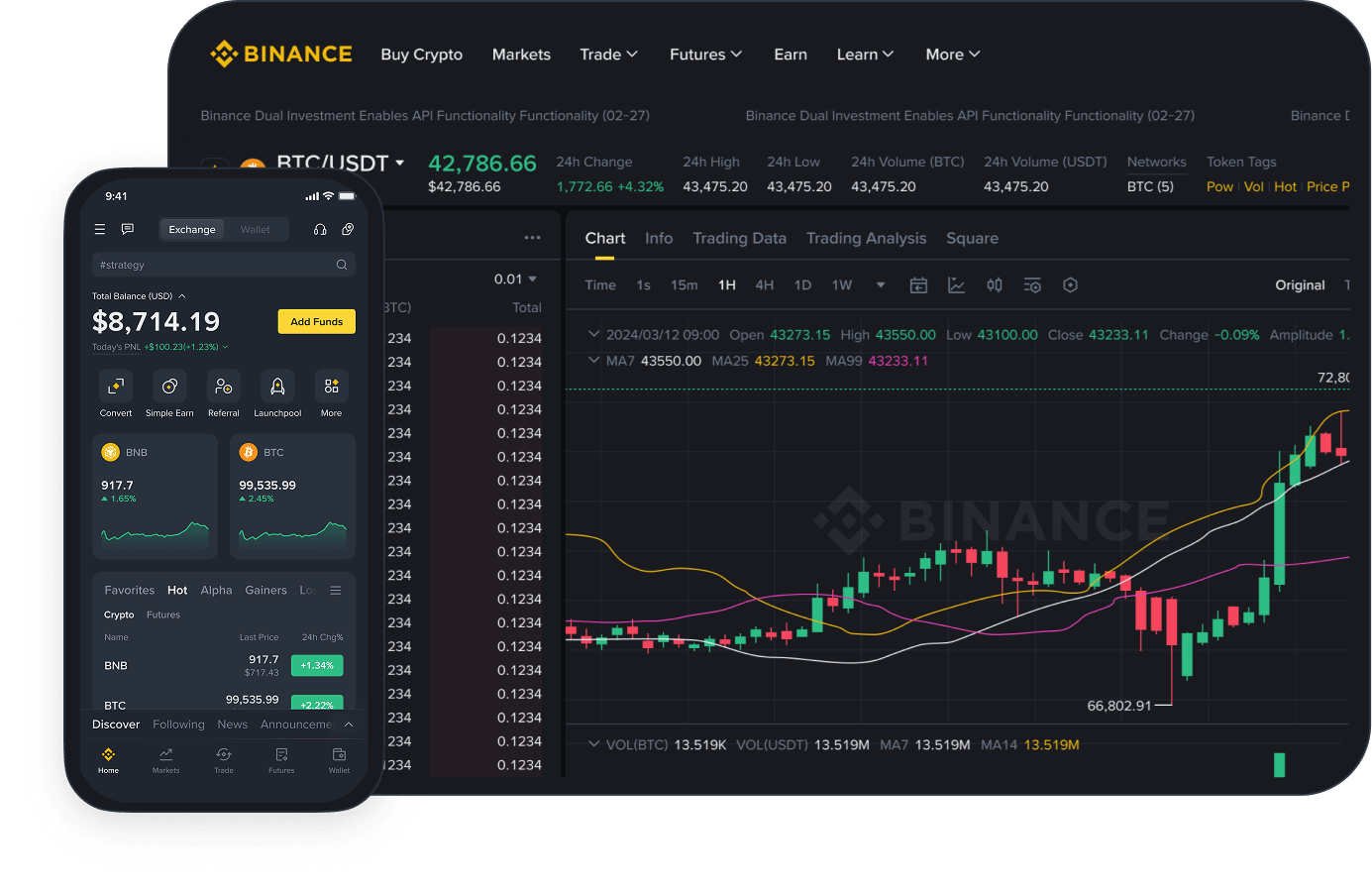
This is less a limitation of Binance specifically than a consequence of how much information complex trading requires.
A well-organized mobile interface cannot remove the underlying complexity of leveraged trading.
Help Center and educational resources
Binance's Help Center and Academy cover topics ranging from account verification and security to futures funding, order types and automated strategies.
These resources are particularly useful when users need to understand a product's actual rules rather than rely on social-media explanations.
Still, published documentation and customer-service performance are different measures.
This review does not claim a particular average support-response time or resolution rate, because no controlled customer-service testing was performed.
User-experience verdict
Binance is more compelling for users who expect their trading needs to expand over time than for those who want the simplest possible buying interface.
The platform offers substantial functionality, but users must be willing to learn how its products and account structures work.
Its interface is best viewed as an environment that supports different levels of trading sophistication, not as a product where every feature should be used from day one.
7. Community Reputation and Market Adoption
Binance's influence extends beyond the transactions executed on its exchange.
Its product announcements, token listings, educational content and security disclosures are followed by traders across multiple markets.
That visibility matters because information about Binance frequently becomes part of the wider cryptocurrency discussion.
However, brand recognition, social-media activity and actual trading quality are different things.
Binance and Cristiano Ronaldo: Global Brand Partnership
Binance's partnership with Portuguese football star Cristiano Ronaldo began in 2022. Rather than relying exclusively on conventional advertising, the collaboration has connected Ronaldo's global fan base with NFTs, digital collectibles and fan-focused experiences.
In 2024, Binance introduced the Forever Worldwide NFT collection, featuring locations associated with Ronaldo's football career. The partnership continued in 2025 through the Forever To The Moon campaign, which offered digital collectibles and opportunities to receive signed merchandise or exclusive fan experiences.
Binance has also previously collaborated with the Argentine Football Association, the Brazilian Football Confederation, Lazio and FC Porto. These relationships demonstrate its history of sports marketing, although earlier agreements should not automatically be considered active today.
An ecosystem that generates its own market discussion
Binance attracts attention through several channels.
Its spot and derivatives products are relevant to active traders. BNB-related services and ecosystem announcements attract another audience. Trading bots and Earn products appeal to users interested in systematic investing or asset management.
New token listings can also draw substantial attention.
But a listing is not an endorsement of an asset's future performance.
Newly listed tokens may experience unstable price discovery, sharp changes in liquidity and concentrated speculative trading.
Traders should distinguish the opportunity to access a market from the investment quality of the asset being traded.
Binance Academy as a distribution advantage
Binance has invested in educational content that explains blockchain concepts, trading mechanisms and platform products.
This serves two purposes.
For users, it reduces the effort required to understand unfamiliar tools.
For Binance, it creates a natural path from learning about a trading concept to exploring the corresponding product.
That connection is commercially valuable, but readers should recognize that exchange-produced educational materials primarily explain the issuer's own ecosystem.
Independent comparisons remain useful when choosing between platforms.
Community trust after the security incident
The October 2026 breach creates a meaningful test of Binance's reputation.
Before the incident, discussions about Binance could focus heavily on trading fees, liquidity, product releases and market opportunities.
After a breach of this magnitude, the effectiveness of incident response, asset restoration and independent security review becomes equally relevant.
The company's stated commitment to absorb losses is important, but lasting confidence will depend on whether its corrective measures prove effective over time.
There is no reliable basis in this review for assigning a numerical global satisfaction score or claiming a verified number of active English-speaking users.
The stronger conclusion is that Binance has broad market visibility and an extensive product community, while trust in its custody infrastructure requires renewed scrutiny.
8. Deposits and Withdrawals
Moving assets into and out of an exchange is a fundamental part of the trading experience.
Binance supports cryptocurrency deposits and withdrawals, along with selected fiat and peer-to-peer services where available.
The process is generally straightforward when the correct asset, network and destination details are used.
Mistakes, however, can be expensive.
Cryptocurrency deposits
Binance generally does not charge a platform fee for cryptocurrency deposits.
That does not mean transferring funds into Binance is necessarily free. The sending wallet or exchange may charge a network or withdrawal fee.
The distinction is important when comparing funding methods.
A trader moving USDT from another platform should consider both the sender's charge and the receiving network's compatibility.
Choosing the correct blockchain network
Many crypto assets exist on multiple blockchain networks.
USDT, for example, can be transferred using different supported networks. The network selected at the sending platform must match the one supported by the receiving address.
Before making a transfer, users should confirm:
| Check | Why it matters |
|---|---|
| Asset | The deposited token must match the intended asset |
| Network | Sending and receiving networks must be compatible |
| Address | Incorrect addresses can cause permanent loss |
| Memo or tag | Some assets require additional identifying information |
| Minimum deposit | Transfers below the minimum may not be credited normally |
| Network status | Deposits or withdrawals may be temporarily unavailable |
For a first transfer involving a substantial amount, a small test transaction may help verify the route, provided the test satisfies the minimum deposit requirement.
Withdrawal fees
Cryptocurrency withdrawal fees depend on the asset and network.
Fees can change with blockchain conditions and platform policies, so a fixed figure quoted in an article may become outdated.
The relevant fee is the amount shown for the selected asset and network when the user prepares the withdrawal.
Choosing the lowest-fee network is not always the correct decision. The destination must support that network, and the transfer route must be appropriate for the asset.
KYC and account restrictions
Binance requires applicable identity verification for access to its services.
The documentation, eligibility conditions and limits can vary by jurisdiction and account status.
Verification requirements are particularly important for users planning to move large amounts or use fiat services.
An account's access to a feature should not be inferred from screenshots or tutorials created for another country.
P2P and fiat services
Where supported, Binance P2P provides an alternative way to transact between cryptocurrency and local payment methods.
Unlike an ordinary spot order matched through the exchange's order book, P2P transactions introduce payment-counterparty considerations.
Users should confirm receipt of funds before releasing crypto and avoid moving transactions outside the platform's intended safeguards.
The availability of fiat payment channels also varies by jurisdiction, banking arrangements and local regulation.
What the October breach means for withdrawals
Binance temporarily suspended withdrawals during its October 2026 incident response, according to its official announcements.
Binance Support
That interruption illustrates a fundamental distinction between holding assets in a self-custodied wallet and holding an exchange account balance.
Even when the underlying blockchain remains operational, an exchange can restrict transfers while conducting security or operational checks.
For traders with time-sensitive settlement requirements, maintaining access to funds outside a single centralized venue may reduce dependence on one operator.
This is not a claim that self-custody is risk-free. It transfers key-management responsibilities to the asset owner.
The appropriate balance depends on trading frequency, technical competence and custody needs.
9. Who Is Binance Best For?
Binance's appeal depends on how many parts of its ecosystem a trader actually needs.
Someone making one Bitcoin purchase every few months may value simplicity more than access to a sophisticated derivatives platform.
A trader running multiple strategies, by contrast, may benefit substantially from integrated market access and portfolio tools.
| User profile | Suitability | Main consideration |
|---|---|---|
| Long-term BTC and ETH investors | Good, with custody considerations | Spot trading and recurring purchases |
| Active spot traders | Strong | Market access, order tools and fee tiers |
| Perpetual futures traders | Strong for eligible users | Contract choice and margin controls |
| Automated strategy users | Strong | Built-in bots and APIs |
| Multi-asset portfolio managers | Good | Rebalancing and account integration |
| Complete beginners | Conditional | Broad functionality creates a learning curve |
| Early-stage on-chain token hunters | Limited as a sole platform | Many early tokens trade outside centralized exchanges |
| Users requiring full self-custody | Not suitable as the sole solution | Exchange custody differs from controlling private keys |
Long-term investors
Binance offers practical tools for buying and accumulating major crypto assets.
Recurring purchases and portfolio-management products may help users maintain a consistent investment process.
However, the decision to keep assets on the exchange should be separate from the decision to buy them.
An investor who does not need continuous trading access may prefer to evaluate independent custody arrangements for at least part of a long-term portfolio.
Active spot traders
This is one of Binance's clearest use cases.
A trader who values established markets, several order types and the ability to manage fees through account tiers can find a comprehensive environment.
Execution quality still depends on the specific asset and order size.
For liquid BTC and ETH markets, Binance deserves serious consideration. For less actively traded tokens, the order book should be evaluated individually.
Derivatives traders
Binance offers substantial flexibility through contract types, collateral arrangements and order-management tools.
These features are valuable to traders who already understand margin, liquidation and funding.
They are not substitutes for a trading plan.
A trader who cannot explain the difference between mark price and last traded price, or between cross and isolated margin, should resolve those gaps before using leveraged positions.
Quantitative and automated traders
Binance is particularly relevant to users who want both ready-made automation and custom technical integrations.
Built-in bots can handle recurring execution tasks, while APIs support more specialized systems.
The platform's breadth reduces the need to maintain unrelated trading accounts solely to access common strategy types.
But reliability, error handling and security remain the responsibility of anyone building external trading systems.
Traders who may prefer another platform
Binance may not be the best primary venue for users whose main interest is trading newly launched on-chain assets before centralized-exchange listings.
Similarly, users who prioritize a particular copy-trading community or highly specialized interface may find a dedicated competitor more suitable.
And for investors whose overriding objective is full control of private keys, a centralized exchange cannot replace a self-custody wallet.
10. Binance Final Verdict
Binance's strongest argument is the depth of its trading infrastructure.
It combines spot markets, derivatives, automation, portfolio tools and APIs in a way that supports a broad range of trading workflows. Its standard spot fees are competitive, and the VIP structure provides additional flexibility for higher-volume participants.
For traders who regularly combine spot positions with futures hedges or systematic strategies, this integration can be more valuable than an isolated fee discount.
That is where Binance stands out: not necessarily as the best individual product in every category, but as a platform capable of supporting several sophisticated trading activities together.
The assessment is less straightforward on security.
The October 29, 2026 breach, involving approximately $6.34 billion in affected digital assets, represents a major failure in the protection of exchange-controlled infrastructure. Binance has stated that it will absorb the losses and has reported substantial asset replenishment and system remediation.
Those actions matter. So does the need for independent verification and sustained improvement.
The result is a platform with considerable trading utility and a serious recent custody-risk event that cannot be dismissed.
For an experienced trader who values product breadth and execution infrastructure, Binance remains worth evaluating. For someone seeking a simple purchase experience or a permanent home for long-term holdings, the case is more conditional.
Huayu Exchange's editorial assessment: Binance is best suited to traders who can make practical use of its integrated trading ecosystem and who manage exchange custody exposure deliberately. Its breadth is a genuine advantage; its recent security record is a material limitation.
Source and References
- Binance Official Website — Trading markets, exchange products and official announcements.
- Binance Trading Fees — Spot and futures fees, VIP tiers and BNB fee deductions.
- Binance Support — Trading rules, deposits and withdrawals, KYC, product updates and security announcements.
- Binance Proof of Reserves — Reserve disclosures, asset snapshots and user-balance verification.
- Binance Proof of Reserves Verification Guide — Merkle Tree and zk-SNARK verification mechanisms.
- Binance Academy — Trading education, blockchain fundamentals and product explanations.
- Binance API Documentation — Spot, futures, order-book and algorithmic trading interfaces.
- Binance official security announcements and independent reporting — The October 2026 security incident, affected assets, recovery measures and subsequent developments.
- Public records from relevant regulatory authorities — Regulatory status and service restrictions applicable to Binance entities.
Affiliate Disclosure: Huayu Exchange may earn commissions through partnership links to certain trading platforms. Our reviews are based on independent research and publicly available information. Commercial partnerships do not constitute guarantees of exchange security or investment returns.
Risk Disclaimer: Crypto assets and leveraged derivatives involve price volatility, liquidity, custody and liquidation risks. This article provides research information about trading platforms only and does not constitute personalised investment advice.


